
Prayagraj: The City at the Confluence, for a First Visit
The city at the confluence of the Ganga and the Yamuna, named Prayag in the Rigveda and renamed Prayagraj in 2018. What is here, when to come, how to reach it, and what the weather will do to your plans.

Prayagraj sits in Uttar Pradesh where the Ganga and the Yamuna meet, about 90 metres above sea level. Most people come for one reason: the Triveni Sangam and the rites performed at it. The city around it is older than the rites are recorded, and this is what is worth knowing before you arrive, whether you are here for Pind Daan at the Sangam or to see the place.
The names, and why there are several
The oldest is Prayag, from pra and yaga, the place of the foremost sacrifice. That is the name in the Rigveda supplement, dated roughly 1200 to 1000 BCE, which is the earliest written mention of the city and the pilgrimage to it.
Akbar came in 1575, judged the confluence strategically important, and had a fort built there in 1584. He called the settlement Ilahabas, the abode of God. Shah Jahan later rendered it Allahabad, and both forms appear on city coins from Akbar’s reign onward. In 2018 the city was renamed Prayagraj, restoring the older name.
You will still meet all of these. The railway station is Prayagraj Junction, the university is Allahabad University, and older residents say Allahabad without thinking about it. None of it indicates confusion about where you are.
How old the city actually is
The question is genuinely contested, and the argument is worth following because it turns on the pillar you will walk past inside the fort.
Northern Black Polished Ware found at the site dates to between 700 and 600 BCE, and excavation since the 1950s has found human settlement around the Sangam from about 800 BCE. Dilip Kumar Chakrabarti argued that Jhusi, across the confluence, was the old town of Prayag rather than the modern city.
The Ashoka pillar is the other half of the argument. Alexander Cunningham held that a Muslim Sultan moved it to the site from Kaushambi. Krishnaswamy and Ghosh disputed that in 1935, on three grounds: the inscription dates, the absence of any mention of such a move in Muslim records, and the sheer difficulty of lifting it. John Irwin agreed in papers published around 1979 and went further, arguing from archaeological and geological work that the pillar’s origins were pre-Ashokan and it had always stood here.
One detail from that work matters to a visitor. The smaller inscriptions scratched onto the pillar over centuries are dated between 1319 and 1575 CE, and they overwhelmingly fall in the month of Magha. People were coming here for the Magh Mela seven hundred years ago and carving the date into the stone.
What the record says about the Sangam
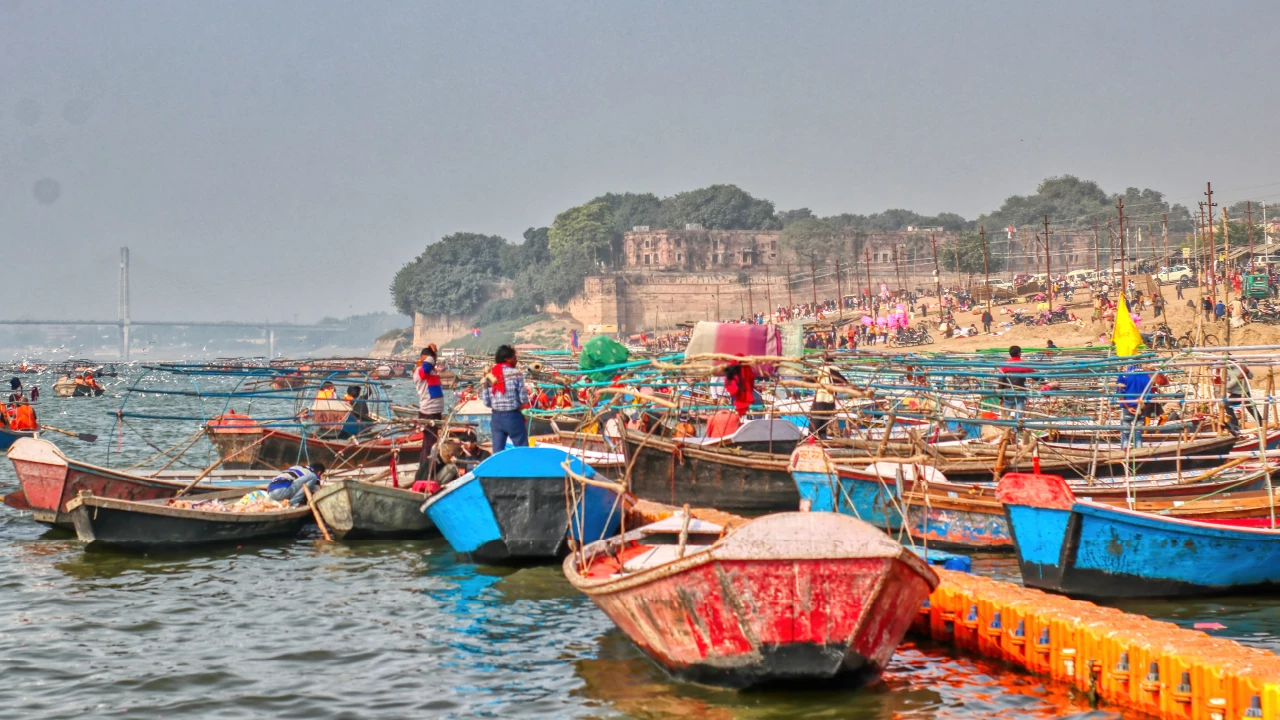
The Agni Purana names Prayaga among the places Brahma performed a homa, and makes the confluence of Ganga, Yamuna and Saraswati the king of pilgrimage destinations, Tirtha Raj. The many versions of the Prayaga Mahatmya, the earliest from the late first century CE, describe the Sangam as busy with pilgrims, priests, sellers, beggars, guides and residents, which is more or less what you will find. The Ramayana places the ashram of the sage Bharadwaj near the town.
The Chinese pilgrim Xuanzang reached it in the seventh century and recorded it as a great city at the junction of the two rivers, with hundreds of deva temples and two Buddhist institutions to the south, a stupa built by Ashoka and a monastery. His memoir of 644 CE describes people fasting near the confluence and then bathing in the belief that it wipes away their sins, and the rich and the rulers arriving to give away charity. There is more on the confluence itself in our guide to the Triveni Sangam.
The colonial century, briefly
The city passed to the British in 1801. A major uprising took place here during the revolt of 1857, and Queen Victoria’s proclamation transferring the government of India from the East India Company to the Crown was read out in the city in 1858. The Allahabad High Court was established in 1866 and remains one of the oldest in the country.
Civil Lines dates from this period and was the largest town-planning project in India before New Delhi: a gridiron layout north of the railway line, in contrast to the older quarters south of it. Much of the colonial building stock is designated heritage; a good deal of the rest is deteriorating. The city later became closely associated with the independence movement through the Nehru family, whose house is here.
How the city is laid out
The east-west railway divides it. South of Prayagraj Junction are the older quarters: Chowk, Johnstongunj, Dariyabad, Khuldabad. North of it are the newer ones: Civil Lines, Georgetown, Tagoretown, Lukergunj, Allahpur, Ashok Nagar, Mumfordgunj, Bharadwaj Puram. Civil Lines is the commercial centre.
The city sits in the Ganga-Yamuna Doab on alluvial soil, with Pratapgarh to the north, Bhadohi east, Rewa south, Chitrakoot west and Kaushambi north-west. A UN Development Programme assessment places it in a low damage risk zone for wind and storm.
One thing worth knowing before you book: air quality here is poor. The WHO’s Global Urban Ambient Air Pollution Database ranked the city third of 2,972 cities surveyed for mean PM2.5 concentration. If anyone travelling has a respiratory condition, plan around it.
The weather, and what it does to a visit
Humid subtropical, Cwa in the Köppen classification, with three distinct seasons and an annual mean of 26.1°C.
| Season | Months | What to expect |
|---|---|---|
| Winter | December to February | Around 22°C by day, 9°C at night. Heavy fog, which delays trains and flights. The best season to visit |
| Summer | March to May | Dry and severe. The record high is 48°C. Start before 8:00 AM or not at all |
| Monsoon | June to September | 1,027 mm of rain a year, most of it here. August is wettest at 333 mm. High water suspends the boats |
The fog is the part visitors underestimate. It is thickest in December and January, which is also Magh Mela season, and it routinely delays arrivals by hours. Build a buffer day if your rite is fixed to a tithi.
Getting here
| By | Detail |
|---|---|
| Air | Prayagraj Airport at Bamrauli, about 12 km from the centre, open since February 1966. Connections to Delhi, Bengaluru, Mumbai, Kolkata, Raipur, Bhopal, Bhubaneswar and Gorakhpur. The nearest international airports are Varanasi and Lucknow |
| Rail | Prayagraj Junction is a major northern junction, with trains from Delhi, Mumbai, Lucknow, Bhopal, Kolkata and Jaipur. Other stations: Prayagraj City, Naini, Prayag, Subedarganj, Bamhrauli, Ram Chaura Road, Cheoki |
| Road | State and city buses, and autorickshaws for everything local. Varanasi is 125 km on NH19, about 2.5 hours |
A piece of aviation history belongs to this city: in February 1911 Henri Pequet flew 6,000 cards and letters from here to Naini, the first airmail flight anywhere in the world.
What else is here
- The Sangam and the fort. The confluence, the Akshayavat inside the Allahabad Fort, and the Ashoka pillar in the fort gateway.
- The twelve Madhav temples. A circuit around the whole Prayag Kshetra, set out in our guide to the Dwadash Madhav.
- Allahabad Museum. One of four national museums in India, and the body recording the flora and fauna of the two rivers.
- Allahabad University. Founded in the colonial period and long central to the city’s character.
- The New Yamuna Bridge. The cable-stayed crossing, and the usual route to Arail.
The riverine landscape still holds a good deal: doves, peacocks, junglefowl, black partridge, parakeets, quails and bulbuls are common, deer are found across the trans-Yamuna area, and Siberian migrants arrive at the Sangam marshes in winter. A turtle sanctuary and a river biodiversity park at the Sangam were approved under the Namami Gange programme, and the Meja Forest Division is developing a blackbuck conservation reserve.
If you are coming for a rite
Most families who contact us are here for two or three days and want the ceremony settled before they arrive, so the trip is about the rite rather than about finding someone to perform it.
| Rite | From | For |
|---|---|---|
| Pind Daan | ₹7,100 | The core ancestral offering |
| Asthi Visarjan | ₹5,100 | Immersion of the ashes after a death |
| Shradh | ₹7,100 | The full ancestral ceremony |
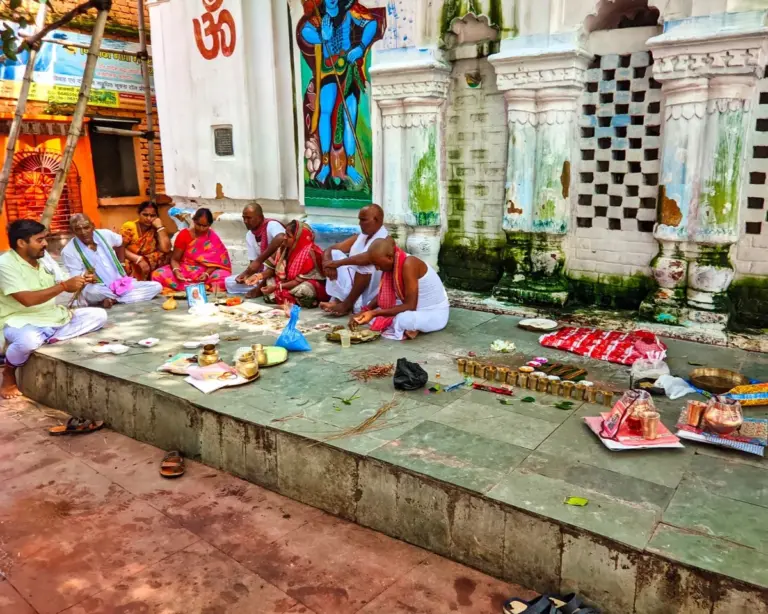
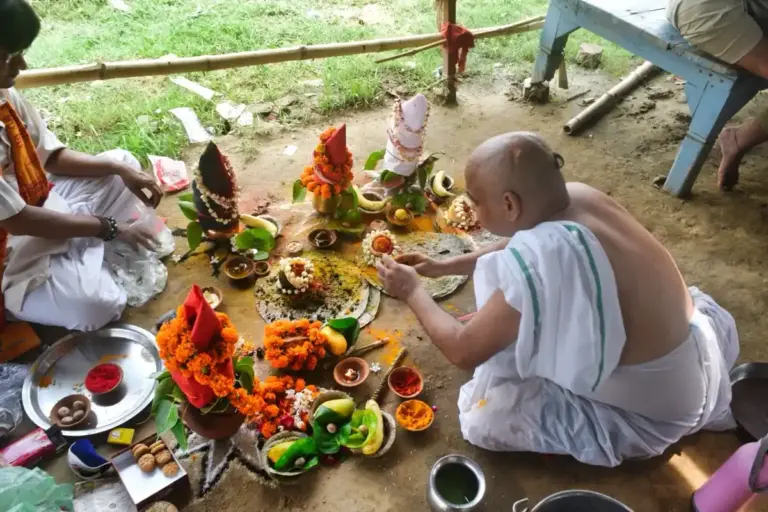
A booking covers the pandit, the boat to the confluence, all samagri and the Sankalp with your gotra and your ancestors’ names. Travel and accommodation are yours. A pandit calls within two hours to fix the tithi.
Keep reading


Blog
10 min read
Barsi: The Hindu First Death Anniversary, and When It Falls
Questions families ask
Prayagraj holds the sacred Triveni Sangam, the confluence of India's holiest rivers: Ganga, Yamuna, and the mystical Saraswati. Immersing ashes here is considered exceptionally auspicious. The Puranas extol the virtues of Prayagraj, stating that Asthi Visarjan at the Sangam helps the departed soul attain liberation from the cycle of birth and death. The combined spiritual energy of the three rivers purifies the last remnants, granting peace (Shanti) and facilitating the soul's onward journey. It is believed that the merits gained here are multiplied manifold compared to many other places
The primary and most sacred location for Asthi Visarjan is the Triveni Sangam itself – the point where the distinct waters of the Ganga and Yamuna meet, and the Saraswati is believed to join from below. Pilgrims typically hire a boat to reach the designated area in the middle of the confluence where the immersion ritual is performed under the guidance of a Pandit.
Usually, the performer (Karta) and their family hire a boat with a Prayagwal Panda (priest). After reaching the Sangam point and often taking a purificatory dip, the Karta, facing south, follows the Panda's guidance. Using Kusha grass, they offer water from the Sangam (mixed with black sesame, barley) from their palms while chanting mantras and invoking the names and gotra of ancestors. The offering is poured directly into the confluence
Prayagraj is revered as the Tirtharaj, the king among all pilgrimage sites. The confluence of the three sacred rivers – Ganga, Yamuna, and the subterranean Saraswati – creates an unparalleled spiritual energy here at the Triveni Sangam. Performing Shradh, especially Pind Daan and Tarpan, at this Sangam is believed to multiply the merit manifold. The Puranas state that offerings made here reach the ancestors directly and grant them immense satisfaction, helping them attain higher realms or liberation (Moksha). Lord Brahma himself performed the first Yagna here, consecrating this land
The Triveni Sangam in Prayagraj is considered the holiest water body in Hinduism. The confluence of these three sacred rivers creates an unparalleled spiritual energy field. It is believed that Lord Brahma performed the first yajna (fire sacrifice) here. Performing Tarpan at the Sangam allows the offerings to merge into this supremely holy water, ensuring they reach the ancestors effectively, purifying their souls, washing away sins, and granting liberation, a benefit amplified by the site's 'Tirtharaj' status
The Magh Mela (occurring annually during the Hindu month of Magh, Jan-Feb) is a period of intense spiritual energy in Prayagraj. Millions of pilgrims, Sadhus, and Saints congregate here for Kalpavas (a month-long vow of austerity and devotion) and holy dips at the Sangam, especially on auspicious bathing days like Paush Purnima, Mauni Amavasya, and Basant Panchami.
Performing Shradh during Magh Mela is considered exceptionally meritorious. The collective positive spiritual vibrations, the presence of numerous enlightened souls, and the heightened sanctity of the Sangam during this period amplify the benefits of the rituals, ensuring profound peace for the ancestors.
Prayagraj, formerly known as Allahabad, is considered one of the holiest cities for performing Asthi Visarjan due to the presence of Triveni Sangam. It is also known as Teerthraj. The confluence of the Ganges, Yamuna, and Saraswati rivers is believed to have purifying powers, making it an ideal place for the ritual. The act of immersing ashes here is thought to help the soul attain peace and liberation.
- Prayagraj city has many hotels, and staying close to the Sangam enhances the spiritual experience. Near the Ghats (like Qila Ghat, Saraswati Ghat, Ram Ghat) and in areas like Daraganj, you will find:
- Numerous Dharamshalas and Ashrams: Run by various religious communities and trusts, offering basic but clean lodging at very nominal costs. These are often the preferred choice for pilgrims focused solely on rituals.
- Panda Accommodations: Some Prayagwal Pandas offer lodging facilities (sometimes basic rooms within their homes or dedicated guest areas) for the families (Yajmans) they serve. This can be convenient as they guide you through all rituals.
- Budget Guesthouses: Plentiful in the lanes leading to the ghats, offering simple private rooms.
- Tented Cities: During major events like Magh Mela or Kumbh Mela, vast tented cities are erected near the Sangam, providing temporary accommodation of various comfort levels.
- Booking in advance, especially during peak times like Pitru Paksha or Magh Mela, is highly recommended
Prayagraj, earlier known as Allahabad, is considered one of the most sacred places for performing Pind Daan, as it is situated at the holy confluence (Triveni Sangam) of three rivers - Ganga, Yamuna, and the mythical Saraswati. The main ritual is performed on the banks of the Ganga river or at the Triveni Sangam, where many pandits and priests are available to assist.
Some of the famous and important places for Pind Daan in Prayagraj include:
- Triveni Sangam
- Ganga Ghat
- Yamuna Ghat
The ritual starts with a holy dip in the sacred waters of Ganga and Yamuna at the Sangam, followed by the primary rituals and rites performed by the priests on the river banks.
Asthi visarjan, the Hindu ritual of immersing the ashes of the deceased, is traditionally performed at specific times. In Prayagraj or Allahabad, the asthis (ashes) are generally collected on the day of cremation or on the 3rd, 7th, or 9th day following the cremation. The immersion should take place before the 10th day. However, if the visarjan is to be done after the 10th day, it is recommended to perform it only after the tirtha-shraddha ceremony. The Pitru Paksha period, which usually falls between September and October, is also considered an auspicious time for asthi visarjan. It is essential to consult with a knowledgeable pandit or priest to determine the most appropriate time based on religious calendars and family traditions.
Both refer to the same city. Prayag is the oldest name, Allahabad dates from the Mughal period, and Prayagraj was restored in 2018. Signage, tickets and residents use a mixture.
December to February for the weather, though that is also fog season. Magh Mela falls in January and February and Pitru Paksha in September or October, and both bring crowds the city otherwise does not have.
Two nights covers one rite at the Sangam without hurry. Three adds the fort, the Akshayavat and part of the Madhav circuit. More than that only if you are adding Varanasi or Ayodhya.
It can be, in winter especially, when fog and smoke combine. Anyone with asthma or a respiratory condition should carry their medication and avoid early mornings outdoors in December and January.
Whatever brought you, the city arranges itself around the water. If a rite is the reason, tell us the names and the dates and we will have the pandit and the boat ready: Pind Daan at the Triveni Sangam.
Still have a question?
Ask our team on WhatsApp and we will help you plan the ceremony.
We reply on WhatsApp within 1–2 hours.
Ask a pandit (opens WhatsApp)Book Your Sacred Ritual
Authentic ceremonies performed by Veda-trained pandits at sacred sites across India.
- Clear package details before you book
- The ceremony in the language you choose
- 2,263+ families served
- Serving since 2019
- GST registered