
Magh Mela 2027 is on until 6 March 2027. Magh Mela 2027 is on See packages & dates See dates
Pitru Paksha 2027 is on until 29 September 2027. Pitru Paksha 2027 is on See packages & dates See dates
Sarva Pitru Amavasya is today. Sarva Pitru Amavasya is on See packages & dates See dates
Gaya ritual guidance
Narayan Bali in Gaya
Narayan Bali at the Phalgu, the remediation rite for unnatural-death ancestors.
The Padma Purana prescribes Narayan Bali — invoking Vishnu Narayan to complete the death rites for ancestors who died unnatural deaths (akal mrityu). Trimbakeshwar is the canonical tirtha per the Skanda Purana; at Gaya, the Vayu Purana names the Phalgu river an incarnation of Vishnu Narayan himself, making the rite uniquely apt here.
- Verified pandits
- Clear package details
- Vedic vidhi
- All samagri included
- Rated 4.8/5 · 500+ reviews
- 2,263+ families served
- Serving since 2019
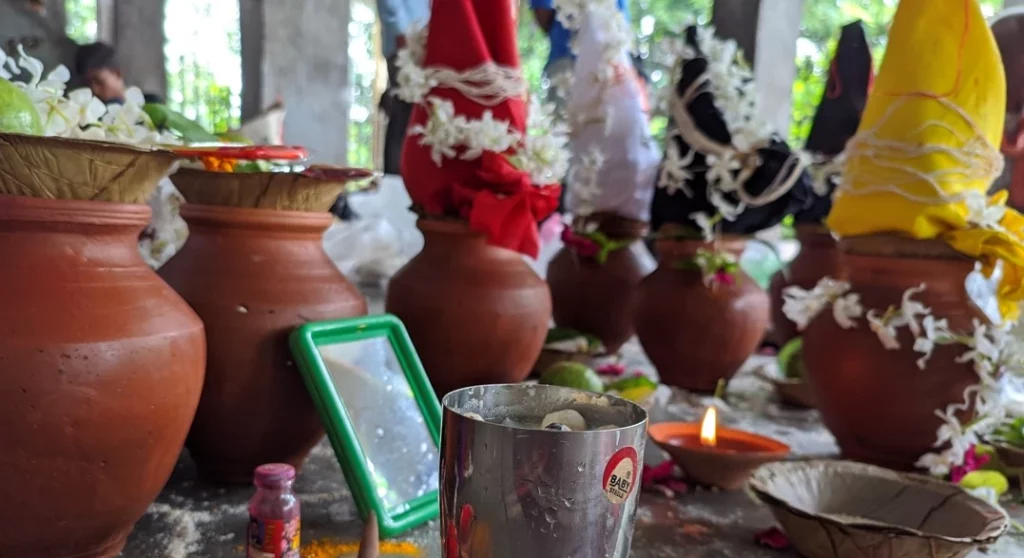
Find your package
Three short questions, the right ceremony
Tell us your situation — we will suggest the package that fits the family. No booking pressure; we will explain the choice on WhatsApp first if needed.
Recommended for you
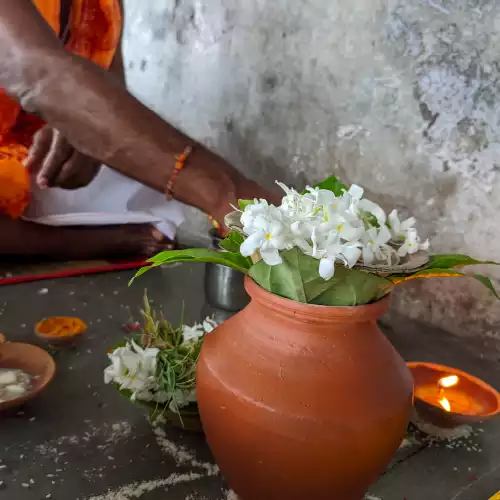
Narayan Bali Poojan in Gaya Pitrupaksha 2026
Price ₹35,000
- Complete Narayan Bali Poojan at Vishnupad Temple area, Gaya
- Experienced qualified pandit (full Vedic mantras)
Recommended for you
Narayan Bali Poojan in Gaya Pitrupaksha 2026
Price ₹35,000
- Complete Narayan Bali Poojan at Vishnupad Temple area, Gaya
- Experienced qualified pandit (full Vedic mantras)
Recommended for you
Online Narayan Bali Poojan in Gaya Pitrupaksha 2026
Price ₹35,000
- Online Narayan Bali Poojan at Gaya (live video, 4–5 hours)
- Experienced pandit
Choose your package
Choose the arrangement that fits your family
Every package includes an experienced Vedic pandit and the required puja samagri. The difference is in boat, location, stay, and tradition.

Online Narayan Bali Poojan in Gaya Pitrupaksha 2026, View & book
- Online Narayan Bali Poojan at Gaya (live video, 4–5 hours)
- Experienced pandit
- All samagri (flowers, diya, til, kusha, rice, honey, sesame, sacred cloths)
- Narayan Bali effigy (constructed as per Vedic tradition)
Price ₹35,000
More rites at Gaya
Asthi Visarjan, Gau Daan, Pind Daan, Shradh, Tarpan and Tripindi Shradh, with pandits at Gaya.
Narayan Bali Poojan in Gaya Pitrupaksha 2026, View & book
- Complete Narayan Bali Poojan at Vishnupad Temple area, Gaya
- Experienced qualified pandit (full Vedic mantras)
- All samagri (flowers, til, kusha, darbha, sacred threads, diya, honey, rice, cotton for effigy)
- Narayan Bali effigy (constructed & consecrated)
Price ₹35,000
Gaya
More rites at Gaya
Asthi Visarjan, Gau Daan, Pind Daan, Shradh, Tarpan and Tripindi Shradh, with pandits at Gaya.
- 2,263+families served
- 10+ yearspandit experience
Why families choose Prayag Pandits
- Families served
- 2,263+
- Serving since
- 2019
- Average rating
- 4.8/5
- GST registered
- Registered
Hereditary Gayawal lineage
qualified in Narayan Bali vidhi + Antyeshti recitation
Padma Purana procedure observed
effigy + second-cremation + Vishnu-Narayan invocation
Phalgu + Vishnupad vedi
Per the Vayu Purana Gaya Mahatmya
Stage-by-stage confirmation
WhatsApp updates after each rite stage; the pandit confirms on WhatsApp when the rite is complete
Voices from families
What families say after the rite
Rated 4.8 out of 5
500+ reviews
Our pandits






- 2,263+ families served
- Serving since 2019
- GST registered
We performed Narayan Bali Poojan on the advice of our family pandit. The ceremony took the full day but Prayag Pandits managed everything perfectly. The senior pandit was very knowledgeable about this complex ritual.
Narayan Bali is a very specific ritual and finding the right pandit was our main concern. Prayag Pandits connected us with an experienced purohit who had performed this poojan many times. Very satisfied. Dhanyavaad.
Very authentic Vedic ceremony. All materials were included as promised. Will definitely use their services again.
प्रयाग पंडित्स से दूसरी बार पूजा करवाई। दोनों बार अनुभव शानदार रहा। उनकी टीम पुराने ग्राहकों को याद रखती है और व्यक्तिगत ध्यान देती है। Dhanyavaad.
हमारे परिवार ने पहली बार ऑनलाइन पूजा करवाई। शुरू में थोड़ा संशय था लेकिन अनुभव बहुत अच्छा रहा। वीडियो कॉल की गुणवत्ता अच्छी थी और पंडित जी ने हमें पूजा में शामिल किया।
The Narayan Bali Poojan was conducted exactly as described in the Garuda Purana. All the required materials were arranged by the team. The 4-5 hour ceremony was performed with full devotion.
Not sure which package fits?
Talk to a family advisor — free, no obligation. We reply on WhatsApp within 1–2 hours.
What's included
Every package lists exactly what is included no pressure for "extra dakshina" on the day
We've seen too many families face hidden boat fees, samagri costs, and "dakshina" pressure on the day. Here's exactly what's covered, and what isn't.
Included in your package
- Hereditary Gayawal Panda Verified Gayawal Panda from a registered Phalgu ghat — the priestly lineage qualified in the Narayan Bali vidhi at Gaya, with the specific mantras drawn from the Padma Purana and Garuda Purana Pretakalpa for akal-mrityu ancestral remediation.
- Complete Narayan Bali Samagri Darbha (kusha) grass for the prescribed human-effigy, gold pieces, ghee, milk, honey, til, jau (barley), gangajal, samidha (sacred wood), kalash, white cloth — all the materials the Padma Purana names for the Narayan Bali procedure, prepared in advance.
- Package add-ons available Optional upgrades: Nag Bali paired-rite (the Padma Purana prescribes Narayan Bali + Nag Bali as the doctrinally complete remediation), Tripindi Shradh combination, online format with live video proof, combined Narayan Bali + Pind Daan packages at the Vishnupad vedi.
- Family Coordinator One person on WhatsApp through your entire booking — fluent in Hindi, English, and major regional languages — before and after the multi-day rite.
- Completion Confirmation WhatsApp message from the Gayawal Panda after each stage completes — Sankalpa, effigy creation, full death-rite recitation, second-cremation, and tirtha-shradh — with a final WhatsApp confirmation when the whole rite is complete.
- Vishnupad vedi + Phalgu coordination The principal Gaya vedi for Narayan Bali is at Vishnupad, where the prescribed effigy-and-second-cremation procedure is performed by a Gayawal Panda. The closing tirtha-shradh is offered at the Phalgu — the river the Vayu Purana names an incarnation of Vishnu — completing the Gaya-Mahatmya alternative to Trimbakeshwar’s canonical Narayan Bali tirtha.
Not included in your package
- Travel to Gaya Train, flight, or road travel. Gaya Junction is well-connected; we can recommend trusted operators. Narayan Bali typically requires a 2-3 day visit for the complete rite plus the recommended Nag Bali pair.
- Hotel / Accommodation Not bundled with the base packages; stay-inclusive bundles available on request for the typical 2-3 day Narayan Bali visit.
- Nag Bali paired-rite (standalone, Not included in base) The Padma Purana prescribes Narayan Bali + Nag Bali as the doctrinally complete pair. The base package covers Narayan Bali only; add the Nag Bali pair on request — many families perform both together at Gaya during a single Pitrupaksha visit.
How it works
Four steps. We carry the rest.
From your first call to same-day confirmation — we handle every coordination, so the family can focus on what matters.
Book & confirm
Choose a package and complete payment online. We confirm details on WhatsApp within 1–2 hours and explain the multi-stage Narayan Bali procedure.
Share ancestral details
Provide gotra, names of departed ancestors (with focus on those who died unnatural / untimely deaths — akal mrityu), the death tithi if known, preferred date — the annual Tithi or a Pitrupaksha day — and any special vidhi requirements.
Narayan Bali at Vishnupad
Gayawal Panda performs the complete multi-stage Narayan Bali vidhi at Vishnupad — Sankalpa, creation of the prescribed darbha-grass human-effigy, recitation of the full Antyeshti (death rites) per the Padma Purana and Nirnaya Sindhu tradition invoking Vishnu Narayan, second-cremation of the effigy, and closing tirtha-shradh at the Phalgu river.
Confirmation & report
Gayawal Panda sends a same-evening WhatsApp confirmation with offerings detail across all rite stages. Online poojas include video delivery (online) within 48 to 72 hours.
- We respond within 1–2 hours · No commitment required
When to perform
When to perform Narayan Bali — Pitrupaksha, the death tithi, or any auspicious day
Narayan Bali is the remediation rite that the Padma Purana, the Nirnaya Sindhu, and the Smriti Kaustubha tradition prescribe for ancestors who died unnatural, untimely, or violent deaths (akal mrityu), where the standard cremation could not complete its prescribed stages. Trimbakeshwar at Nashik is the canonical Narayan Bali tirtha per the Triambakeshwar Mahatmya tradition and centuries of continuous practice; Gaya is a major alternative site through the Vayu Purana Gaya Mahatmya — the Phalgu river an incarnation of Vishnu Narayan, with the principal Gaya vedi for the rite at Vishnupad. Pitrupaksha (Sep 26 → Oct 10, 2026) is the peak window; the death tithi of the akal-mrityu ancestor is primary; the rite is valid year-round outside sutaka periods.
Pitrupaksha
Most ideal
Mahalaya
Sarva Pitru
Death tithi
Akal mrityu
Amavasya
Monthly
Year-round
Always valid
Two ways to perform
In-person at the Phalgu, or online from anywhere
Travel to Gaya
Performed by your own hands at the Vishnupad vedi with the closing tirtha-shradh at the Phalgu under a hereditary Gayawal Panda — Sankalpa, darbha-effigy creation, full second-cremation invoking Vishnu Narayan, and tirtha-shradh. The 2-3 day visit typically pairs with Nag Bali; pricing for the pair depends on lineage count, Brahmin-bhojan scale, and samagri additions.
- Karta performs Sankalpa & key offerings personally
- Vishnupad vedi (principal) + Phalgu tirtha-shradh
- Optional Nag Bali paired-rite — pricing on consultation
- Combined with Pind Daan / Tripindi Shradh on request
from ₹35,000
Online for NRI families
For families abroad or unable to travel. Sankalpa recited remotely; Gayawal Panda performs the multi-stage Narayan Bali at the Phalgu with live video proof through the effigy-creation, second-cremation, and tirtha-shradh stages.
- Live Zoom / WhatsApp ceremony across all stages
- Names & gotra confirmed remotely before sankalpa
- Includes video delivery (online) within 48 to 72 hours
- Performed with your family's Sankalp, in your names
from ₹35,000
Complete guide
Narayan Bali in Gaya
everything families ask before booking
An editorial reference covering the ritual, the place, eligibility, timing, and what to keep ready — written for families weighing the decision.
About Narayan Bali
Narayan Bali in Gaya
Book Online and In person Narayan Bali in gaya Packages
- 2,263+ Families Served Since 2019
- Pooja Samagri Included
- Experienced Pandits
- 4.8/5 Average Rating
- Online Pooja Available
Book Narayan Bali in Gaya
Pitrupaksha 2026 Dates
In 2026, Pitrupaksha commences on 26 September and concludes with Sarva Pitru Amavasya on 10 October. Each day of this period is dedicated to performing Tarpan for different family members.
Here are the dates:
| Date | Name | Occasion |
|---|---|---|
| September 26 | Purnima Shraddha | Bhadrapada, Shukla Purnima |
| September 27 | Pratipada Shraddha | Ashwina, Krishna Pratipada |
| September 28 | Dwitiya Shraddha | Ashwina, Krishna Dwitiya |
| September 29 | Tritiya Shraddha | Ashwina, Krishna Tritiya |
| September 29 | Maha Bharani | Ashwina, Bharani Nakshatra |
| September 30 | Chaturthi Shraddha | Ashwina, Krishna Chaturthi |
| September 30 | Panchami Shraddha | Ashwina, Krishna Panchami |
| October 1 | Shashthi Shraddha | Ashwina, Krishna Shashthi |
| October 2 | Saptami Shraddha | Ashwina, Krishna Saptami |
| October 3 | Ashtami Shraddha | Ashwina, Krishna Ashtami |
| October 4 | Navami Shraddha | Ashwina, Krishna Navami |
| October 5 | Dashami Shraddha | Ashwina, Krishna Dashami |
| October 6 | Ekadashi Shraddha | Ashwina, Krishna Ekadashi |
| October 7 | Dwadashi Shraddha | Ashwina, Krishna Dwadashi |
| October 7 | Magha Shraddha | Ashwina, Magha Nakshatra |
| October 8 | Trayodashi Shraddha | Ashwina, Krishna Trayodashi |
| October 9 | Chaturdashi Shraddha | Ashwina, Krishna Chaturdashi |
| October 10 | Sarva Pitru Amavasya | Ashwina, Krishna Amavasya |
List of vedis for performing Pind daan in Gaya
Vishnupad Temple
Gaya City
Sarowars in Gaya
| Pind Vedi Name | Place |
|---|---|
| Brahma pad | VishnuPad Temple Circile |
| Dakshinaagni pad | VishnuPad Temple Circile |
| Garhyapatyaagni pad | VishnuPad Temple Circile |
| Aahwanyaragni pad | Sambhyaagni pad |
| Awasthayaagni pad | VishnuPad Temple Circile |
| Surya pad | VishnuPad Temple Circile |
| Kartikya pad | VishnuPad Temple Circile |
| Indra pad | VishnuPad Temple Circile |
| Agast pad | VishnuPad Temple Circile |
| Kanwan pad | VishnuPad Temple Circile |
| Chandra pad | VishnuPad Temple Circile |
| Ganesh pad | VishnuPad Temple Circile |
| Kaach pad | VishnuPad Temple Circile |
| Maatang pad | VishnuPad Temple Circile |
| Kasyap pad | VishnuPad Temple Circile |
| Gajakarna pad | VishnuPad Temple Circile |
| Sitakund | On the Bank of Falgu River (East side) in front of Deoghat |
| Ramgaya | On the Bank of Falgu River (East side) in front of Deoghat |
| Gaya seer | VishnuPad Samshan Ghat |
| Gaya kup | VishnuPad Temple Circile |
| Mund Pristha | On Karsili Hill |
| Aadi gaya | On Karsili Hill |
| Dhaut Pad | Dakshin Gate |
| Waitrani | Dakshin Gate |
| Bheem Gaya | Manglagauri |
| Goprachar | Manglagauri |
| Akshay wat | Maranpur |
| Gadalol | Near akshay Wat |
| Gaytri Ghat | Near Brahmni Ghat |
| Rudra pad | VishnuPad Temple Circile |
| Pind Vedi Name | Place |
|---|---|
| Punpun | Punpun Ghat Station in Gaya – Patna Railway |
| Godawari | On the Way to Manglagauri |
| Falgu River | From Dev Ghat to Pitamaheswar |
| Pretseela | Underneath of Pretshila Hill |
| Brahmakund | Underneath of Pretshila Hill |
| Ramsheela | Near Panchayati Akhara |
| Kakwali | Near Ramsheela Hill |
| Uttarmanas | Pitamaheswar Mohalla |
| Dakhinmanas | Surya Kund in Vishnupad Area |
| Udichi | Surya Kund in Vishnupad Area |
| Kankhal | Surya Kund in Vishnupad Area |
| Jihwal | On the bank of Falgu River near Vishnupad Temple |
| Gadhadhar Vedi | VishnuPad Temple Circile |
| Sharswati Vedi | East side of Amba village in Gaya – Bodhgaya road |
| Matangwapi | Bodhgaya |
| Dharmarnaya | Bodhgaya |
| Bodhitaru | Bodhgaya |
| Brahma Sarowar | Maranpur |
| Kaakbali | Maranpur |
| Aamrasechan | Near Manglagauri Temple |
| Tarakbarahm | Near Manglagauri Temple |
| Name of Sarowar |
|---|
| Brahma Sarowar |
| Waitarani Sarowar |
| Rukmini Talab |
| Suryakund |
| Pitamaheswar |
| Godawari |
| Ramsheela |
| Pretsheela |
| Pind Vedi Name | Place |
|---|---|
| Brahma pad | VishnuPad Temple Circile |
| Dakshinaagni pad | VishnuPad Temple Circile |
| Garhyapatyaagni pad | VishnuPad Temple Circile |
| Aahwanyaragni pad | Sambhyaagni pad |
| Awasthayaagni pad | VishnuPad Temple Circile |
| Surya pad | VishnuPad Temple Circile |
| Kartikya pad | VishnuPad Temple Circile |
| Indra pad | VishnuPad Temple Circile |
| Agast pad | VishnuPad Temple Circile |
| Kanwan pad | VishnuPad Temple Circile |
| Chandra pad | VishnuPad Temple Circile |
| Ganesh pad | VishnuPad Temple Circile |
| Kaach pad | VishnuPad Temple Circile |
| Maatang pad | VishnuPad Temple Circile |
| Kasyap pad | VishnuPad Temple Circile |
| Gajakarna pad | VishnuPad Temple Circile |
| Sitakund | On the Bank of Falgu River (East side) in front of Deoghat |
| Ramgaya | On the Bank of Falgu River (East side) in front of Deoghat |
| Gaya seer | VishnuPad Samshan Ghat |
| Gaya kup | VishnuPad Temple Circile |
| Mund Pristha | On Karsili Hill |
| Aadi gaya | On Karsili Hill |
| Dhaut Pad | Dakshin Gate |
| Waitrani | Dakshin Gate |
| Bheem Gaya | Manglagauri |
| Goprachar | Manglagauri |
| Akshay wat | Maranpur |
| Gadalol | Near akshay Wat |
| Gaytri Ghat | Near Brahmni Ghat |
| Rudra pad | VishnuPad Temple Circile |
| Pind Vedi Name | Place |
|---|---|
| Punpun | Punpun Ghat Station in Gaya – Patna Railway |
| Godawari | On the Way to Manglagauri |
| Falgu River | From Dev Ghat to Pitamaheswar |
| Pretseela | Underneath of Pretshila Hill |
| Brahmakund | Underneath of Pretshila Hill |
| Ramsheela | Near Panchayati Akhara |
| Kakwali | Near Ramsheela Hill |
| Uttarmanas | Pitamaheswar Mohalla |
| Dakhinmanas | Surya Kund in Vishnupad Area |
| Udichi | Surya Kund in Vishnupad Area |
| Kankhal | Surya Kund in Vishnupad Area |
| Jihwal | On the bank of Falgu River near Vishnupad Temple |
| Gadhadhar Vedi | VishnuPad Temple Circile |
| Sharswati Vedi | East side of Amba village in Gaya – Bodhgaya road |
| Matangwapi | Bodhgaya |
| Dharmarnaya | Bodhgaya |
| Bodhitaru | Bodhgaya |
| Brahma Sarowar | Maranpur |
| Kaakbali | Maranpur |
| Aamrasechan | Near Manglagauri Temple |
| Tarakbarahm | Near Manglagauri Temple |
| Name of Sarowar |
|---|
| Brahma Sarowar |
| Waitarani Sarowar |
| Rukmini Talab |
| Suryakund |
| Pitamaheswar |
| Godawari |
| Ramsheela |
| Pretsheela |
Common questions about the procedure
What is Narayan Bali and who is it performed for?
Narayan Bali is the remediation rite that the Padma Purana, the Nirnaya Sindhu, and the Smriti Kaustubha tradition together prescribe for ancestors who died unnatural, untimely, or violent deaths — accident, suicide, sudden illness, drowning, fire, or death in a foreign land — where the standard cremation (Antyeshti) could not complete its prescribed stages. The rite invokes Vishnu Narayan to receive the death rites on behalf of the ancestor; a human-effigy is created from darbha grass and the prescribed materials, the full Antyeshti is recited over the effigy, and the effigy is then cremated as a “second cremation” completing the original. The rite is doctrinally distinct from Tripindi Shradh (three-pindas within the shradh rite-family) and from Pind Daan (pinda offering for moksha-release).
Why perform Narayan Bali at Gaya?
Trimbakeshwar at Nashik is the canonical Narayan Bali tirtha per the Triambakeshwar Mahatmya tradition and centuries of continuous practice (see our Trimbakeshwar Narayan Nagbali guide for the canonical-site detail). Gaya is a major alternative site through the Vayu Purana Gaya Mahatmya — the Phalgu river is named an incarnation of Vishnu Narayan himself. The principal Gaya vedi for the rite is at Vishnupad, where Gayawal Pandas perform the prescribed effigy-and-second-cremation procedure; the closing tirtha-shradh is offered at the Phalgu. For families who cannot travel to Trimbakeshwar, or who are already performing other ancestral rites at Gaya (pind-daan, shradh, tarpan), the Vishnupad-anchored Narayan Bali is the doctrinally valid Gaya-Mahatmya alternative.
Who can perform Narayan Bali in Gaya?
The eldest son or designated karta of the deceased holds the authority. After marriage, the son performs the rite with his wife. If the eldest son is deceased, the younger son carries out the rite. In the absence of a son, the grandson (son’s son); in the absence of male issue from the deceased, the brother; if the departed had only daughters, the daughter’s son holds the right. In modern practice, when no male issue is available, daughters and daughters-in-law perform the rite under Gayawal Panda guidance and the rite is fully valid. We coordinate the family-relation verification + sankalpa wording during pre-booking.
When should Narayan Bali in Gaya be performed?
Narayan Bali is performed whenever the family is ready for the remediation — there is no strict calendar window (unlike shradh, which is more closely Pitrupaksha-anchored). Four windows carry intensified Mahatmya merit: (1) Pitrupaksha — the 16-day fortnight in Ashwina Krishna Paksha (Sep 26 — Oct 10, 2026); (2) Mahalaya / Sarva Pitru Amavasya — catches all akal-mrityu ancestors; (3) The death tithi of the akal-mrityu ancestor; (4) Monthly Amavasya. The rite is valid year-round. We recommend booking 3-4 weeks in advance during Pitrupaksha as Phalgu coordination is dense.
What is the difference between Narayan Bali, Tripindi Shradh, and Pind Daan?
Three doctrinally distinct rites. Narayan Bali is the remediation rite (Padma Purana) — a human-effigy is created, the full Antyeshti is recited invoking Vishnu Narayan, and the effigy is cremated as a “second cremation” to complete the death rites the original cremation could not complete. Tripindi Shradh is a special shradh subtype (within the shradh rite-family) — three pindas offered to specific deity-groups for akal-mrityu ancestors; no effigy, no second-cremation. Pind Daan is the moksha-release pinda offering — rice-flour balls at the sacred vedis for ancestral liberation. Many families perform all three at Gaya during a single Pitrupaksha visit on different days.
What is Nag Bali and should I add it to Narayan Bali?
The Nirnaya Sindhu and the Triambakeshwar tradition that the Padma Purana corroborates prescribe Narayan Bali + Nag Bali as the doctrinally complete pair. Nag Bali is the remediation rite for curses related to harming serpents (Naga) — accidentally killing a snake in a previous life or in the family lineage, or any pitri-dosha rooted in Naga-curse. The two rites are typically performed together over 2-3 days. We offer Nag Bali as an add-on to the Narayan Bali base package; the combined-pair pricing is determined during pre-booking consultation based on three factors: (1) the lineage count (how many ancestors and which side of the family), (2) the Brahmin-bhojan scale (how many Brahmins fed on the closing day), and (3) any additional samagri elections (premium gold pieces, extended darbha quantities). Many Gaya families perform both during a single Pitrupaksha visit.
Can Narayan Bali be performed online for NRI families?
Yes. Online Narayan Bali is performed by a Gayawal Panda at the Vishnupad vedi with live video proof through all the multi-stage rite components — the Sankalpa, the darbha-effigy creation, the full Antyeshti recitation, the second-cremation, and the closing tirtha-shradh at the Phalgu. The karta recites Sankalpa remotely (over Zoom or WhatsApp); names and gotra are confirmed remotely before sankalpa; the ceremony includes video delivery (online) within 48 to 72 hours. The Parashar Smriti and Yajnavalkya Smriti both describe Pratinidhi Karma (rite performed by an authorised pandit on the family’s behalf, anchored on the karta’s sincere Sankalpa) — the Sankalpa and the offering define the rite, not physical presence. Online Narayan Bali at Gaya is priced at ₹35,000, the same sale price as the in-person variant.
Can I combine Narayan Bali with other ancestral rites at Gaya?
Yes — the full Gaya rite-set. Many families perform Narayan Bali for their akal-mrityu ancestors, Pind Daan at Vishnupad for moksha-release of all ancestors, Shradh at the Phalgu for the annual Tithi observance, and Tarpan daily through the Pitrupaksha fortnight. We coordinate combined packages on request; pricing depends on the rite-mix selected. See our Pind Daan in Gaya, Shradh in Gaya, and Tarpan in Gaya pages for the standalone rites.
Spiritual depth & scriptural detail
Drawn from puranic references and pandit consultations — for families who want to understand the ritual’s meaning before booking.
What scriptural sources prescribe Narayan Bali?
Narayan Bali is prescribed by a layered tradition spanning Purana + dharmashastra-nibandha texts. The Padma Purana carries the foundational akal-mrityu-remediation framework. The Nirnaya Sindhu (17th-century dharmashastra-nibandha by Kamalakara Bhatta) preserves the detailed procedural text — the human-effigy specification, the prescribed mantras, the second-cremation sequence — that pandits actually use today. The Smriti Kaustubha reinforces the same procedure with regional variations. The Triambakeshwar Mahatmya tradition canonises the rite at Trimbakeshwar; later texts extend it to alternative tirthas including Gaya through the Vayu Purana Gaya Mahatmya. For the doctrinal purpose: the karta creates a human-effigy from darbha grass and prescribed materials representing the akal-mrityu ancestor; the full Antyeshti is recited over the effigy, invoking Vishnu Narayan; the effigy is cremated as a second-cremation. The same tradition pairs Narayan Bali with Nag Bali (Naga curse remedy) as the doctrinally complete 2-3 day combined rite.
Why is Trimbakeshwar the canonical Narayan Bali tirtha, and how is Gaya the alternative?
Trimbakeshwar at Nashik is named the canonical Narayan Bali tirtha by the Triambakeshwar Mahatmya tradition and centuries of continuous practice — the site where the Godavari river’s origin and the Trimbakeshwar Jyotirlinga together provide the doctrinal anchor for the remediation rite. Trimbakeshwar holds the canonical role; the rite has been performed there continuously since the Nirnaya Sindhu codified the procedure. See our Trimbakeshwar Narayan Nagbali guide for the canonical-site detail. Gaya is a MAJOR ALTERNATIVE site through the Vayu Purana Gaya Mahatmya, which names the Phalgu an incarnation of Vishnu Narayan himself; the principal Gaya vedi for the rite is at Vishnupad, where Gayawal Pandas perform the prescribed effigy-and-second-cremation procedure. For families who cannot travel to Trimbakeshwar, or who are already performing other ancestral rites at Gaya (pind-daan, shradh, tarpan), the Vishnupad-anchored Narayan Bali is the doctrinally valid Gaya-Mahatmya alternative.
How is Narayan Bali different from Tripindi Shradh?
Two distinct rite-families commonly confused in popular discourse. Tripindi Shradh is a subtype WITHIN the shradh rite-family — performed for akal-mrityu ancestors, three pindas (rice-flour balls) are offered to three specific deity-groups at the prescribed vedis. No effigy is created; no second-cremation is performed; the rite stays within the shradh-and-pinda-offering framework. Narayan Bali is a SEPARATE rite-family — a human-effigy is created from darbha grass, the full Antyeshti (death rites) is recited over the effigy invoking Vishnu Narayan, and the effigy is cremated. Narayan Bali completes the original cremation’s missing stages; Tripindi Shradh provides the shradh-class merit for the same ancestors. Many families perform BOTH at Gaya during a single Pitrupaksha visit for the same akal-mrityu ancestor — they serve different doctrinal purposes.
What does “akal mrityu” mean, and why does it require remediation?
Akal mrityu — Sanskrit “untimely death” — refers to death that occurs before the natural lifespan completes: accident, suicide, sudden illness in youth, drowning, fire, war, death in a foreign land, or any death where the standard Antyeshti (death rites prescribed in the Manusmriti and Garuda Purana) could not be completed at the proper time. The Garuda Purana Pretakalpa describes the consequence: the soul of an akal-mrityu ancestor remains in the preta state, unable to ascend to the pitri-loka, because the rites that would normally enable the ascent were incomplete. Narayan Bali, per the Padma Purana, is the remediation: the rites are performed over a human-effigy, invoking Vishnu Narayan, completing what the original cremation could not. The soul is then released from the preta state.
Why pair Narayan Bali with Nag Bali?
The Nirnaya Sindhu and the Triambakeshwar tradition (corroborated by the Padma Purana) prescribe Narayan Bali + Nag Bali as the doctrinally complete pair. Nag Bali is the remediation rite for curses related to harming serpents (Naga) — many lineages carry a Naga-related pitri-dosha from a real or transmitted offense (accidentally killing a snake, building over a sarpa-dosha site, or generational karma). The pair is structurally complementary: Narayan Bali addresses the akal-mrityu of the specific ancestor; Nag Bali addresses any Naga-curse that may have CAUSED the akal-mrityu or that lingers in the lineage. Performing one without the other is valid but incomplete; the tradition names the pair as the proper sequence for remediation. Most Gaya families opt for the pair — the 2-3 day combined rite carries Mahatmya merit for the entire lineage. Combined-pair pricing is determined during pre-booking consultation based on lineage count, Brahmin-bhojan scale, and samagri elections.
Are there restrictions on when Narayan Bali should NOT be performed?
Yes — three traditional restrictions to know. (1) Sutaka periods: The Manusmriti chapter 5 prescribes a sutaka (ritual-impurity) window for the family following a recent death (typically 10-13 days for the direct family, varying by relationship-degree per Manusmriti smriti-tables). Narayan Bali should not be performed during the family’s sutaka window for any other deceased member; we schedule after the sutaka concludes. (2) Adhika Maas (intercalary month): The lunar calendar inserts an extra month roughly every 33 months; ancestral rites including Narayan Bali are traditionally avoided during Adhika Maas (Adhika Maas 2026 falls within Jyeshtha — May-June 2026). (3) Specific tithis: Some pandit lineages avoid certain tithis (Chaturthi, Navami) for Narayan Bali specifically; we coordinate the auspicious date during pre-booking based on the family’s ancestral configuration and the akal-mrityu ancestor’s death tithi. If you’re unsure whether your situation qualifies for the rite or whether timing restrictions apply, share the family details on WhatsApp and our team will confirm.
What are the Pitrupaksha 2026 dates and how should families plan Narayan Bali?
Pitrupaksha 2026 runs from September 26 (Saturday — Purnima Shradh) through October 10 (Saturday — Sarva Pitru Amavasya / Mahalaya). For Narayan Bali specifically: (1) Mahalaya Amavasya (Oct 10) is the universal-ancestors day — best for akal-mrityu ancestors whose death tithi is unknown. (2) Ghata Chaturdashi (Oct 9) is dedicated to those who died violently or by accident — directly relevant for akal-mrityu. (3) The annual death-anniversary Tithi of the specific ancestor is also valid. We recommend booking 3-4 weeks in advance during Pitrupaksha as the Narayan Bali multi-stage rite requires extended Gayawal Panda time + Phalgu ghat coordination across 2-3 days when paired with Nag Bali.
Frequently asked
FAQs
Questions families ask us on WhatsApp and over the phone.
Generally, the eldest male member of the family performs the Narayan Bali puja. However, family members (both male and female) whose relatives suffered an unnatural or untimely death can initiate or participate in the ritual. It is often undertaken by families facing persistent problems or misfortunes believed to be linked to Pitru Dosha (ancestral affliction) caused by such deaths.
Pind Daan: This is a general ancestral rite performed for all deceased ancestors (usually annually during Pitru Paksha or upon death) to nourish and appease them, ensuring their peaceful journey. It involves offering rice balls (pindas). It is a fundamental duty for Hindus.
Narayan Bali: This is a specific ritual performed primarily for ancestors who died an unnatural or untimely death, or whose funeral rites were not performed correctly. Its main aim is liberation from the troubled state (Pret Yoni) caused by such deaths and alleviation of resulting Pitru Dosha. While Pind Daan might be part of the Narayan Bali process, Narayan Bali addresses a specific type of death and associated problems.
Typically, the pandit or service provider you book in Gaya will arrange for all the necessary puja materials. Common items include betel nuts, vermilion, pan leaves, incense, Ganga jal, sesame seeds, barley, milk, curd, flowers, wheat flour, rice, etc. The cost of samagri is often included in the package price.
Costs can vary significantly based on:
- The duration (1 day vs 3 days).
- The number of pandits involved (often 2-7 priests).
- Whether additional rituals like Tripindi Shradh or specific Daan (charity like Gau Daan – cow donation) are included.
- Whether it’s an offline (in-person) or online puja.
- The service provider.
Estimates range widely:
- Simple puja samagri might cost around ₹800-₹1200.
- Basic puja services (1 day, few priests) might start from around ₹4,700 – ₹15,000.
- More elaborate packages (3 days, multiple priests, significant daan) can range from ₹30,000 – ₹46,000 or more.
- It’s essential to get a clear quote detailing inclusions from the provider.
Narayan Bali can be performed even years after an unnatural death if the family faces persistent issues attributed to Pitru Dosha stemming from that event, or if it’s realized that proper rites were not performed. Performing it in a powerful location like Gaya is considered highly effective regardless of when the death occurred
Still have a question?
Ask our team on WhatsApp and we will help you plan the ceremony.
We reply on WhatsApp within 1–2 hours.
Ask a pandit (opens WhatsApp)Free consultation
Talk to a family advisor today
We’ll listen, understand your family’s situation, and recommend the right package — never push. We reply on WhatsApp within 1–2 hours.
- Clear package details before you book
- The ceremony in the language you choose
- 2,263+ families served
- Serving since 2019
- GST registered