

What’s included
Included in your package
- Experienced Tirth Purohit at Garhmukteshwar
- Complete samagri til, barley, kusha, tulsi, flowers, ghee, honey, milk, Gangajal, incense
- Sankalp with family name, gotra & tithi
- Asthi Visarjan at Brij Ghat in Ganga
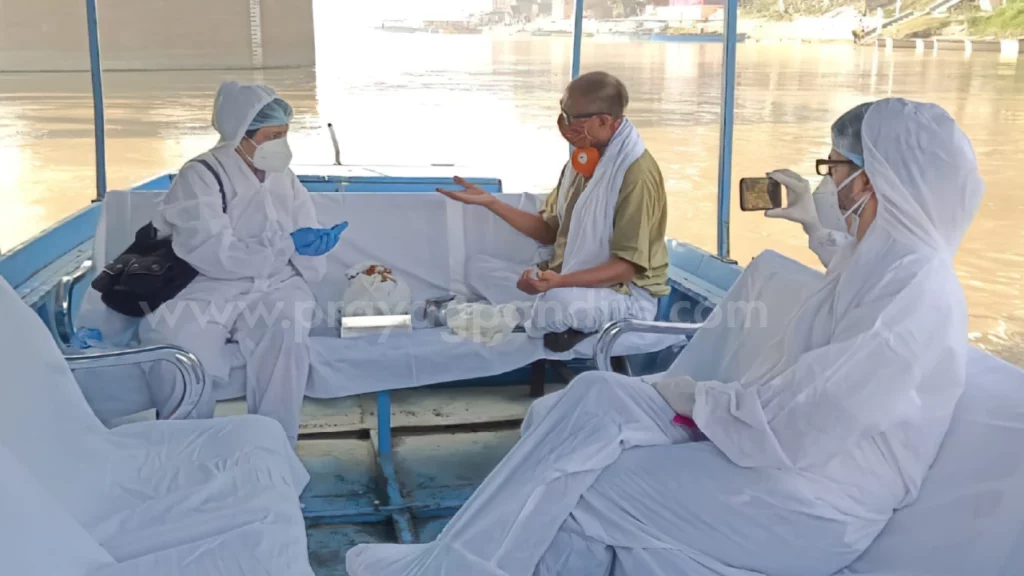
- Sacred boat ride for immersion into main current
- Tarpan with Gangajal, sesame & barley
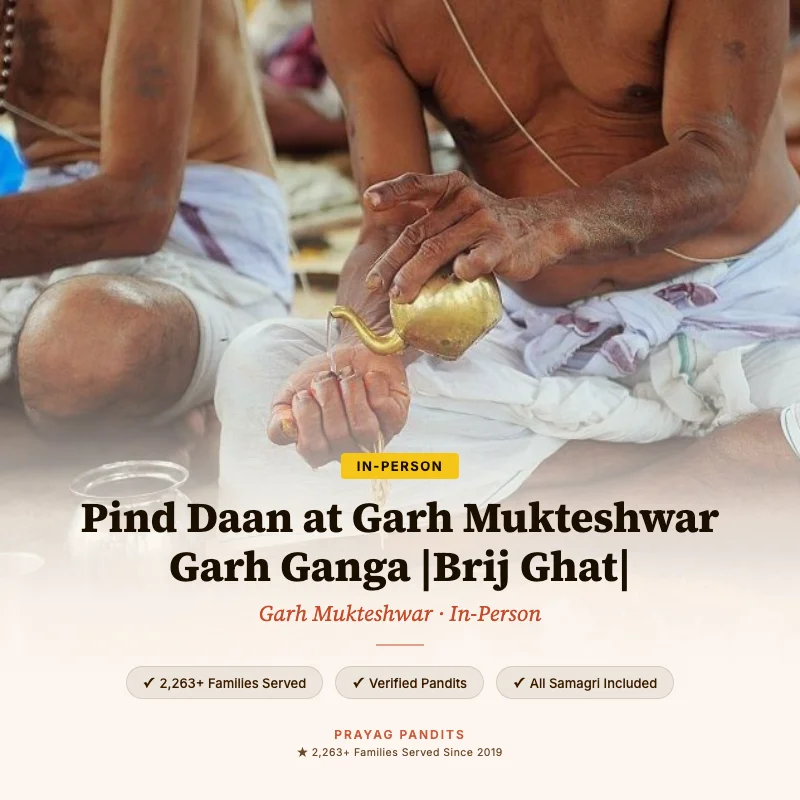
- Basic Pind Daan rice-ball offering to departed
Not included in your package
- Travel to Garhmukteshwar
- Accommodation
- Meals for family
- Brahmin Bhoj / Gau Daan (available as add-ons)
- Extra Dakshina/Gifts/Donations made to the Priest/Pandit
How it works
Choose your pooja
Review your package and any available additions, then add it to your booking.
Share your preferences
Enter your contact details, preferred date and time. Add ancestral details if you wish.
We coordinate with you
Our team confirms the arrangements and shares your coordinator’s details 24 hours before the pooja.
Participate in your pooja
Follow the participation and joining arrangements described in your package and shared by your coordinator.
What families say after the rite
From families who booked Asthi Visarjan at Garh Ganga | Garh Mukteshwar | MuktiDham.
Rated 4.8 out of 5
500+ reviews · Prayag Pandits
This poojarated 4.1 out of 515 reviews
Our pandits







- 2,263+ families served
- Serving since 2019
- GST registered
Families on video
The player loads only when you press play.


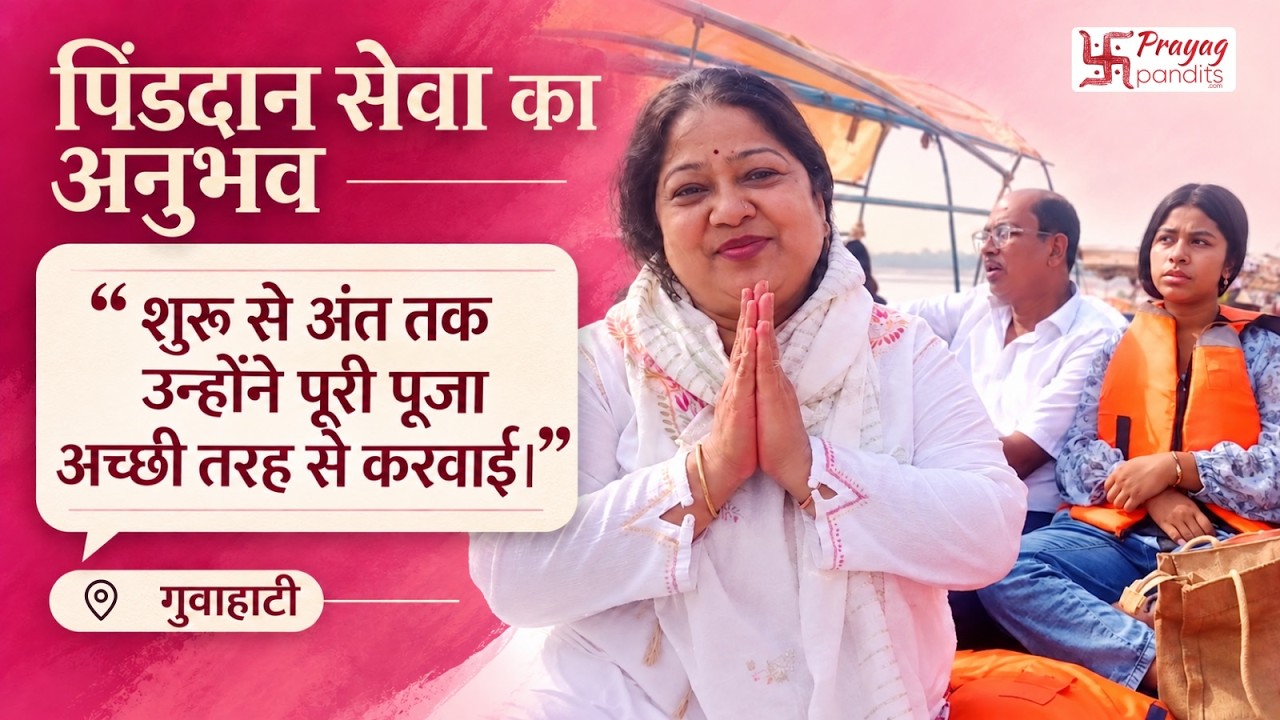
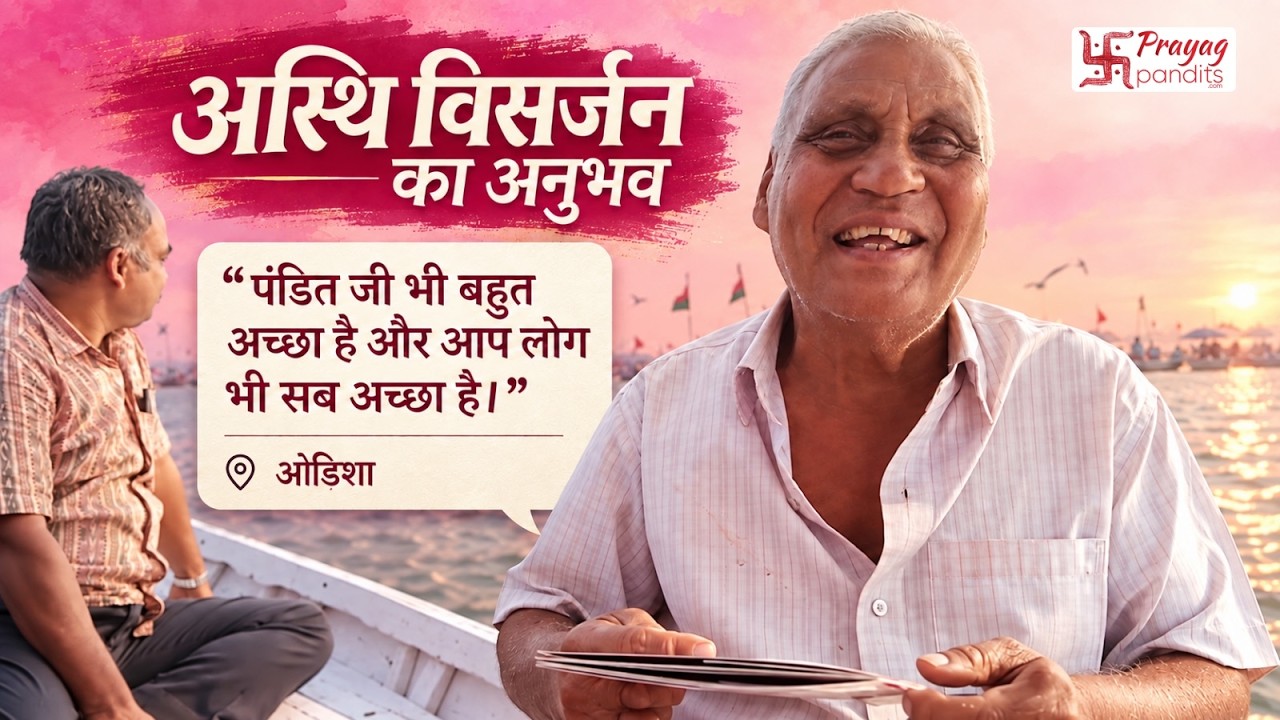


In their words
कूरियर से अस्थि भेजने का विकल्प बहुत सुविधाजनक है। टीम ने सब कुछ गोपनीय और सम्मानजनक तरीके से किया। विसर्जन के बाद फोटो और वीडियो भी भेजे। धन्यवाद प्रयाग पंडित्स।
ऑनलाइन अस्थि विसर्जन सेवा बहुत अच्छी है। हम विदेश में रहते हैं और आ नहीं सकते थे। वीडियो कॉल पर सब कुछ देख सके। पंडित जी ने सम्मानपूर्वक सारी विधि पूरी की।
अस्थि विसर्जन कराने के बाद पूरे परिवार को शांति मिली। प्रयाग पंडित्स ने सब कुछ बहुत अच्छे से संभाला। स्टेशन से पिकअप, घाट तक व्यवस्था, और पूजा - सब उत्तम था।
The team was very sensitive to our emotions during this difficult time. The pandit performed every ritual with care and explained the significance in simple language. Truly grateful for this service.
Being abroad makes it difficult to perform these rituals in person. The online asthi visarjan option was perfect for our family. We could participate from three different countries via the video call. 🙏
Was worried how my mother's asthivisarjan will be performed at garh ganga. The pandit was very well behaved and performed pujan with great care. He and his helper recieved us at ghat and took us to the puja place. Very happy with service recieved.
Booked a rite with us? Tell other families how it went.
Write a reviewQuestions families ask
The Garud Purana recommends performing Asthi Visarjan within the first ten to thirty days after death, ideally coordinated with the eleventh-day (Ekadashi) rites. However, the scriptures are clear that the ceremony is fully valid whenever it is performed — weeks, months, or even years after the death. Many families who could not travel during the pandemic, or whose relatives passed away abroad, have performed Asthi Visarjan years later with complete scriptural validity. What matters is sincere intent and proper Vedic ritual — both of which our team ensures.
Particularly auspicious periods for Asthi Visarjan at Garhmukteshwar include Pitrupaksha (September–October), when the ancestral realm is most accessible; Amavasya (new moon days), which are universally sacred to the Pitrs; and Kartik month (October–November), when Brij Ghat hosts one of the largest pilgrimage gatherings in North India. Early morning — between 6:00 AM and 10:00 AM — is the most auspicious part of the day for performing the ceremony.
Yes. If you have preserved the ashes of more than one family member, multiple can be immersed in a single ceremony. The Sankalp will include the names of all departed being honoured, and the pandit recites the prescribed mantras for each. Many families find it meaningful to honour parents, grandparents, or multiple generations together in a single ceremony at this tirtha. Please inform us at booking so the pandit can prepare the Sankalp accordingly.
Yes. Families based abroad who have preserved the ashes of a loved one can book this service. Two options are available. First, you can send the Asthi Kalash to a family member in India who then travels to Garhmukteshwar to perform the ceremony. Second, if no family member can travel to India, we offer a live online Asthi Visarjan at Garh Ganga — our pandit performs the complete ceremony at Brij Ghat while you participate and witness via WhatsApp video call in real time. For online bookings, please contact us on WhatsApp at +91 7754097777 to discuss the arrangement in detail.
The container holding the ashes is traditionally immersed in the river immediately after the ashes have been released. If the vessel is clay, it goes directly into the Ganga. If it is metal or another material, the pandit will guide you — typically, clean ritual vessels are also immersed in the river. The pandit takes care of all guidance on this; you do not need to make any separate arrangements for the container. Some families also bring personal items of the departed — a piece of clothing, favourite flowers — to offer alongside the ashes. This is entirely at the family’s discretion and the pandit will accommodate it within the ceremony.
Yes, and many families choose to do so. Our Pind Daan at Garh Mukteshwar service can be booked alongside this package, with both ceremonies performed on the same visit. Performing Pind Daan and Asthi Visarjan together at the same sacred tirtha fulfils both the immersion rite and the ongoing ancestral nourishment rite in a single journey. Please mention this when booking so we can coordinate the timing and arrange both ceremonies in the correct sequence.
Still have a question?
Ask our team on WhatsApp and we will help you plan the ceremony.
We reply on WhatsApp within 1–2 hours.
Ask a pandit (opens WhatsApp)Know your ceremony
There is something quietly remarkable about Garhmukteshwar. It sits on the banks of the Ganga just 65 to 70 kilometres from Delhi — close enough that a family can leave home early in the morning, perform the complete Asthi Visarjan ceremony at this ancient tirtha, and return by afternoon. For tens of thousands of families across Delhi NCR, Ghaziabad, Noida, Meerut, Muzaffarnagar, and western Uttar Pradesh, this closeness is not a compromise. It is the reason Garhmukteshwar has served as the primary cremation and ancestral rite site for these communities for centuries.
But proximity is only part of the story. Garhmukteshwar is not simply convenient — it is a deeply sacred tirtha in its own right. The presiding deity here is Mukteshwar Mahadev, one of the ancient Shiva lingas associated in the Skanda Purana with the bestowal of mukti — liberation from the cycle of rebirth. The very name of the town encodes this promise: Garh, the fort or stronghold, and Mukteshwar, the Lord of Liberation. Shiva, who grants liberation from the bonds of karma, is the presiding witness to every last rite performed on these ghats. The soul of the departed is surrendered not merely to the Ganga but to Mukteshwar himself — and the Puranic tradition understands this as a form of divine acceptance.
Families who have performed Asthi Visarjan at Garhmukteshwar repeatedly describe the same experience: a sense of completeness, of having done the right thing in the right place. The Ganga here flows freely through the doab floodplains, wide and unhurried, without the density of larger pilgrimage cities. Brij Ghat — the primary cremation and Asthi Visarjan ghat — carries the quiet weight of generations of grief and release. When the ashes of a loved one enter these waters, they enter a river that has received such offerings across centuries of devotion.
Why Families Trust Prayag Pandits
Many families from Delhi and Haryana are surprised to learn that Garhmukteshwar is not merely a convenient alternative to Haridwar or Prayagraj — it is itself a tirtha of considerable Puranic standing. The Skanda Purana mentions Garhmukteshwar (referred to as Brijakshyetram in its original references to this stretch of the Ganga) as a place where ancestral rites carry heightened efficacy, particularly for families from the Mathura-Meerut-Delhi corridor. This is the sacred geography that has shaped Hindu pilgrimage patterns in North India for two thousand years.
The Ganga at Garhmukteshwar carries a specific character. Unlike the Ganga at Haridwar, which descends from the mountains and still carries the energy of its glacial origin, the Ganga here has settled into the plains and flows with a measured, maternal quality. The water at Brij Ghat is renowned for its purity — one of the cleaner stretches of the river in Uttar Pradesh, relatively unaffected by industrial discharge at the point of the ghat. Pilgrims who bathe here during the Kartik Mela — one of North India’s largest annual pilgrimage fairs — number in the hundreds of thousands. The ghat is a living tirtha, not a ceremonial relic.
The Mukteshwar Mahadev temple, which stands adjacent to the ghats, has a further significance for Asthi Visarjan specifically. In the tradition of Shiva as Mrityunjaya — the Conqueror of Death — performing last rites in the vicinity of a Shiva temple adds the dimension of divine benediction to the ceremony. The pandit who performs the Asthi Visarjan begins with a brief prayer at the temple before proceeding to the ghat, connecting the ceremony to the presiding deity’s grace. This dual axis — the Ganga as purifier and liberator, and Mukteshwar Mahadev as the divine witness — gives the ceremony at Garhmukteshwar a completeness that pure river-based rituals elsewhere sometimes lack.
For a full account of this tirtha’s history, geography, and significance for ancestral rites, see our detailed guide: Garhmukteshwar — Complete Guide to the Ganga’s Closest Tirtha to Delhi.
Many families planning their first visit to Garhmukteshwar want to understand what the ceremony actually involves — how long it takes, what the sequence of rituals is, and what role family members play. The following account gives you a detailed sense of what to expect from the time you arrive at Brij Ghat to the moment the ceremony concludes.
The complete ceremony from arrival to closing takes approximately one to one and a half hours. Most families arrive in the morning — ideally between 6:00 AM and 10:00 AM, when the ghat is calmer and the ritual conditions are most auspicious. Our pandit will be present at Brij Ghat to receive you on arrival.
Before the ceremony begins, the pandit will spend a few minutes with the head of the family — typically the eldest son or nearest male relative — confirming the gotra, the name of the departed, the approximate date of death, and the name of the present city. These details form the core of the Sankalp, the formal declaration that initiates the ritual. If you do not know your gotra, please inform us in advance. The pandit will use the Kashyap gotra, which is the traditional default for families who have lost knowledge of their ancestral gotra.
Your Ceremony at Brij Ghat — Step by Step
From arrival at Garhmukteshwar to the closing prayers — a complete walkthrough of the Asthi Visarjan ceremony
Arrival at Garhmukteshwar & Mukteshwar Temple Darshan
Your family arrives at Garhmukteshwar and proceeds first to Mukteshwar Mahadev temple adjacent to the ghats. A brief darshan here — offering flowers, incense, and a prayer to Bhagwan Shiva — connects the ceremony to the presiding deity of this tirtha. Mukteshwar, the Lord of Liberation, is invoked as the divine witness to the rite. Our pandit meets your family here or directly at the ghat, according to your preference, and guides the family to Brij Ghat.
Ghat Preparation & Sankalp
At Brij Ghat, the pandit prepares the puja space and arranges all samagri. The Asthi Kalash is placed on a clean cloth with reverence. The head of the family performs a brief ritual bath or Gangajal sprinkling before the ceremony begins. Then comes the Sankalp — the formal declaration of intention — in which the family member names the departed, states the gotra and family lineage, identifies the Hindu tithi, and formally declares the purpose of the ceremony. This Sankalp directs the entire ritual’s spiritual energy toward the specific soul being honoured.
Boat Journey on the Ganga
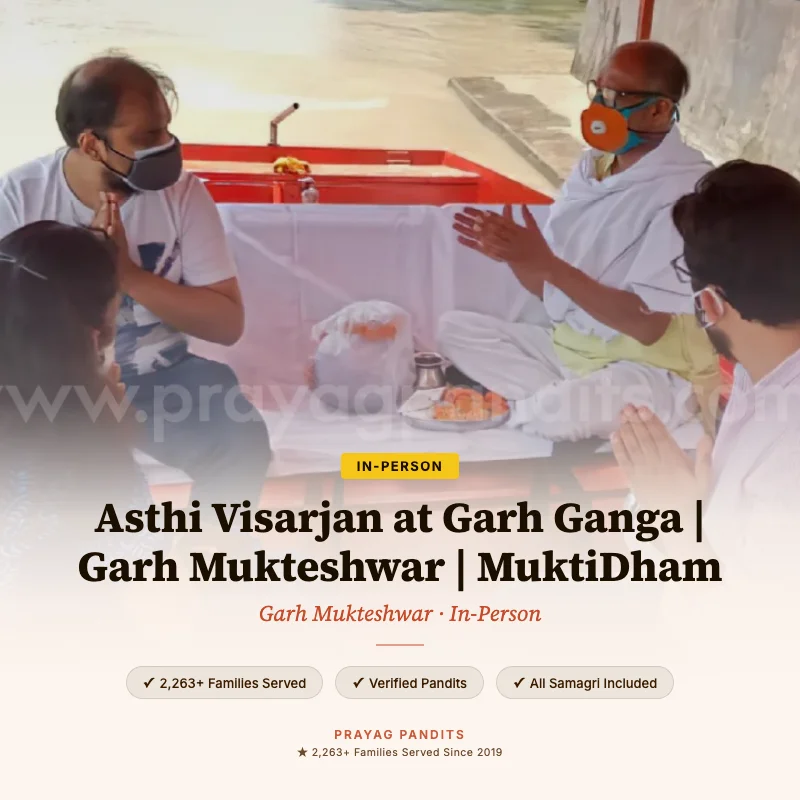
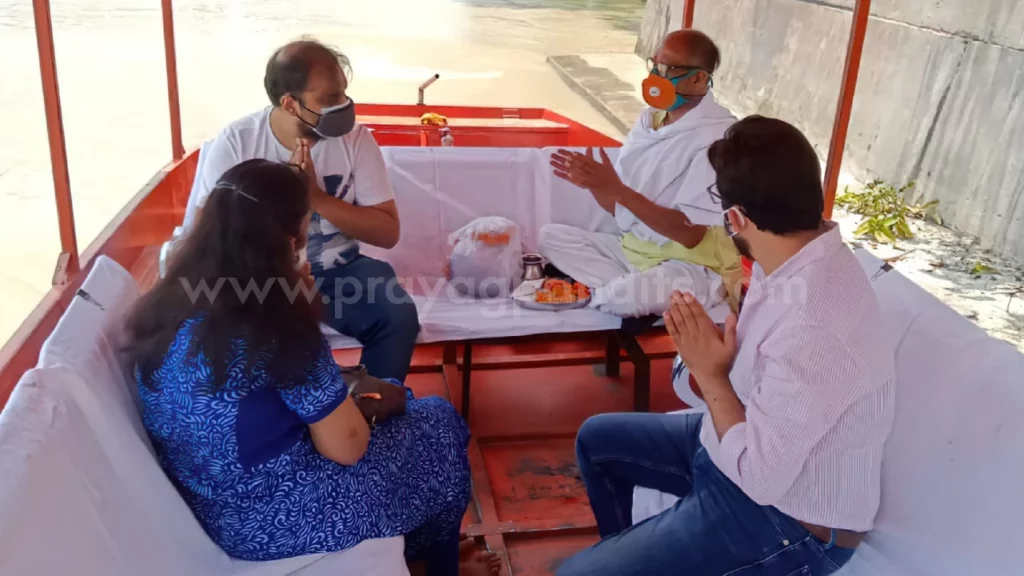
After the Sankalp and ghat-side preparations, the family boards the ceremonial boat. The pandit recites preparatory mantras as the boat moves out onto the Ganga. The Asthi Kalash travels with the family on the boat. The movement onto the river itself carries significance — the family is now surrendering their loved one to the sacred waters, and the journey toward immersion is already a form of release.
Asthi Poojan & Visarjan in the Ganga
On the river, the pandit first performs Asthi Poojan — a puja of the ashes themselves, treating the physical remains with the same reverence due to the human being whose body they were. The pandit recites the Asthi Visarjan mantra sequence as prescribed in the Garud Purana. The family member then immerses the ashes with their own hands into the Ganga. Flower petals are offered as the ashes flow into the current. The Pind Daan offering follows immediately — rice balls lowered into the river in the name of the ancestor, the final nourishing gift.
Tarpan & Closing Prayers
After the immersion, Tarpan is performed: Gangajal mixed with sesame seeds and barley, cupped in the palms and poured into the river in the names of the departed and all ancestors recalled in the Sankalp. This is the final act of sustained nourishment — water and grain offered across the river of life to those who have crossed it. The pandit closes with prayers for the peace of the departed soul — shanti for the one who has gone — and blessings for the well-being and continued strength of the family that remains. The boat returns to Brij Ghat, and the ceremony is complete.
Garhmukteshwar is exceptionally well connected to Delhi and the surrounding regions. The journey from most parts of Delhi NCR takes between 90 minutes and 2.5 hours depending on your starting point and traffic conditions. This accessibility — combined with the tirtha’s genuine sacred weight — is why Garhmukteshwar has served as the primary site for Asthi Visarjan for millions of families across this region for generations.
By Road from Delhi and NCR
The most convenient route is via NH-9 (Delhi–Moradabad Highway, formerly NH-24). From Delhi, take the NH-9 exit from the Delhi-Meerut Expressway or via Akshardham and proceed toward Hapur. Garhmukteshwar is approximately 65 to 70 kilometres from central Delhi and 35 kilometres beyond Ghaziabad city. The town and Brij Ghat are well signposted from the main highway. Typical driving times:
- From Central Delhi (Connaught Place): 1.5 to 2 hours via NH-9
- From Noida / Greater Noida: 1.5 to 2 hours via NH-9 through Ghaziabad
- From Gurgaon / Faridabad: 2 to 2.5 hours via the Delhi ring road and NH-9
- From Meerut: 45 to 60 minutes on NH-9
- From Muzaffarnagar / Haridwar direction: 45 to 90 minutes on NH-9 toward Delhi
Most families coming for Asthi Visarjan prefer to hire a private vehicle — especially when carrying the Asthi Kalash — as it allows flexibility in timing and avoids the discomfort of public transport during a deeply emotional journey. Our team can suggest reliable local transport contacts if needed.
By Train
The nearest railway station to Garhmukteshwar is Hapur Junction, approximately 20 kilometres away. Multiple trains connect Delhi (Anand Vihar Terminal, New Delhi Station) to Hapur throughout the day, with journey times of 45 to 90 minutes. From Hapur Junction, Garhmukteshwar is accessible by auto-rickshaw or shared jeep in approximately 30 to 45 minutes. The Garhmukteshwar Road station (also called Garh station) on the Moradabad line is even closer — about 5 kilometres from Brij Ghat — though trains are less frequent at this station.
GPS Navigation
Enter “Brij Ghat Garhmukteshwar” in Google Maps or any navigation app. The ghat is well mapped and navigation is reliable. If approaching from the highway, follow signs for Garhmukteshwar town and then follow signs to the ghat area. Our pandit’s contact details are shared at booking, and he can guide you by phone if needed.
Our qualified pandit
Senior Tirth Purohit — Asthi Visarjan & Ancestral Rites SpecialistOur qualified pandit has been conducting Asthi Visarjan, Tarpan, and Pind Daan ceremonies at sacred tirthas across North India for over ten years. He brings deep knowledge of the Garud Purana vidhi and the specific traditions of Garh Ganga tirtha, having conducted thousands of ancestral rites at Brij Ghat. Families from across Delhi NCR, Haryana, and western Uttar Pradesh consistently choose Pandit Kuldeep for the care and devotion with which he conducts these deeply personal ceremonies. He explains every step of the ritual in clear Hindi so that the family is not merely witnessing but participating with full understanding. His calm presence through what is often the most difficult moment a family shares is something families recall long after the ceremony.
Book With Our Pandit
We performed Asthi Visarjan for my mother at Garh Ganga last year. We are from Ghaziabad, so Garhmukteshwar was the most natural choice for our family — we had always heard it was the right place for this ceremony from this part of UP. Prayag Pandits made the booking simple and Pandit Kuldeep was already at the ghat when we arrived. He explained each step of the ritual before doing it, which our whole family found helpful — we understood what was happening and why, not just watching someone perform something we did not understand. The moment the ashes entered the Ganga was very moving. We felt complete. We felt we had done right by her.Prayag Pandits Booking Guarantee
Every ceremony is conducted with full Vedic correctness, an experienced purohit, and personal accountability to your family. We understand this is not a transaction — it is your family’s most sacred responsibility.
- Booking confirmed within 2 hours via WhatsApp
- Pandit's name and contact number shared at confirmation
- Full refund if your chosen date cannot be served
- Private ceremony — your family alone, not a group ritual
- Live video option available for NRI families worldwide
Asthi Visarjan at Garh Ganga (Garh Mukteshwar) costs ₹5,100 (regular price ₹7,100). This is the most affordable sacred Ganga immersion site and closest to Delhi NCR — just 3 hours by road. The price covers the experienced pandit, complete samagri, ceremony at Brij Ghat, and full documentation. No hidden charges.