



What’s included
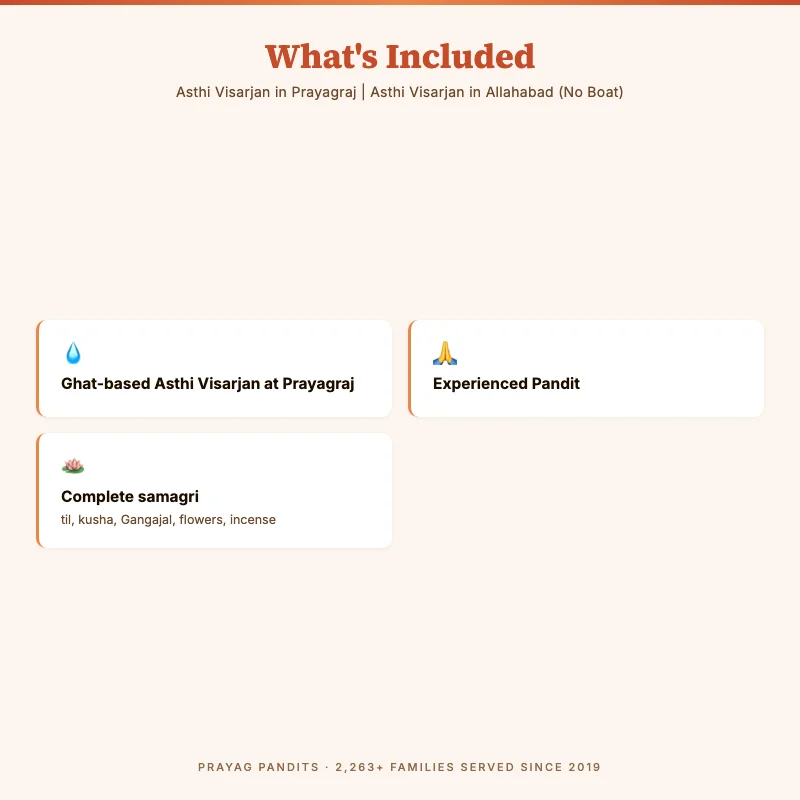
Included in your package
- Ghat-based Asthi Visarjan at Prayagraj
- Experienced Pandit
- Complete samagri til, kusha, Gangajal, flowers, incense
Not included in your package
- Private boat to Sangam midpoint (upgrade to Premium package available)
- Travel to Prayagraj
- Accommodation
- Meals
- Airport / station pickup & drop
- Dhoti / Gamcha / Towel
- Extra Dakshina/Gifts/Donations made to the Priest/Pandit
How it works
Choose your pooja
Review your package and any available additions, then add it to your booking.
Share your preferences
Enter your contact details, preferred date and time. Add ancestral details if you wish.
We coordinate with you
Our team confirms the arrangements and shares your coordinator’s details 24 hours before the pooja.
Participate in your pooja
Follow the participation and joining arrangements described in your package and shared by your coordinator.
What families say after the rite
From families who booked Asthi Visarjan in Prayagraj | Asthi Visarjan in Allahabad (No Boat).
Rated 4.8 out of 5
500+ reviews · Prayag Pandits
This poojarated 4.3 out of 521 reviews
Our pandits









- 2,263+ families served
- Serving since 2019
- GST registered
Families on video
The player loads only when you press play.




In their words
ऑनलाइन अस्थि विसर्जन सेवा बहुत अच्छी है। हम विदेश में रहते हैं और आ नहीं सकते थे। वीडियो कॉल पर सब कुछ देख सके। पंडित जी ने सम्मानपूर्वक सारी विधि पूरी की।
Being abroad makes it difficult to perform these rituals in person. The online asthi visarjan option was perfect for our family. We could participate from three different countries via the video call. Dhanyavaad.
The ceremony at Prayagraj was beautiful. Early morning visarjan with proper mantras. The pandit was very experienced and conducted the poojan with great devotion. Highly satisfied. 🙏
The Asthi Visarjan service was conducted with dignity and proper Vedic rituals. The pandit explained the spiritual significance of each step. The team also helped with accommodation recommendations.
We performed Asthi Visarjan at Prayagraj through Prayag Pandits. The ceremony was very peaceful and the pandit was extremely respectful during the entire process. The boat ride to the sangam was well arranged. 🙏
Amazing service. The folks here were super supportive during such a hard time for us. They handled everything so smoothly, felt like a burden was lifted off our shoulders. Highly recommended
Booked a rite with us? Tell other families how it went.
Write a reviewQuestions families ask
The traditional preference is within the first month, but practically speaking, Asthi Visarjan can be performed at any time after death. Ashes can be safely preserved for months or even years. Many families wait until they can travel to a sacred teerth. Pitrupaksha is a particularly good time for families who have been keeping ashes, as the ancestral realm is most accessible during this fortnight.
Yes. If you have preserved the ashes of more than one family member, they can be immersed in the same ceremony. The Sankalpa will include the names of all the departed being honoured, and the pandit will recite the appropriate mantras for each. Many families make a single trip to Prayagraj to honour multiple generations together.
The traditional practice is to also immerse the container in the river after emptying it. The pandit will guide you on this. If the container is biodegradable (clay), it can go directly into the water. Metal containers may be offered at the ghat or handled according to the pandit’s guidance.
Early morning — the Brahma Muhurta and the hours just after sunrise — is traditionally considered the most auspicious time for all sacred rites at the ghat. However, Asthi Visarjan is not restricted to specific hours and can be performed throughout the morning. We recommend avoiding afternoons and evenings for this particular ceremony.
The core ritual — pandit, samagri, pooja, immersion, Tarpan, and closing prayers — is identical. The difference is the location of the immersion. Our premium package includes a private boat to the exact midpoint of the Triveni Sangam, the precise confluence of all three rivers. This standard package performs the immersion from the ghat itself, where the rivers meet at their banks. Both are spiritually complete; the premium option offers the added experience and significance of the boat journey to the exact confluence. See our full services page for premium package details.
Still have a question?
Ask our team on WhatsApp and we will help you plan the ceremony.
We reply on WhatsApp within 1–2 hours.
Ask a pandit (opens WhatsApp)Know your ceremony
There are families who return from Prayagraj having performed one of the most sacred rites in Hindu tradition — Asthi Visarjan, the immersion of their beloved’s ashes in sacred waters — and they carry a peace that is difficult to describe. The weight of grief does not vanish, but something shifts. The act of returning the physical remains to the sacred river, of completing the final duty of love, brings a closure that no other ritual offers.
Asthi Visarjan at Prayagraj, performed from the ghat where the Ganga and Yamuna meet, is this closing of the circle. Our standard package — priced at ₹5,100 — is designed for families who wish to perform this sacred rite with full ritual correctness and proper pandit guidance, without the additional cost of a private boat to the Sangam midpoint.
The ritual is complete. The location is sacred. The pandit is experienced. What you are choosing is a ghat-based ceremony rather than a boat-based one — and as we explain below, this distinction does not reduce the spiritual validity of the rite one bit.
When a Hindu dies, the body is cremated according to the Antyesti (last rite) procedures. After cremation, the bones and ashes that remain — called asthi (bones) or phool (literally, flowers) in devotional language — are collected and preserved for immersion in sacred waters. This immersion is called Asthi Visarjan — the release or immersion of the remains.
The Garuda Purana is specific about why Asthi Visarjan matters. After death, the soul undergoes a period of transition during which the completion of proper rites by relatives accelerates its liberation. The Antyesti (cremation rites) begin this process; Asthi Visarjan in sacred water completes it. The physical matter of the body — reduced to its most elemental form through fire — is returned to the sacred river, which carries it into the divine realm. The Ganga especially is described as a direct channel to the celestial world; what enters her waters is said to ascend with her.
The Skanda Purana states: Asthi Sangame visarjayan, pitrun mukti prayacchati — by immersing the remains at a Sangam (confluence), one grants liberation to the ancestor. This is not merely comfort. This is a scriptural guarantee of what the ritual accomplishes when performed correctly.
For a complete understanding of the Asthi Visarjan ceremony, its rituals and their meanings, read our detailed guide: Asthi Visarjan Poojan — All You Need to Know.
The Ganga flows through many cities. Why is Prayagraj considered particularly sacred for Asthi Visarjan?
The answer lies in the Triveni Sangam — the confluence of three rivers. At Prayagraj, the Ganga meets the Yamuna, and the invisible Saraswati joins them from underground. This three-river confluence creates what the Matsya Purana calls an akshay teerth — an inexhaustible sacred field where spiritual merit accumulates without limit and where offerings are received with extraordinary amplification.
The Padma Purana describes Prayagraj as the place where Lord Brahma performed the first Yagna at the dawn of creation. The divine energy of that original creative act still resonates here, making every sacred offering made at this location especially potent.
When the ashes of a departed soul are released into the Sangam waters — whether from the midpoint by boat or from the ghat where the rivers first join — they are received by this threefold sacred energy. The Ganga, Yamuna, and Saraswati together carry what you release toward the divine realm with a power that no single river, however sacred, can match alone.
This is the question that families most commonly ask when comparing our standard package with our premium boat package: if we don’t go to the precise midpoint confluence by boat, is the ritual still fully valid?
The answer, both scripturally and practically, is yes.
The Triveni Sangam’s sacred zone begins at the ghats where the rivers first visibly come together, not merely at the precise midpoint of the water. The scriptural references to Prayag Teerth encompass the entire Sangam geography, including the ghats at its edge. Priests and families have performed Asthi Visarjan from the ghats of Prayagraj for thousands of years — long before boats became a standard option for the midpoint journey.
What matters spiritually is the intention, the proper conduct of the ritual, and the sacred water that receives the remains. At the ghat where the Ganga and Yamuna meet, all three of these are fully present. The pandit conducting the ceremony recites the complete ritual vidhi. The samagri (materials) used are the same as in any boat-based ceremony. The water receiving the ashes is the same Triveni Sangam water.
For families who prefer or require the boat journey to the precise confluence midpoint, we offer a premium Asthi Visarjan package that includes a private boat. The choice between the two is a matter of personal preference and budget — not of ritual completeness.
Traditionally, the eldest son of the deceased performs the Asthi Visarjan, just as he leads the cremation rites. In the absence of a son, a daughter, son-in-law, grandson, or other close family member may perform the ritual. When a family travels together to Prayagraj, all members may be present and participate in the prayers even if one person formally performs the immersion.
There is no strict restriction based on gender in the modern practice of this ritual. Many families today perform Asthi Visarjan together as a collective act of farewell, with the pandit guiding whoever is present through the ceremony.
The traditional guidance is that Asthi Visarjan should be performed within the first ten to thirty days after death, though it can be performed later if circumstances make the earlier timeline impossible. Many families delay for weeks or months due to practical constraints — travel distance, finances, coordination — and the ritual remains valid and complete whenever it is ultimately performed.
Certain times are considered especially auspicious:
- Within the first 12 days after death: The most traditionally preferred window, before the 12th-day (Dwadasha) Shraddh ceremony
- Pitrupaksha: For ashes that have been kept due to practical constraints, Pitrupaksha is an excellent and spiritually powerful time to perform Asthi Visarjan, as the ancestral realm is most accessible during this fortnight
- Makar Sankranti: One of the most auspicious solar transitions of the year for any offering at a teerth
- Amavasya (new moon days): Sacred to the pitrs, Amavasya is always appropriate for ancestral rites
Arrival at the Ghat
The family arrives at the designated ghat carrying the ashes and bones (typically kept in a clay or copper pot, wrapped in clean white cloth). The pandit receives you, and after brief introductions, the ritual setup begins. The ashes remain covered until the moment of immersion.
Ritual Purification
The pandit guides the family through achamana — the ritual sipping of water for purification — and a brief sprinkling of Gangajal to purify the body before the ceremony begins.
Sankalpa
The formal Sankalpa is recited: your name, gotra, location, the current auspicious time, and your intention — naming the departed and declaring your purpose. This directs the entire ritual’s spiritual energy toward the specific soul you are honouring.
Pooja and Prayers
Before the immersion, the pandit conducts a brief but complete puja — flowers, incense, diya, and prayers to Ganga Mata, to the Yamuna, and to the departed soul. This prayer acknowledges the sacred waters as receivers and guardians of what is being offered.
Asthi Visarjan — The Immersion
The ashes and bones are gently transferred into the river. As they enter the water, the pandit recites the final mantras of release — prayers that bid farewell to the departed and ask the Ganga to carry them toward liberation. Family members may add flower petals to the water as the ashes flow outward.
Tarpan
Immediately following the immersion, Tarpan is performed — water mixed with sesame and barley, offered three times to the departed soul, as a final nourishing gift. This completes the ceremony as a whole act of love and farewell.
Closing Prayers
The ceremony closes with a prayer for the departed soul’s onward journey — for peace, for liberation, for the best possible continuation. Blessings for the living family follow. The pandit offers a brief final word about the meaning of what has been accomplished, which many families find deeply comforting.
- The ashes and bones in a sealed container — clay pots are traditional, but any clean, sealed container is acceptable
- Clean, modest clothing — white or undyed is traditional for mourning rites
- The name and approximate death date of the departed
- Your gotra (family lineage name) — if unknown, the pandit will use Kashyap gotra
- Any personal mementos you wish to offer to the river alongside the ashes — some families include the departed’s favourite flowers, or a small cloth they wore
Asthi Visarjan is not merely a religious obligation. It is one of the most psychologically and spiritually meaningful acts of closure available in any culture. The act of physically releasing the remains of someone you love — of entrusting them to the sacred river, to the confluence of divine waters — marks the end of the period of active mourning and the beginning of remembrance.
Families consistently describe the experience as simultaneously heartbreaking and relieving. The tears that come at the ghat are real and necessary. The peace that follows is equally real. The Hindu tradition understood something profound: grief needs a form, a ritual container. Asthi Visarjan at a place like Prayagraj provides that container in its most complete and meaningful form.
Our pandits are experienced not only in the ritual but in the emotional reality of grieving families. They conduct the ceremony with the gentleness and dignity that this most personal of rites deserves.