

What’s included
Included in your package
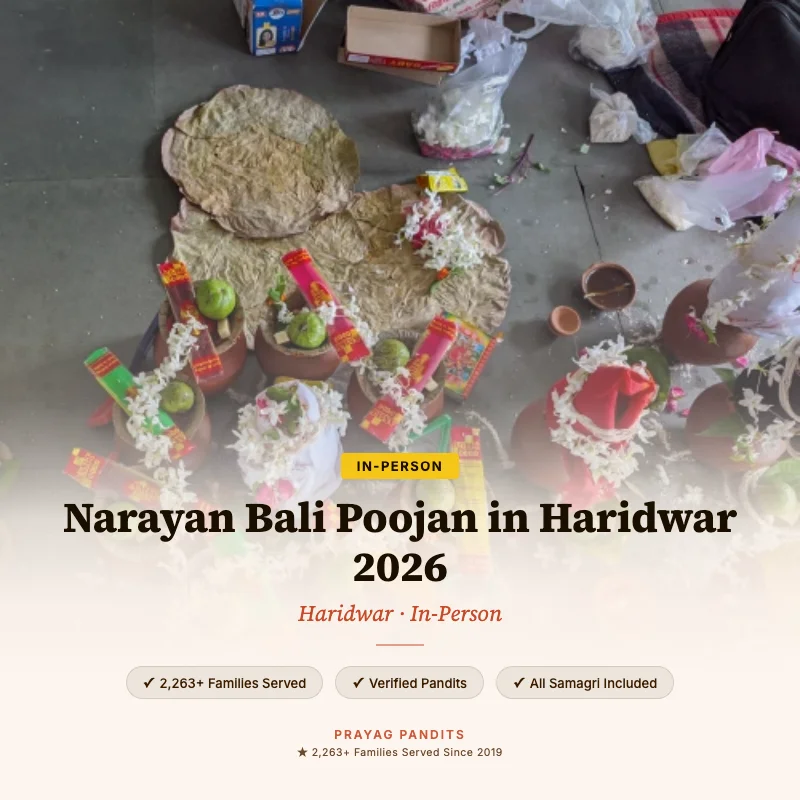
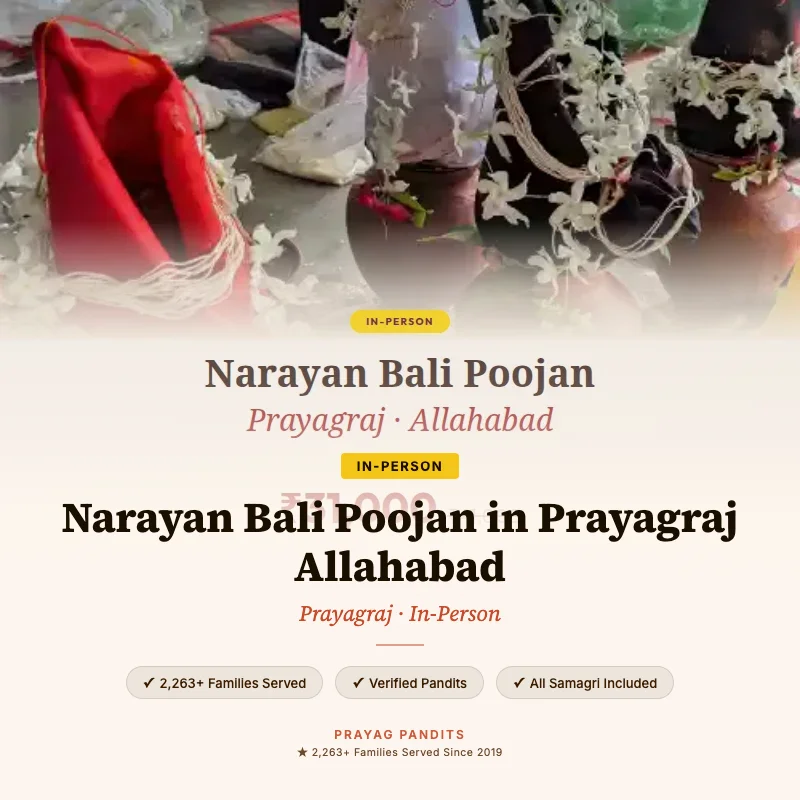
- Complete Narayan Bali Poojan at Triveni Sangam, Prayagraj
- Experienced qualified pandit full ceremony
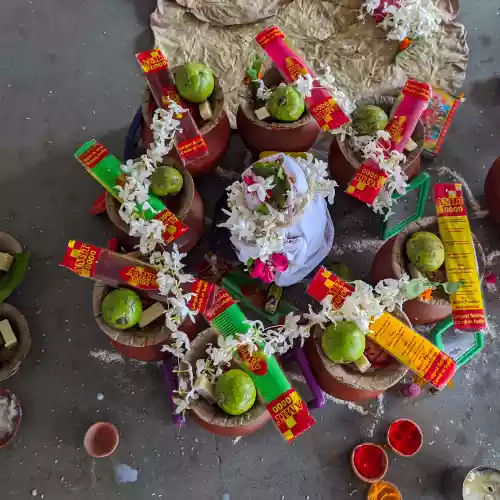
- All samagri flowers, til, kusha, darbha, sacred threads, diya, honey, five grains, cotton for effigy
- Narayan Bali effigy constructed & consecrated during ceremony
- Boat to Sangam confluence for effigy immersion
- Brahmin to receive offerings on behalf of departed
- Pre-ceremony consultation & Sankalpa documentation
Not included in your package
- Travel to Prayagraj
- Accommodation in Prayagraj
- Meals
- Tripindi Shradh / additional Pind Daan (separate services)
- Extra Dakshina/Gifts/Donations made to the Priest/Pandit
How it works
Choose your pooja
Review your package and any available additions, then add it to your booking.
Share your preferences
Enter your contact details, preferred date and time. Add ancestral details if you wish.
We coordinate with you
Our team confirms the arrangements and shares your coordinator’s details 24 hours before the pooja.
Participate in your pooja
Follow the participation and joining arrangements described in your package and shared by your coordinator.
What families say after the rite
From families who booked Narayan Bali Poojan in Prayagraj Allahabad.
Rated 4.8 out of 5
500+ reviews · Prayag Pandits
This poojarated 4.3 out of 520 reviews
Our pandits






- 2,263+ families served
- Serving since 2019
- GST registered
Families on video
The player loads only when you press play.
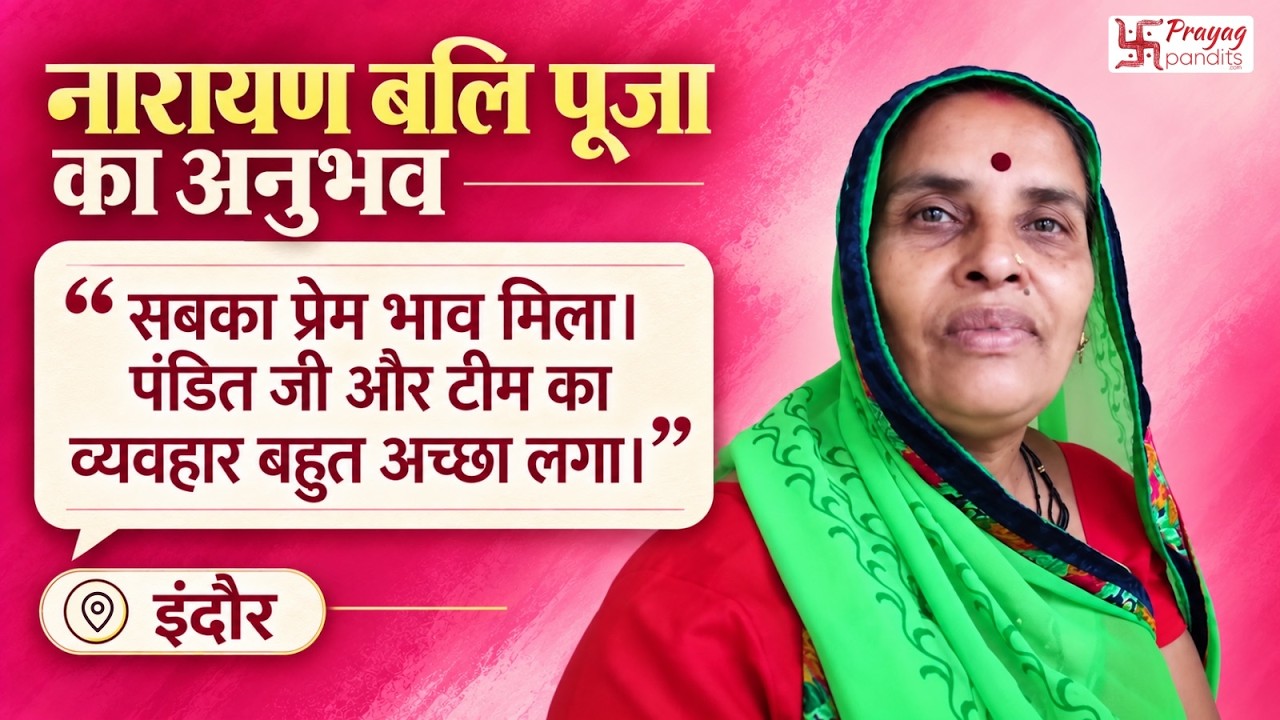


In their words
सेवा उत्तम है। कोई छिपा हुआ खर्च नहीं। जो बताया गया वही किया गया। पंडित जी बहुत विनम्र और ज्ञानी हैं। दोबारा जरूर बुक करेंगे।
We are settled abroad and wanted to perform the puja in Prayagraj. Prayag Pandits made it possible. Grateful.
The Narayan Bali Poojan was conducted exactly as described in the Garuda Purana. All the required materials were arranged by the team. The 4-5 hour ceremony was performed with full devotion.
Narayan Bali is a very specific ritual and finding the right pandit was our main concern. Prayag Pandits connected us with an experienced purohit who had performed this poojan many times. Very satisfied. Jai Shri Ram.
We performed Narayan Bali Poojan on the advice of our family pandit. The ceremony took the full day but Prayag Pandits managed everything perfectly. The senior pandit was very knowledgeable about this complex ritual. Dhanyavaad.
Complex ritual but the team made it simple for us. They explained what Narayan Bali is, why we needed it, and what to expect. The pandit was thorough and patient throughout the long ceremony.
Booked a rite with us? Tell other families how it went.
Write a reviewQuestions families ask
Pind Daan: A general rite for all departed ancestors, usually performed annually (especially during Pitru Paksha) or after death, to nourish and satisfy them. It's a fundamental duty.
Narayan Bali: A specific ritual targeted towards souls who died unnaturally or whose final rites were improper. Its primary focus is liberation from a troubled state (Pret Yoni) and resolving the specific Pitru Dosha caused by such deaths. While Pind Daan is often part of Narayan Bali, the latter addresses a very specific type of death and its consequences.
While specifics can vary, the core procedure involves:
- Holy Bath: Taking a purifying dip in the Triveni Sangam.
- Sankalpa: A formal vow to perform the ritual.
- Deity Worship: Invoking Lord Ganesha, Kalash Sthapana, and worshipping principal deities (Brahma, Vishnu, Rudra/Shiva, Yama, Savitr/Tatpurusha).
- Narayan Bali Homa/Puja: Fire ceremony or specific puja dedicated to Lord Vishnu (Narayan).
- Invoking the Soul: Using mantras to call upon the specific departed soul(s).
- Creating Artificial Body (Pind): A symbolic body, often made of wheat flour, is created.
- Symbolic Funeral Rites: Rituals are performed on the artificial body to allow the soul to fulfill desires and then attain liberation through symbolic cremation/funeral.
- Pinda Pradan & Tarpana: Offering rice balls and water oblations at the Sangam.
- Brahmin Bhojan & Dakshina: Feeding Brahmins and offering donations.
- Tirth Purohits at Sangam: Approach the official Tirth Purohits (traditional priests associated with the pilgrimage site) at Triveni Sangam. They have generations of experience.
- Online Platforms: Reputable platforms specializing in puja services list verified pandits for Prayagraj (e.g., Prayag Pandits, Diyabati, Sri Mandir, DevDham, 99Pandit, PurePrayer). Check reviews.
- Local References: Seek recommendations from established temples or ashrams near the Sangam.
- Directories: Local directories like Justdial list pandits offering Narayan Bali services.
Ensure the pandit is experienced in Narayan Bali specifically at Prayagraj.
The core benefits (peace for the soul, removal of Pitru Dosha, resolution of family problems) are significantly amplified due to the sacredness of Prayagraj:
- Enhanced Liberation: The power of Triveni Sangam provides a stronger impetus for the soul's Moksha.
- Profound Pitru Dosha Removal: The purifying energies effectively cleanse ancestral afflictions.
- Greater Ancestral Blessings: Appeased ancestors bestow potent blessings for family prosperity, health, and harmony from this holy site.
- Spiritual Merit: Performing rites at Tirthraj Prayag accrues immense spiritual merit (Punya) for the performer.
Yes, given Prayagraj's significance for all ancestral rites:
- Tripindi Shradh: Often performed to appease ancestors neglected for long periods or those with strong attachments.
- Nag Bali: Sometimes combined (as Narayan Nagbali) if death involved snakes or for Sarpa Dosha removal. Nagvasuki Temple in Prayagraj is relevant here.
- Asthi Visarjan: If not already done, immersion of ashes at Triveni Sangam is highly meritorious.
- General Pind Daan/Tarpana: Additional offerings at the Sangam for overall ancestral peace.
You can absolutely perform Narayan Bali at Prayagraj during Pitrupaksha, and doing so adds considerable merit to the ceremony. Pitrupaksha is the period when the Pitru Dwar — the ancestral gateway — is considered open, which intensifies the effect of all ancestral rites. That said, unlike Gaya, Prayagraj does not become overcrowded with Narayan Bali-specific ceremonies during Pitrupaksha, which means the experience is quieter and more personally focused. If you wish to perform the ceremony during Pitrupaksha, book early as slots are limited.
It is strongly recommended that the primary family member — typically the eldest son, or the nearest male relative of the deceased — remain present for the entire ceremony. Other family members may step away briefly if necessary. The Sankalpa requires at least one family member to be present and actively witnessing throughout. The ceremony is deeply moving, and most families find that they do not want to leave — it is not a passive or tedious process.
Yes. Women can and do attend Narayan Bali. In the tradition followed at Prayagraj, women observe and witness the ceremony and may be asked to participate in certain offering moments. In cases where a woman is the only family member available to perform the rite — for example, for a brother who died without leaving male heirs — our pandits accommodate this fully and know the appropriate variations in the ritual protocol.
No. These are two distinct ceremonies with different purposes. Narayan Bali is specifically for souls who died unnatural deaths or whose last rites were incomplete. Tripindi Shradh is performed when three or more generations of ancestors have not received proper Shradh for an extended period. In some cases, both are recommended together, but they are separate rituals performed on separate occasions. Our pandit will help you understand which one your family’s situation calls for.
We recommend booking at least 2 to 3 weeks in advance. This gives our team time to confirm the pandit, identify an auspicious date on the Panchang, and prepare all the ritual materials. It also gives you time to make your travel arrangements to Prayagraj without rushing. For ceremonies during Pitrupaksha or major Hindu festival periods, 4 to 6 weeks’ advance booking is recommended.
Still have a question?
Ask our team on WhatsApp and we will help you plan the ceremony.
We reply on WhatsApp within 1–2 hours.
Ask a pandit (opens WhatsApp)Know your ceremony
There are forms of grief that families carry quietly for years, sometimes for decades, without ever having a name for them. A grandfather who drowned and whose body was never found. An uncle who died in a factory accident before anyone could reach him. A young woman who took her own life, and whose family, overwhelmed by sorrow and social stigma, never performed the proper rites. The grief is spoken of, sometimes, in lowered voices — but the ritual response that could actually address what is happening spiritually is often unknown or left undone.
Narayan Bali Poojan is that response. It is one of the most profound ceremonies in the Vedic tradition — not a general ancestral offering, but a precise act of compassion directed at a soul that was denied the passage it deserved. You come to Prayagraj, stand at the edge of the Triveni Sangam where three rivers meet, watch your pandit build a symbolic body for your ancestor from sacred materials, hear the Vedic mantras that perform — in full, properly, with all the reverence that was missing the first time — the last rites for a life that ended badly. And then you watch that effigy enter the water and disappear.
Something changes in that moment. Families who have attended this ceremony often describe it as the first time they have felt that a particular burden, carried for as long as they can remember, has been set down.
Narayan Bali can be performed online, and for many families in distant locations, that is the right choice. But if you are able to travel to Prayagraj and attend the ceremony in person, the experience is of a different order entirely.
Physical presence at a sacred site during a Vedic ritual is not simply traditional practice — it is recognized in the Vedic literature as carrying its own spiritual merit, called kshetra phal, the fruit of the sacred field. When you are physically at the Triveni Sangam, the vibration of the water, the sound of the mantras in open air, the sight of the immersion, and your own body’s presence in that field all contribute to the depth of the ceremony in ways that a screen cannot replicate. You are a witness in the truest sense — your consciousness is fully present to the act of liberation being performed for your ancestor.
For an ancestor who suffered, who was denied a proper farewell, there is something deeply right about a living family member making the effort to travel, to be present, to stand at the water’s edge and see the ceremony through with their own eyes. The effort itself is an act of love.
Prayagraj has been called Tirtharaj — the king of all pilgrimage sites — in the Vedic and Puranic literature. The Triveni Sangam, where the Ganga and Yamuna visibly meet and the underground Saraswati joins them invisibly, is a site of exceptional spiritual power. The Matsya Purana states that bathing at the Sangam, or performing sacred rites there, dissolves sin and liberates souls across generations. The Padma Purana describes it as one of the three places where liberation can be attained even in this age of Kali Yuga.
For the purposes of Narayan Bali, the Sangam’s power lies in its quality as a Moksha Kshetra — a field of liberation. The three rivers carry three distinct energies: the Ganga purifies, the Yamuna dissolves attachments through devotion, and the Saraswati — invisible but ever present — dissolves the ignorance and confusion that keeps souls bound. For an ancestor trapped in a state of Pret Yoni (limbo between death and rebirth), immersion of the Narayan Bali effigy at the Triveni Sangam combines these three liberating forces at once.
This is why Prayagraj is one of the principal sites prescribed in the Garuda Purana for Narayan Bali — alongside Gaya, Kashi, and Hardwar. Learn more about the spiritual significance of the Triveni Sangam and why it holds this position in the Hindu sacred geography.
Not every family will need this ritual. The Garuda Purana and Skanda Purana identify the specific circumstances that call for it. Narayan Bali is prescribed when:
- An ancestor died in an accident — road, industrial, agricultural, or otherwise
- An ancestor drowned or died in a fire
- A family member died by suicide
- An ancestor was murdered or died by violence
- A body was not recovered, and last rites were performed symbolically or not at all
- The last rites (Antim Sanskar) were performed incompletely, incorrectly, or by persons who did not know the proper procedures
- A child died in infancy, before the naming ceremony
- The family is experiencing persistent Pitru Dosha symptoms: financial losses, miscarriages, chronic illness, broken marriages, disturbed household atmosphere, or recurring nightmares
- An astrologer or learned pandit has specifically identified Pret Badha or severe Pitru Dosha in a family member’s horoscope
Coming to Prayagraj for Narayan Bali is a pilgrimage in itself. A little preparation before your visit will help the ceremony go smoothly and allow you to be fully present for it.
What to Bring
- A white or light-colored cotton dhoti or kurta for men; a plain white or light-colored saree or salwar for women. Avoid synthetic fabrics and dark colors, particularly black, on the day of the ceremony.
- A list of the ancestors for whom the ritual is being performed — name, relationship, and cause of death if known. This is used in the Sankalpa.
- Your family’s gotra (lineage name). If you do not know your gotra, our pandit will use Kashyap as the default, which is the standard Vedic practice.
- An open mind and a willingness to follow the pandit’s guidance throughout the ceremony. You do not need to memorize anything — the pandit will instruct you at each step.
What to Expect on the Day
Arrive at our designated meeting point near the Sangam at the time agreed with our team — generally early morning, before 8 a.m. Our team member will meet you and escort you to the ritual site. The ceremony is conducted at the Sangam itself, either at the ghat or, for the immersion portion, by boat to the actual point of confluence.
The ceremony runs approximately 4 to 5 hours. It begins with Ganesh Puja, then Navgraha Stuti, then the formal Sankalpa — the most important moment — followed by the construction and consecration of the Narayan Bali effigy, the performance of all stages of last rites over it, and finally the immersion at the Sangam. You will be asked to participate in certain moments: repeating mantras after the pandit, pouring water, or placing offerings. These participatory moments are not difficult — the pandit will guide you clearly.
Accommodation and Logistics
Prayagraj has accommodation options across all budget ranges, from simple dharamshalas near the Sangam to comfortable hotels in the Civil Lines area. Our booking team can provide guidance on suitable places to stay, and we can arrange transportation from your accommodation to the Sangam on the ceremony day. For those arriving by train, Prayagraj Junction (also called Allahabad Junction) is the main railway station, well-connected to all major cities.
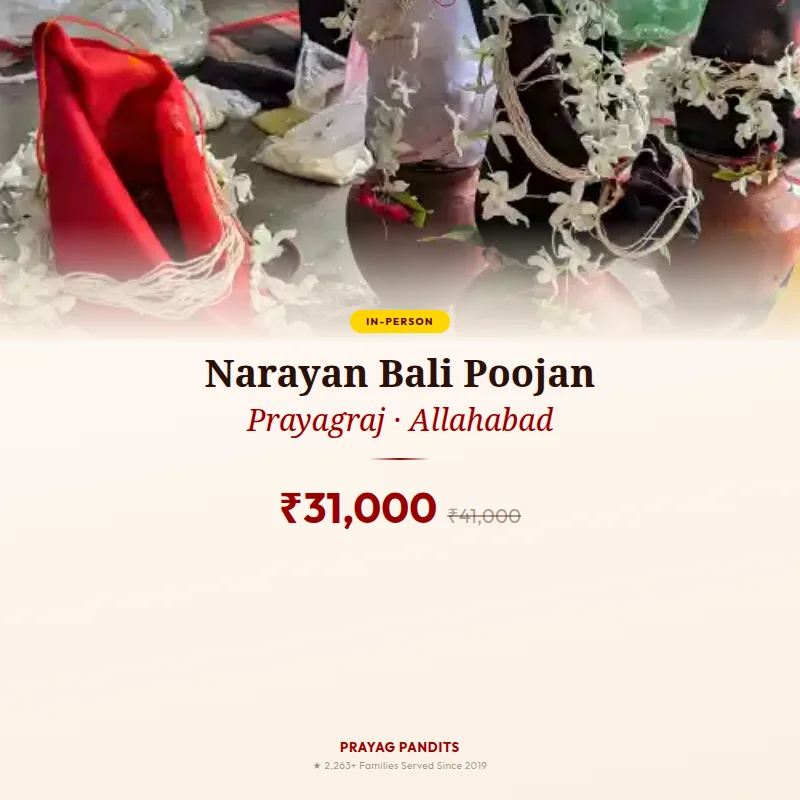
Narayan Bali Puja at Prayagraj costs ₹31,000 (regular price ₹41,000). This is a 3-day ceremony performed at the sacred Triveni Sangam by 3-5 experienced pandits. The price covers all pandit fees, extensive samagri for Narayan Bali and Nag Bali rituals, Brahmin bhoj for all 3 days, temple arrangements, and complete documentation. No hidden charges.