

What’s included
Included in your package
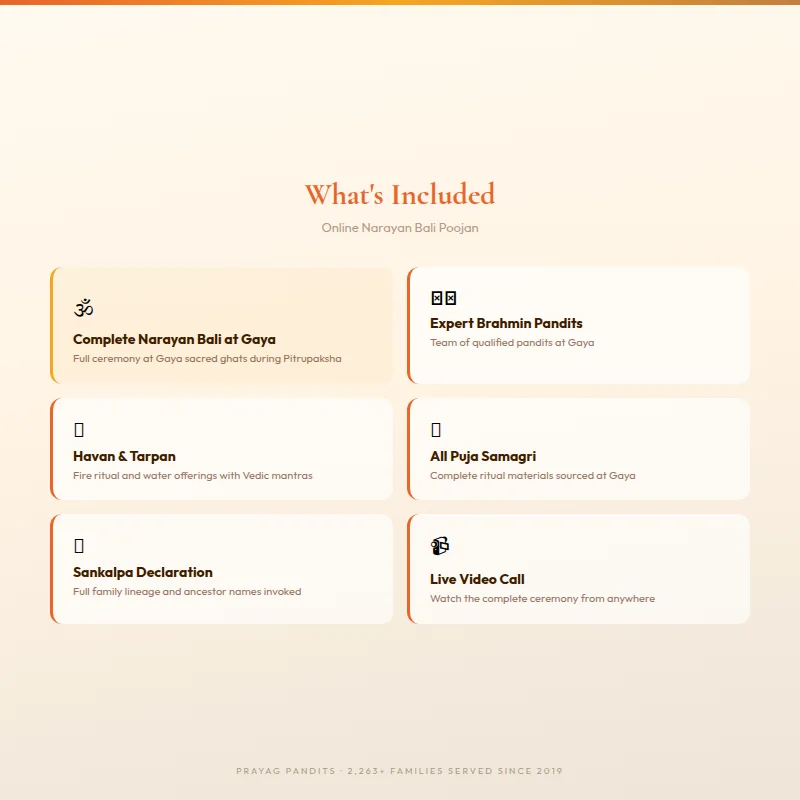
- Online Narayan Bali Poojan at Gaya live video, 4–5 hours
- Experienced pandit
- All samagri flowers, diya, til, kusha, rice, honey, sesame, sacred cloths
- Narayan Bali effigy constructed as per Vedic tradition
- 1 Brahmin Bhojan included as part of ritual completion
- Effigy immersion at Phalgu River
- Live video call + recorded meeting via Google Meet / Zoom within 72 hours
- Sankalpa + pre-ceremony consultation + post-ceremony follow-up
Not included in your package
- Physical travel or accommodation
- Additional rituals (Tripindi Shradh / Nagbali — separate)
- Temple / ghat donations (optional, at discretion)
- Extra Dakshina/Gifts/Donations made to the Priest/Pandit
How it works
Choose your pooja
Review your package and any available additions, then add it to your booking.
Share your preferences
Enter your contact details, preferred date and time. Add ancestral details if you wish.
We coordinate with you
Our team confirms the arrangements and shares your coordinator’s details 24 hours before the pooja.
Participate in your pooja
Follow the participation and joining arrangements described in your package and shared by your coordinator.
What families say after the rite
From families who booked Online Narayan Bali Poojan in Gaya Pitrupaksha 2026.
Rated 4.8 out of 5
500+ reviews · Prayag Pandits
This poojarated 4 out of 516 reviews
Our pandits
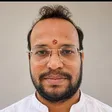
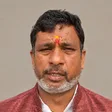


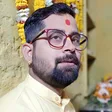
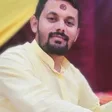
- 2,263+ families served
- Serving since 2019
- GST registered
Families on video
The player loads only when you press play.
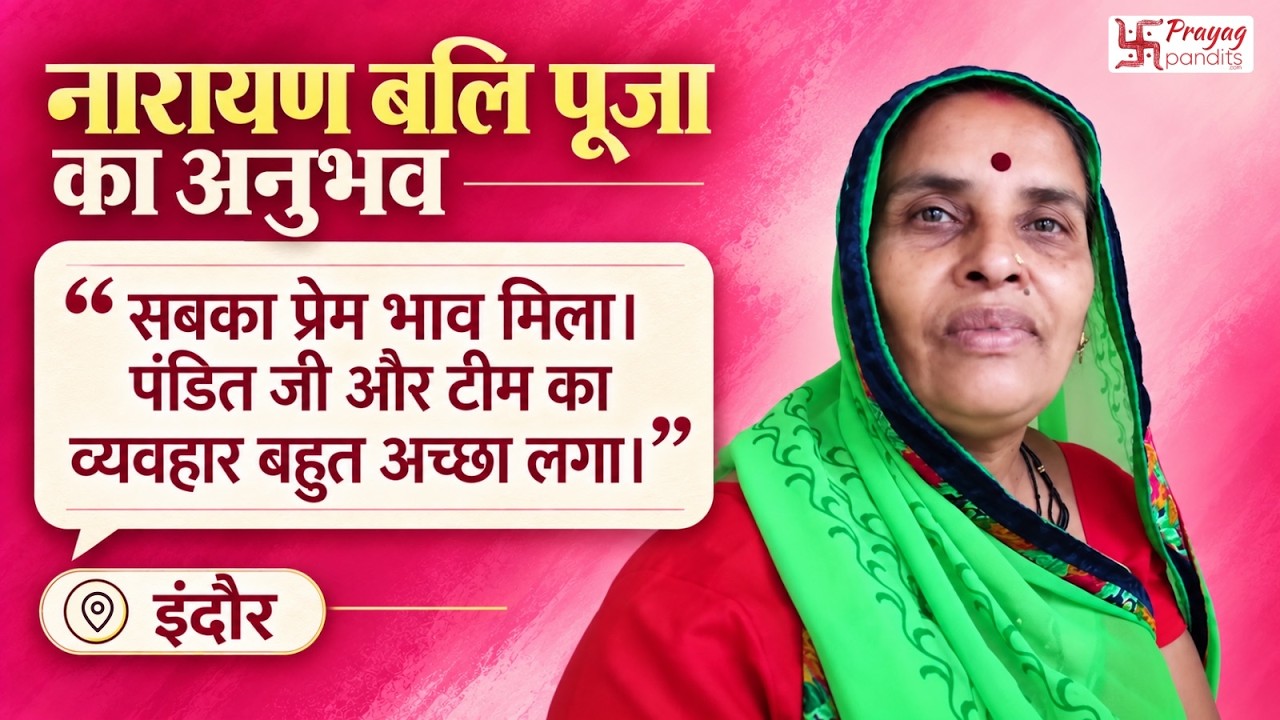


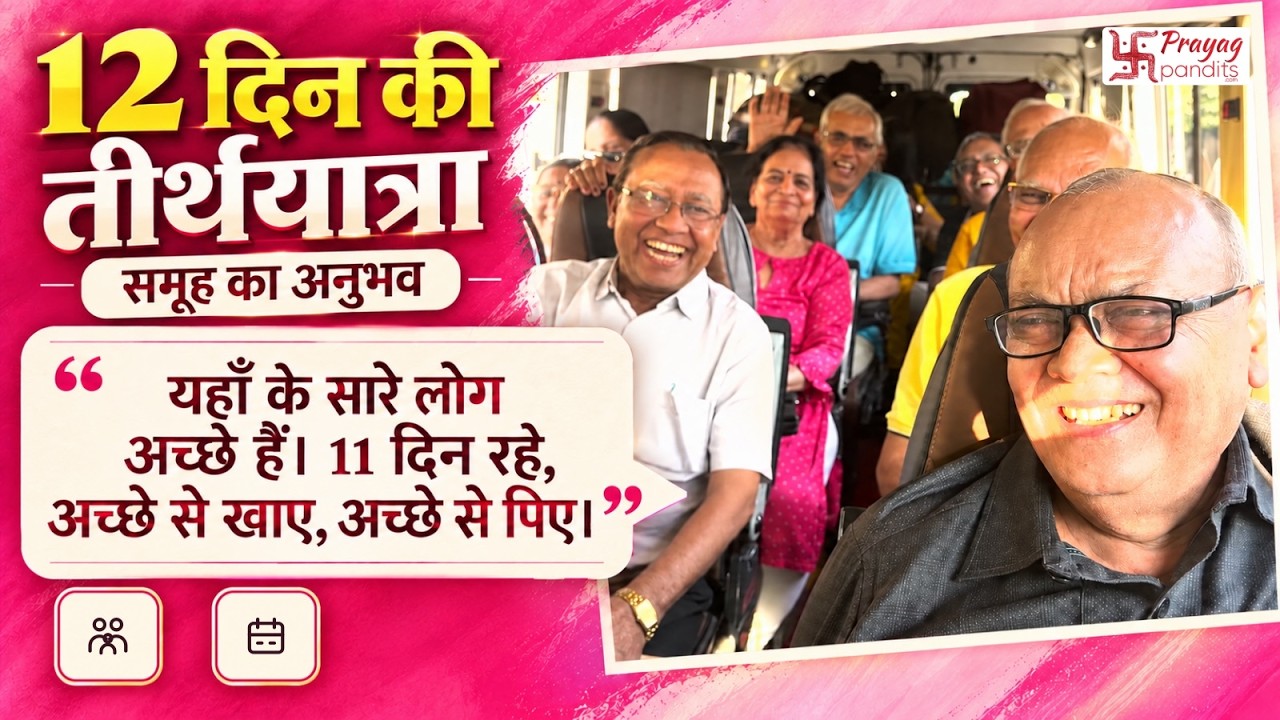
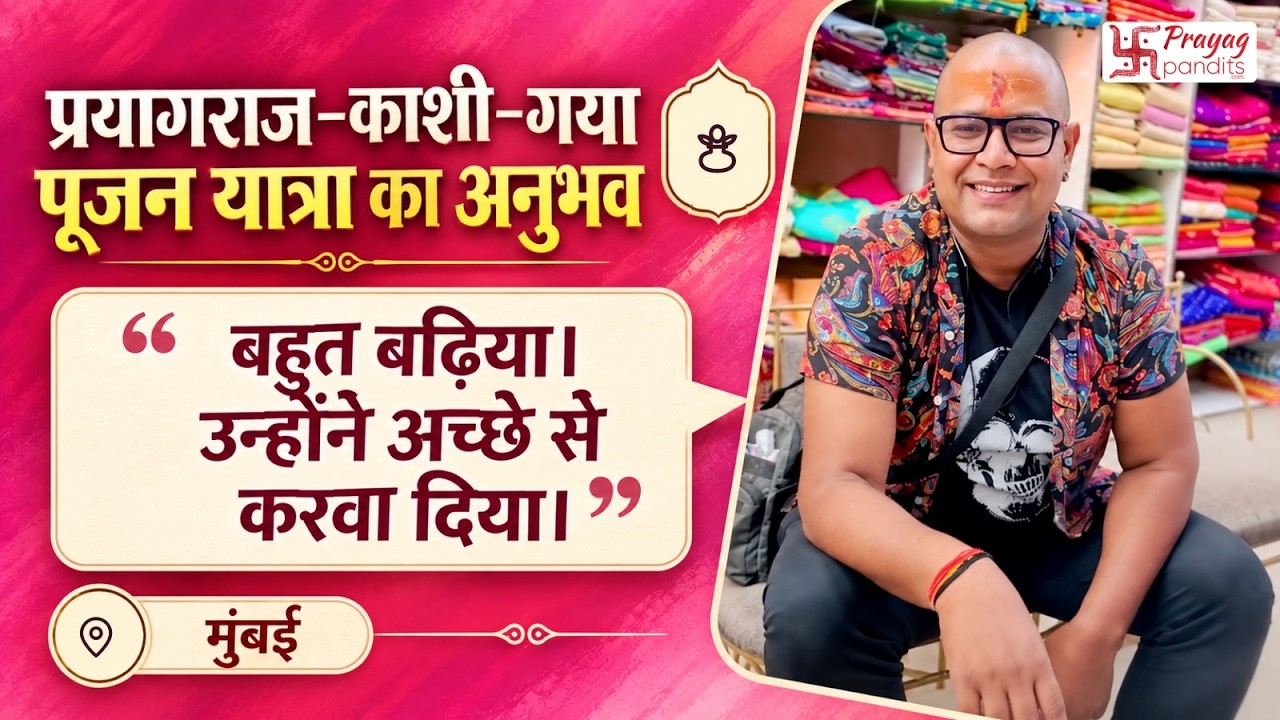
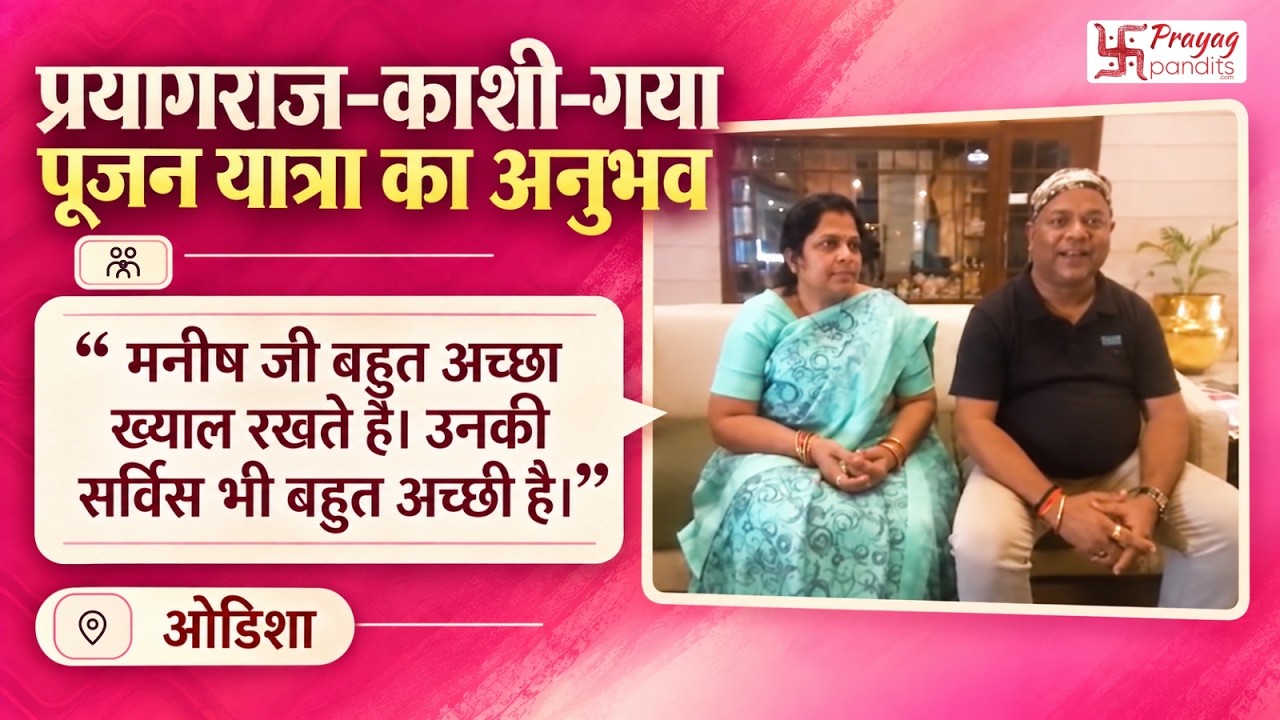
In their words
Narayan Bali is a very specific ritual and finding the right pandit was our main concern. Prayag Pandits connected us with an experienced purohit who had performed this poojan many times. Very satisfied. Dhanyavaad.
We performed Narayan Bali Poojan on the advice of our family pandit. The ceremony took the full day but Prayag Pandits managed everything perfectly. The senior pandit was very knowledgeable about this complex ritual. Dhanyavaad.
प्रयाग पंडित्स से दूसरी बार पूजा करवाई। दोनों बार अनुभव शानदार रहा। उनकी टीम पुराने ग्राहकों को याद रखती है और व्यक्तिगत ध्यान देती है। Dhanyavaad.
The Narayan Bali Poojan was conducted exactly as described in the Garuda Purana. All the required materials were arranged by the team. The 4-5 hour ceremony was performed with full devotion.
हमारे परिवार ने पहली बार ऑनलाइन पूजा करवाई। शुरू में थोड़ा संशय था लेकिन अनुभव बहुत अच्छा रहा। वीडियो कॉल की गुणवत्ता अच्छी थी और पंडित जी ने हमें पूजा में शामिल किया। Dhanyavaad.
We had been facing family issues for years and were advised to perform Narayan Bali. After the poojan at Gaya through Prayag Pandits, we felt a significant change in our household peace. Dhanyavaad.
Booked a rite with us? Tell other families how it went.
Write a reviewQuestions families ask
Gaya is one of the most sacred Hindu pilgrimage sites (Teertha Kshetras) and is especially renowned as a 'Mukti-Sthal' (place of salvation). It's believed that souls of the departed wander here, awaiting rituals from their descendants. Lord Vishnu himself is said to have granted salvation to Gayasur here, blessing the place for ancestral rites. Furthermore, Lord Rama performed Pind Daan for his father Dasharatha in Gaya. Due to these divine associations and its inherent sanctity, performing Narayan Bali in Gaya is believed to yield exceptionally potent results for the liberation of troubled souls.
The primary purpose is to provide liberation (Moksha) and peace (Shanti) to the souls of ancestors who died unnaturally. It aims to fulfill their lingering desires, release them from a state of suffering or wandering, prevent them from causing distress (Pitru Dosha) to their living descendants, and secure their blessings for the family's well-being, prosperity, and harmony.
While Narayan Bali can technically be performed in Gaya throughout the year (365 days), certain periods are considered more auspicious:
- Pitru Paksha: This 15/16 day period dedicated to ancestors is considered the most potent time. (In 2026, Pitru Paksha runs from 26 September to 10 October)
- Amavasya (New Moon), Poornima (Full Moon), Dwadashi (12th lunar day), Ashtami (8th lunar day).
- Specific auspicious Nakshatras (lunar mansions) like Kritika, Vishakha, Punarvasu, etc.
- Ideally, it can be performed on the 11th day after death, but it's often done later when the need arises or is identified.
- It should generally be avoided during Grahan (eclipse) days, Ekadashi, Ashtami, and Dashami (though some sources list Ashtami as auspicious, so clarification with the performing pandit is recommended).
The procedure is complex and best performed by experienced pandits. Key steps typically include:
- Sankalpa: Taking a vow to perform the ritual.
- Purification: Taking a holy bath (often in the Phalgu river).
- Puja: Worship of Lord Ganesh, Kalash Sthapana (establishing a sacred pot), invoking deities like Brahma, Vishnu, Rudra, Yama, and Savitr.
- Narayan Bali Homa: Fire ritual dedicated to Lord Narayan.
- Invoking the Soul: Using mantras to invoke the specific soul(s).
- Artificial Body: Creating a symbolic body (pind) usually from wheat flour. Rituals are performed allowing the soul to possess this body to fulfill desires
- Funeral Rites: Performing symbolic funeral rites for the artificial body to liberate the soul.
- Pinda Pradan: Offering rice balls.
- Tarpana: Offering water oblations.
- Brahmin Bhojan/Daan: Feeding Brahmins and giving charity (Dakshina).
The Phalgu River is considered extremely sacred for ancestral rites in Gaya. Taking a holy dip in the river for purification before the puja and performing parts of the ritual, like Tarpana (water offerings), on its banks is a common and important practice, believed to enhance the efficacy of the rites.
Yes. If you suspect an unnatural death or have visible symptoms of Pret Badha but do not have complete information, our pandit will perform a Sankalpa that covers all ancestral souls in your lineage who may be in need. You do not need to have documentary proof of the cause of death — the ritual works on the basis of spiritual intention and the force of the mantras.
No. The efficacy of Narayan Bali depends primarily on the Sankalpa — the declaration of intent that directs the merit to your family — the correct performance of the ritual by a qualified pandit, and the sacred power of the location. All three are fully present in this service. The Sankalpa explicitly names you and your family, ensuring the spiritual merit reaches you regardless of physical distance.
Yes. We encourage the participation of all immediate family members who wish to observe. You can share the video call link with family across different cities or countries. The more family members who witness and mentally participate in the Sankalpa, the stronger the collective intention.
In most cases, Narayan Bali is a one-time ceremony. Unlike annual Shradh, it is not meant to be repeated every year. However, if the astrologer or pandit identifies multiple ancestors in need, or if the Pitru Dosha is particularly severe, a Tripindi Shradh may be recommended alongside it. Our pandit will advise based on your specific situation during the pre-ceremony consultation.
On the day of the ritual, we ask that participating family members observe a personal fast or eat only light sattvic food (no meat, no alcohol), take a bath before joining the video call, light a diya at home, and maintain a respectful, meditative state of mind during the ceremony. You do not need to perform any separate rituals at home — the pandit’s work in Gaya covers the complete ceremony. Your mindful, intentional presence during the call is what is asked of you.
Still have a question?
Ask our team on WhatsApp and we will help you plan the ceremony.
We reply on WhatsApp within 1–2 hours.
Ask a pandit (opens WhatsApp)Know your ceremony
Some deaths leave behind more than grief. When a person dies suddenly in an accident, takes their own life, drowns, or is killed by violence, the soul does not always follow the natural path of departure. According to Vedic tradition, such souls — stripped of their final rites or taken before their time — can become trapped between worlds. They linger, unable to move forward, and their restlessness begins to affect the living family in ways that are difficult to explain: persistent illness, financial ruin, broken marriages, miscarriages, recurring nightmares, or an unshakeable sense of dread within the household. The condition is known as Pret Badha or Pitru Dosha of the most severe kind.
Narayan Bali Poojan is the Vedic remedy prescribed for exactly this situation. It is a full-day ceremony that creates a symbolic body (the “bali” or effigy) for the departed soul, performs proper last rites over it with Vedic mantras, and immerses that effigy into sacred waters — giving the soul the dignified departure it was denied. If you cannot travel to Gaya but your family needs this ritual performed during the most sacred window of Pitrupaksha 2026, our online service brings the complete ceremony to you through a live video call, performed by our experienced pandits at Gaya itself.
Of all the places in India where ancestral rites can be performed, Gaya holds a position unlike any other. The Garuda Purana states explicitly that Pind Daan performed at Gaya liberates ancestors who are trapped in lower realms, including those who died unnatural deaths. The city is considered the body of Lord Vishnu himself — specifically, the Vishnupad Temple marks the footprint of Vishnu, and the ground of Gaya is said to be charged with Vishnu’s liberating shakti (Vaikuntha shakti). This divine energy acts upon the soul’s karmic bindings and helps dissolve even the most difficult attachments to the material world.
Now combine this with Pitrupaksha — the 16-day period in the dark fortnight of Ashwin month (September 26 to October 10, 2026) when the Pitru Dwar, the gateway between the ancestral realm and our world, stands open. During this period, the Vedic tradition holds that ancestors actively draw closer to their descendants, and the spiritual merit of every ritual performed for them is multiplied many times over. The thinning of the veil between worlds during Pitrupaksha makes ancestral rites performed in Gaya during this period uniquely potent — not by superstition, but by the consistent testimony of the Puranas and the experience of countless families across generations.
Performing Narayan Bali at Gaya during Pitrupaksha 2026 is not merely a religious ceremony. It is a precise convergence of the right place, the right time, and the right ritual — directed with complete focus on liberation for your ancestor’s soul.
The ritual is designed to address several interlinked spiritual problems simultaneously:
- Pret Yoni liberation: Souls who died in accidents, by suicide, drowning, murder, or sudden death often enter a state called Pret Yoni — a limbo existence between death and rebirth. Narayan Bali specifically creates the conditions for these souls to exit this state.
- Proper last rites for incomplete funerals: If the original funeral was rushed, incomplete, performed incorrectly, or not performed at all (as sometimes happens in emergencies or when bodies are not recovered), Narayan Bali gives the soul a second, properly executed departure.
- Resolution of severe Pitru Dosha: When a family has been suffering from Pitru Dosha — particularly the symptoms connected to unnatural ancestral deaths — this ritual works at the root cause rather than the surface.
- Removal of Pret Badha: Ghostly afflictions affecting the household, unusual patterns of misfortune, and the particular form of suffering caused by a trapped ancestral soul can be addressed through this ceremony.
- Restoration of ancestral blessings: When ancestors are at peace and in their rightful place in the higher realms, their blessings flow naturally toward the living family — supporting health, prosperity, and clarity of direction in life.
The clearest indicators that Narayan Bali may be needed include:
- An ancestor who died in an accident, by drowning, by fire, by suicide, or was murdered
- An ancestor whose body was not recovered, or whose last rites were performed improperly or incompletely
- A family member who died young or suddenly without anyone being present
- Recurring miscarriages or fertility problems with no medical explanation
- Persistent financial decline despite genuine effort
- Repeated broken relationships or marriages in the family
- Unexplained illness affecting multiple family members across generations
- Nightmares or a persistent sense of heaviness and dread within the home
- An astrologer has identified Pret Badha or severe Pitru Dosha in the horoscope
If any of these apply, book a consultation with our pandit team before Pitrupaksha 2026. We will help you determine whether Narayan Bali alone is sufficient, or whether it should be paired with our Prayagraj-based Narayan Bali service or another complementary rite.
We understand that traveling to Gaya during Pitrupaksha is not always possible — due to distance, health, age, professional obligations, or the sheer difficulty of arranging travel during one of the busiest pilgrimage periods of the year. The online format was created specifically to ensure that no family is denied access to this ritual because of practical constraints.
The ceremony proceeds in the following sequence:
Before the Ritual Day
Once you book, our pandit team contacts you to gather the necessary information: the name and details of the ancestor for whom the ritual is being performed, the circumstances of their death (to the best of your knowledge), and your family’s gotra. A pre-ceremony consultation is included, during which our pandit will explain the ritual’s significance, what to expect on the day, and any personal preparations you should make at home.
On the Day of the Ritual
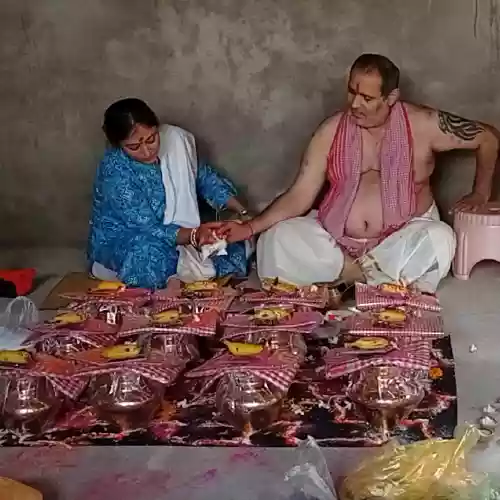
The ceremony begins early in the morning in Gaya. You join via a live video call — the link is shared with you the previous evening. The pandit first performs Sankalpa, the sacred declaration of intent, naming you and your family specifically. This Sankalpa is what ensures the merit of the ritual reaches you directly, regardless of physical distance.
The pandit then constructs the Narayan Bali effigy — a representation of the trapped soul made according to Vedic specifications — and performs the complete sequence of last rites over it with Vedic mantras. Throughout the 4 to 5 hours of the ceremony, you and your family members can watch, participate in prayers from your location, and observe the proceedings in real time.
The ritual concludes with the effigy being immersed in the sacred waters of Phalgu River at Gaya — the same river where Lord Rama himself performed Pind Daan for his father, Dasharatha. This immersion is the moment of liberation — the trapped soul is symbolically released and given passage forward.
After the Ritual
Our pandit team is available for a follow-up conversation to explain what was performed and to answer any questions about next steps or additional practices you can do at home to strengthen the work done.
Pitrupaksha 2026 runs from September 26 (Purnima) to October 10 (Sarva Pitru Amavasya). Bookings for the online ceremony are limited, as each slot requires a dedicated pandit and a specific time on the Gaya ghats. We recommend booking at least 3 to 4 weeks before your desired date. Slots fill quickly, particularly in the second week of Pitrupaksha as Sarva Pitru Amavasya approaches.