




What’s included
Included in your package
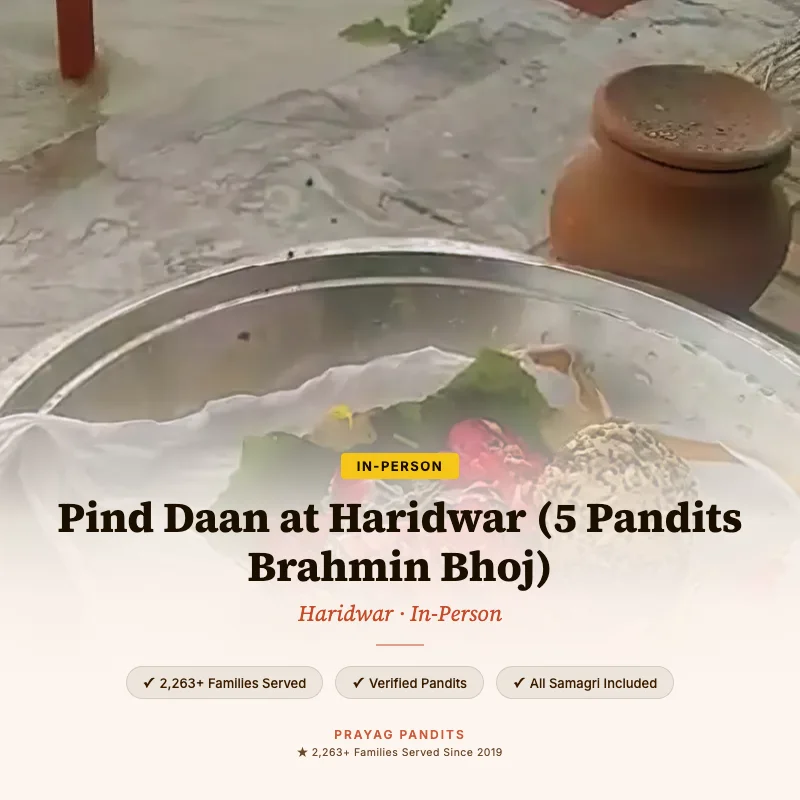
- Pind Daan at Har Ki Pauri, Haridwar
- 5 experienced Pandits
- Complete samagri til, kusha, Gangajal, flowers
- Tarpan with three-generation ancestor invocation
- Brahmin Bhoj for the 5 Pandits after pooja completion
Not included in your package
- Travel to Haridwar
- Accommodation in Haridwar
- Airport / station pickup & drop
- Personal meals (Brahmin Bhoj is separate)
- Gau Daan (available as add-on)
- Photography / videography
- Extra Dakshina/Gifts/Donations made to the Priest/Pandit
This is not a Daswa Pind Daan package.
How it works
Choose your pooja
Review your package and any available additions, then add it to your booking.
Share your preferences
Enter your contact details, preferred date and time. Add ancestral details if you wish.
We coordinate with you
Our team confirms the arrangements and shares your coordinator’s details 24 hours before the pooja.
Participate in your pooja
Follow the participation and joining arrangements described in your package and shared by your coordinator.
What families say after the rite
From families who booked Pind Daan at Haridwar (5 Pandits Brahmin Bhoj).
Rated 4.8 out of 5
500+ reviews · Prayag Pandits
This poojarated 4.3 out of 516 reviews
Our pandits






- 2,263+ families served
- Serving since 2019
- GST registered
Families on video
The player loads only when you press play.



In their words
हमने गया जी में पिंडदान करवाया। पंडित जी ने विष्णुपद मंदिर से लेकर फल्गु नदी तक सभी स्थानों पर विधि-विधान से पूजा करवाई। बहुत शांति मिली। 🙏
Excellent experience. We were worried about how to perform Pind Daan from abroad but the online option made it possible. The live video call was clear and we could participate in real time. The pandit was patient and answered all our questions.
Third time booking with Prayag Pandits. Always reliable service. The pandits are well versed in the scriptures and perform rituals with full devotion. The pricing is fair and transparent. No hidden charges. Om Shanti.
Very authentic Vedic ceremony. All materials were included as promised. Will definitely use their services again.
Very professional service. The pandit ji explained every step of the ritual which helped us understand the significance. Everything was arranged well including the samagri. We are grateful to Prayag Pandits for making this spiritual journey meaningful. Om Shanti.
Outstanding service for Pind Daan. The pandit arrived early, set up everything neatly, and began the ceremony right on time. His pronunciation of Sanskrit shlokas was impeccable. Very authentic experience.
Booked a rite with us? Tell other families how it went.
Write a reviewQuestions families ask
Haridwar, meaning "Gateway to God," is one of the seven holiest places (Sapta Puri) in Hinduism. Its significance for Pind Daan stems from several factors:
- Presence of the Holy Ganges: The River Ganges begins its journey across the plains from Haridwar, making its waters exceptionally pure here. Performing rituals on its banks is believed to cleanse sins and grant salvation (Moksha) to ancestors.
- Mythological Significance: Legend states that drops of Amrit (elixir of immortality) fell in Haridwar during the Samudra Manthan, making the location sacred. Performing Pind Daan here is believed to leverage this sacredness for ancestral peace.
- Gateway to Char Dham: As the starting point for the Char Dham Yatra, Haridwar possesses a deep spiritual aura conducive to ancestral rites.
- Belief in Liberation: Hindus believe performing Pind Daan in Haridwar helps the departed soul transition smoothly from Pretlok (spirit world) to Pitralok (ancestral realm) and ultimately attain Moksha. It's also believed to bring good health and prosperity to the performer.
Several sacred Ghats (river banks) and temples in Haridwar are specifically used for Pind Daan:
- Kushavarta Ghat: This is considered the primary and often the best site for Pind Daan ceremonies in Haridwar.
- Har Ki Pauri: While famous for Ganga Aarti, Har Ki Pauri (especially the Brahma Kund area within it) is also a prominent and highly auspicious location for Pind Daan.
- Narayani Shila Temple: Located near Mayapur, this temple dedicated to Lord Vishnu houses a sacred stone (Shila) specifically associated with ancestral rites (Pitra Karma). Pind Daan here is considered very potent for appeasing ancestors and resolving Pitru Dosh.
- Vishnu Ghat: Being dedicated to Lord Vishnu (protector and preserver), this ghat is also suitable for Shraddha and Pind Daan rituals.
- Gau Ghat: Popular for rituals aimed at the salvation of departed souls.
- Kankhal Sati Ghat: While principally known for Asthi Visarjan (ash immersion), some rites related to ancestors are also performed here.
The general process, guided by a Pandit in Haridwar, usually involves:
- Purification: Taking a holy bath (Snan) in the Ganges River at one of the designated Ghats.
- Wearing Appropriate Attire: Donning clean, white traditional clothes like a dhoti and kurta.
- Sankalpa: Making a vow or resolution to perform the ritual for specific ancestors.
- Invocation: Praying to deities like Lord Ganesha and Lord Vishnu, and invoking the ancestors.
- Pinda Preparation: Making Pindas (round balls) typically from rice flour, barley flour, honey, ghee, milk, and black sesame seeds.
- Pinda Offering: Offering the prepared Pindas to the ancestors while chanting specific mantras provided by the Pandit. Seven pinds are often offered, with one specifically for the recently deceased.
- Tarpan: Offering water mixed with black sesame seeds to quench the thirst of ancestral spirits.
- Brahmin Bhoj (Optional but recommended): Offering food to Brahmins, which is believed to satisfy the ancestors further.
- Dakshina: Offering fees/gifts to the presiding Pandit.
Traditionally, Pind Daan is performed by the eldest son. However, other male relatives like younger sons, grandsons, brothers, or nephews can also perform it. Importantly, if no suitable male relatives are available or willing, female relatives such as daughters, wives (widows), or mothers can perform Pind Daan in Haridwar.
This is primarily an in-person ceremony, designed for families who can travel to Haridwar. The full value of the five-pandit ceremony and Brahmin Bhoj is best experienced when the primary Karta is physically present. However, if travel is not possible, we can arrange the ceremony on your behalf with you witnessing via video call, similar to our online packages. Please contact us directly to discuss this option if physical presence is not feasible.
The number five is not arbitrary in Vedic ritual — it corresponds to the Pancha Prana (five vital energies) and the Pancha Bhuta (five elements) that form the basis of both the living body and the offerings made in ceremony. A five-priest ceremony has a traditional basis in amplified-scale Vedic rituals that goes back to the Yajurveda’s description of large-scale Shradh ceremonies. Three priests is a common middle option; seven would be appropriate for even more complex situations like Narayan Bali. For standard Pind Daan at maximum quality, five represents the ideal combination of completeness and proportion.
Absolutely, and we encourage it. Haridwar and Rishikesh are 24 kilometers apart and are easily combined into a single 2-3 day trip. We do not book accommodation or transport, but we are happy to recommend trusted options. The Pind Daan ceremony itself typically requires half a day, leaving ample time for additional pilgrimage activities during your Haridwar visit.
Performing Pind Daan at Gaya is complete in its own right — the Garuda Purana’s prescription for Gaya leaves nothing uncertain about its efficacy. Haridwar is a separate tirtha with its own spiritual character and scriptural basis, not a supplementary step after Gaya. Many families perform Pind Daan at multiple tirthas over the years as an expression of continued care for their ancestors, not because any single ceremony was insufficient. If you have already done Gaya, Haridwar adds the distinct blessing of the “first-touch” Ganga water and Vishnu’s footprint at Har Ki Pauri to your family’s ancestral rites.
For Pitrupaksha 2026 (September 26 to October 10), we recommend booking at least 3 to 4 weeks in advance. Haridwar receives a very large number of pilgrims during Pitrupaksha, and our five-pandit team has limited capacity for concurrent ceremonies. The last few days of Pitrupaksha — particularly Sarva Pitru Amavasya on October 10 — are especially high-demand. For those planning a visit around Sarva Pitru Amavasya specifically, booking 6 to 8 weeks ahead is advisable.
Still have a question?
Ask our team on WhatsApp and we will help you plan the ceremony.
We reply on WhatsApp within 1–2 hours.
Ask a pandit (opens WhatsApp)Know your ceremony
In the geography of Hindu pilgrimage, Haridwar occupies a position that no other city can replicate. This is where the Ganga leaves the Himalayas and touches the plains of India for the first time — where the river, having descended from Gangotri through the mountains, arrives finally at Har Ki Pauri, the ghat that carries Lord Vishnu’s own footprint imprinted in stone. The water here is mountain-cold, visibly clear, and carries the full accumulation of everything the Ganga has passed through from its glacial source: the energy of the peaks, the blessing of the Char Dham, the sanctity of a river that has never yet touched the earth of human habitation.
For Pind Daan, this quality of the Ganga matters deeply. The Puranas describe the water at Har Ki Pauri as “pratham sparsha Gangajal” — the first-touch Ganga water, the most potent form of the sacred river because it arrives at this point in its most spiritually concentrated state, before dispersing across the plains. Pind offerings immersed in this water are believed to reach the ancestors with particular speed and clarity.
This premium package at ₹31,999 is distinguished from standard Haridwar Pind Daan services by two features: five qualified pandits performing the ceremony simultaneously, and Brahmin Bhoj — the feeding of Brahmins that the Vishnu Purana identifies as an essential component of complete ancestral rites.
The name “Har Ki Pauri” translates as “the steps of Hari (Vishnu).” According to tradition, Vishnu left his footprint imprinted in a stone slab at this ghat, and the stone remains visible today — the most visited and revered spot on Haridwar’s ghats. The Skanda Purana’s Kedar Khanda section describes Har Ki Pauri as one of the most sacred spots on earth for all forms of ancestral rites, specifically because Vishnu’s physical presence — his footprint — is still accessible there.
The ghat is also the site of Haridwar’s famous evening Ganga Aarti, a ceremony that draws thousands of devotees every evening to watch priests swing lit lamps over the river while Vedic hymns rise over the water. But for those performing Pind Daan, the morning hours at Har Ki Pauri — before the crowds gather, when the water is at its coolest and clearest — are considered the most auspicious time.
Your Pind Daan ceremony is arranged for this morning window, at the designated ritual platform at Har Ki Pauri, by our five-pandit team who are permanently stationed in Haridwar and intimately familiar with the ghat’s ritual geography.
Most Pind Daan services, whether at Haridwar or elsewhere, use a single priest. A single qualified priest is entirely capable of performing a complete and valid Pind Daan ceremony — the ritual’s efficacy does not depend on the number of priests. The five-pandit format of this package accomplishes something different: it amplifies.
In Vedic ritual theory, the concept of “avrthi” (repetition of mantras) and “bahula” (multiplicity of performers) increases the resonance of a ceremony in the same way that multiple instruments playing in harmony create a sound more powerful than any single instrument. When five priests simultaneously recite the Pind Daan mantras — the Yajurveda’s Pitru Suktas, the Tarpan mantras, the Sankalpa — the sound vibration fills the ritual space at a different level of intensity. The ancestors are believed to receive this amplified call with greater ease, particularly those who have been long unremembered or who are in difficult states in the afterlife.
There is also a more straightforward benefit: with five priests dividing the different components of the ceremony, the ritual can cover a broader range of the traditional Pind Daan sequence without time compression. The Sankalpa is performed once, but the subsequent Tarpan, pinda preparation, mantra recitation, and offering can all proceed simultaneously across different aspects of the ceremony, resulting in a more complete and unhurried ritual.
The inclusion of Brahmin Bhoj in this package is not an add-on or a luxury feature — it is a scriptural requirement for complete ancestral rites that many Pind Daan services omit for the sake of simplicity. The Vishnu Purana states this plainly: “Brahmin bhojanam shradhhasya purnatvam” — the feeding of Brahmins is what makes a Shradh ceremony complete. The Manu Smriti echoes this, specifying that Shradh performed without feeding at least one Brahmin is like offering food without a recipient.
The reasoning is rooted in a specific Vedic understanding of the relationship between the physical and the ancestral realms. The living Brahmins who receive the meal at Brahmin Bhoj are considered, in the ritual context, to be the ancestors themselves manifesting in living form to receive the nourishment. This is not symbolic language — it is a precise description of what the ceremony is designed to accomplish. The ancestors, who cannot eat physical food in the afterlife, receive the nourishment through the Brahmins who eat on their behalf.
Brahmin Bhoj for this package is arranged with qualified Brahmins at an established location in Haridwar, conducted with the proper ceremonial protocols — the meal is prepared according to traditional requirements, the Brahmins are seated facing the appropriate direction, the Sankalpa is performed in the names of your ancestors, and the completion prayers are said after the meal. You receive documentation of this component as part of your ceremony completion report.
The choice between Haridwar and Gaya for Pind Daan is not a question of one being superior to the other — they hold different kinds of spiritual authority and serve different family circumstances well.
Haridwar’s primary advantage is the Ganga itself. Gaya’s Phalgu River, while sacred, is a dry-bed river for much of the year — offerings are made to its sands rather than to flowing water. Haridwar’s Ganga is always present, always flowing, always mountain-fresh. For families whose tradition places particular emphasis on the Ganga as the vehicle of ancestral liberation, Haridwar’s ceremony carries a quality that Gaya’s cannot replicate.
Accessibility is another practical factor. Haridwar is connected to Delhi by a direct 6-hour train journey, has a well-developed pilgrimage infrastructure, and is situated in Uttarakhand’s well-connected tourism corridor. For families who want to combine the Pind Daan with other Char Dham pilgrimage activities or who are visiting North India, Haridwar integrates naturally into the itinerary in a way that Gaya does not.
Haridwar also has a long history of being associated with the Kumbh Mela — occurring every 12 years (the last major Kumbh was 2021, the next will be 2033) and the Ardh Kumbh every 6 years. The spiritual momentum accumulated by the city over generations of the world’s largest religious gathering makes its waters and grounds a site of extraordinary concentrated merit. You can read more about related Pind Daan options we offer in our Shradh Poojan in Haridwar service page.
Before arriving in Haridwar, the primary Karta (the family member performing the rites) should prepare a list of ancestor names and gotras covering the paternal side across at least three generations. Names of ancestors on the maternal side may also be included — the Sankalpa allows for both lineages to be covered within the same ceremony. If gotra information is unavailable, the Kashyapa gotra is conventionally used as a substitute, and your priest will advise on this.
The Karta traditionally observes celibacy and a vegetarian diet for at least one day before the ceremony. White or light-colored clothing is conventional. There is no requirement for fasting on the day itself — physical presence and mental focus during the ceremony are what matter most.
If you are traveling with family members who are in a state of ritual impurity (recent childbirth, active menstruation), they may be present as witnesses but should not participate in the Sankalpa as co-Kartas. Your priest will guide you on any other specific considerations based on your family’s tradition.
The Kedar Khanda of the Skanda Purana devotes substantial text to Haridwar’s significance for ancestral rites. One passage describes the city as “dvara mukta” — the doorway to liberation — specifically because it is the point where the Ganga arrives at the human world from the divine mountains. Offerings placed in the Ganga at Haridwar are described as entering the river at the point of maximum divine concentration, before the water disperses into the plain and mingles with earthly influences.
The Vishnu connection at Har Ki Pauri adds another dimension. The footprint of Vishnu means that Vishnu’s attention is, by tradition, perpetually directed at this spot. Pind offerings made in Vishnu’s sight at this ghat carry an implicit petition to the Lord himself to assist in the liberation of the named ancestors. Combined with five-priest amplification and the completion of Brahmin Bhoj, this ceremony fulfills every major scriptural criterion for complete ancestral rites at this tirtha.