




What’s included
Included in your package
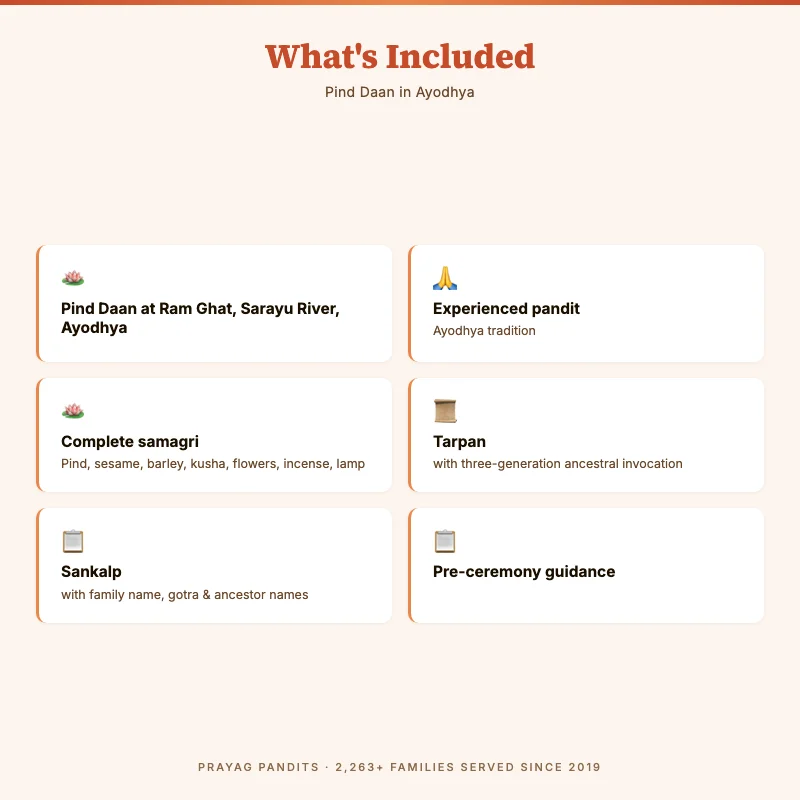
- Pind Daan at Ram Ghat, Sarayu River, Ayodhya
- Experienced pandit Ayodhya tradition
- Complete samagri Pind, sesame, barley, kusha, flowers, incense, lamp
- Tarpan with three-generation ancestral invocation
- Sankalp with family name, gotra & ancestor names
- Pre-ceremony guidance
Not included in your package
- Travel to Ayodhya
- Accommodation
- Station / airport pickup & drop
- Ram Janmabhoomi darshan (separate)
- Photography / videography
- Extra Dakshina/Gifts/Donations made to the Priest/Pandit
This is not a Daswa Pind Daan package.
How it works
Choose your pooja
Review your package and any available additions, then add it to your booking.
Share your preferences
Enter your contact details, preferred date and time. Add ancestral details if you wish.
We coordinate with you
Our team confirms the arrangements and shares your coordinator’s details 24 hours before the pooja.
Participate in your pooja
Follow the participation and joining arrangements described in your package and shared by your coordinator.
What families say after the rite
From families who booked Pind Daan in Ayodhya.
Rated 4.8 out of 5
500+ reviews · Prayag Pandits
This poojarated 4.7 out of 518 reviews
Our pandits








- 2,263+ families served
- Serving since 2019
- GST registered
Families on video
The player loads only when you press play.


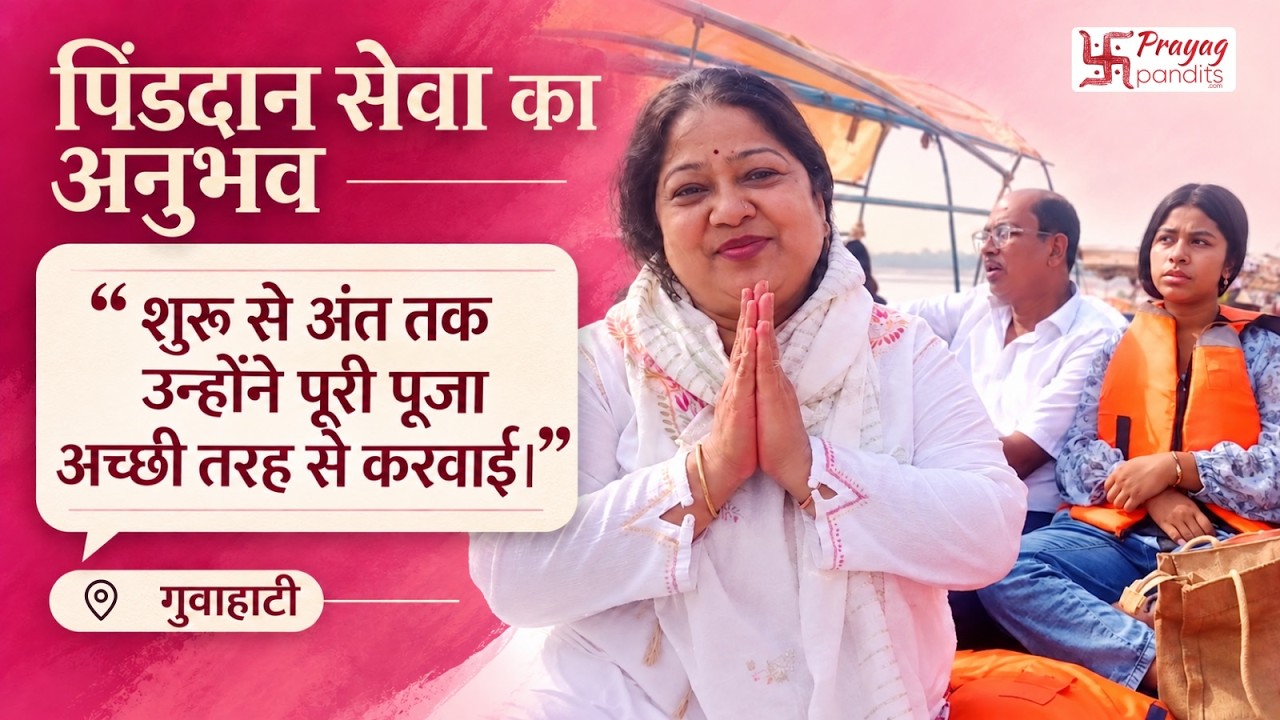

In their words
पितृपक्ष में पिंडदान करवाया। पूरी व्यवस्था उत्तम थी। पंडित जी समय पर आए और सभी विधि-विधान पूर्ण भक्तिभाव से सम्पन्न करवाए। प्रसाद वितरण भी अच्छा था।
The coordination was excellent. We received all details well in advance. The puja was performed exactly as described.
पिंडदान की पूरी व्यवस्था बहुत अच्छी थी। पंडित जी ने सभी मंत्रों का सही उच्चारण किया और हर विधि को विस्तार से समझाया। परिवार के सभी सदस्य संतुष्ट हैं। प्रयाग पंडित्स की सेवा सराहनीय है। Jai Shri Ram.
Outstanding service for Pind Daan. The pandit arrived early, set up everything neatly, and began the ceremony right on time. His pronunciation of Sanskrit shlokas was impeccable. Very authentic experience.
We booked Pind Daan for our late father's shradh ceremony. The pandits were very knowledgeable and performed all rituals with proper Vedic mantras. The whole family felt at peace after the poojan. Highly recommended for anyone looking for authentic rituals. Om Shanti.
Smooth experience from start to finish. The live video call gave us peace of mind that everything was done correctly.
Booked a rite with us? Tell other families how it went.
Write a reviewQuestions families ask
Pitrupaksha, the 15-day period in the Hindu month of Bhadrapada (typically September), is the most important time for Pind Daan at any tirtha. During Pitrupaksha, the veil between the living and the ancestral realm is considered thinner, and any rite performed in this period carries heightened merit. In Ayodhya, Pitrupaksha observances at Ram Ghat are attended by large numbers of pilgrims. Beyond Pitrupaksha, each monthly Amavasya (new moon) is auspicious for ancestral rites, as are the death anniversaries of departed family members.
Our pandit provides all the ritual samagri, so you do not need to arrange any ceremonial items. You should bring a change of clothes for after the ritual bath in the Sarayu River. Wear simple, clean clothing — preferably white or light-coloured, as is traditional for ancestral rites. Bring a list of the names and gotras of your ancestors if you have them. If you do not know the gotras, that is not an obstacle — the pandit has alternative Sankalp phrases for this.
Yes. The standard ceremony covers the three preceding generations — parents, paternal grandparents, and paternal great-grandparents, with maternal lineage also included. If you have specific ancestors from further back whom you wish to honour by name, this can be accommodated. Many families also request a collective Sankalp for all ancestors whose names are not known — this is entirely proper and is provided for in the traditional ritual framework.
The standard Pind Daan ceremony at Ram Ghat is typically completed in around 30–45 minutes. Family-specific requirements may affect the exact finish time. We recommend arriving at the ghat no later than 8 AM, as the forenoon period before noon is the traditional and most auspicious time for the rite.
Yes. Our pandits are accustomed to working with families from different parts of India and with diaspora families who speak Tamil, Telugu, Gujarati, Marathi, or English. The mantras are in Sanskrit and will be recited by the pandit. The Sankalp portions that require your verbal participation can be translated and explained to you so you understand what you are affirming. Many families find that hearing the Sanskrit recitations at the ghat — even without full comprehension of every word — is itself a profound experience.
Still have a question?
Ask our team on WhatsApp and we will help you plan the ceremony.
We reply on WhatsApp within 1–2 hours.
Ask a pandit (opens WhatsApp)Know your ceremony
Ayodhya is among the most sacred cities in Hindu tradition — one of the Sapta Puri, the seven holy cities that grant liberation. It is the birthplace of Lord Rama, the city of the Raghu dynasty, and the place where the Sarayu River flows with the quiet power of countless generations of devotion. To perform Pind Daan in Ayodhya is to give your ancestors the gift of liberation in the very city where dharma was most perfectly lived.
Our in-person Pind Daan in Ayodhya service is priced at ₹11,000. You travel to Ayodhya, and our experienced pandit meets you at the Sarayu Ghat to conduct the full ceremony with all required samagri. This is a complete, physically attended ceremony — not a proxy service.
Not every place on earth carries the same weight for ancestral rites. The tradition of tirtha-shraddha — performing Shradh and Pind Daan at sacred sites — rests on the understanding that the sanctity of a place amplifies the effect of the ceremony. Among all tirthas, those associated with Lord Vishnu’s avatars hold a special place in this tradition.
Ayodhya derives its status for Pind Daan from a specific scriptural event: Lord Rama himself performed the Shradh ceremony for his father King Dasharatha on the banks of the Sarayu. This is recorded in Valmiki Ramayana. When the ideal king — who is simultaneously the ideal son and the seventh avatar of Vishnu — performs pitru karma at a particular location, that location becomes marked in the consciousness of the tradition as the right place for this rite. Pilgrims have returned to the Sarayu ghats for this purpose for thousands of years, following directly in the path that Rama traced.
The Sarayu River itself is not described in the texts as an ordinary river. It is said to be a celestial river that descended from the higher realms. Ancestors receive what is offered here through a channel that transcends ordinary earthly distance.
The primary site for Pind Daan in Ayodhya is Ram Ghat on the Sarayu River. This ghat has been the center of ritual life in Ayodhya for as long as the city has been a place of pilgrimage. It is the ghat where the Raghu dynasty performed their daily ritual bathing, where the ashes of Rama’s lineage were consigned to the Sarayu, and where pilgrims come today from every part of India to pay their respects to the ancestors.
Ram Ghat is well-maintained, accessible, and carries an atmosphere of composed reverence that is well-suited to the solemnity of Pind Daan. There are no crowds of tourist activity here — this is a working ghat dedicated to ritual, not commerce. You will find other families performing their own ancestral rites alongside yours, which in itself is a reminder that the thread connecting the living to the departed is universal.
When you arrive at the ghat, our pandit will be waiting for you. The ceremony proceeds in the following sequence:
Arrival and Preparation
- You take a ritual bath in the Sarayu River before the ceremony begins — this is both an act of purification and a way of formally entering the sacred space
- The pandit arranges the samagri on a wooden plank at the ghat’s edge
- You take a seat facing the river, with the pandit at your side
Sankalp
- The Sankalp is the most critical moment of the ceremony. The pandit leads you through a declaration that names you, your gotra, the date according to the Hindu calendar, the location (Ayodhya, Sarayu River, Ram Ghat), and the specific ancestors for whom the rite is being performed
- The Sankalp binds the ceremony to your lineage and to the specific souls you are honoring
Pind Nirmaan and Pind Daan
- The pinds are prepared at the ghat from barley flour, sesame seeds, honey, and other prescribed ingredients
- Each pind is shaped and offered with the recitation of the specific Pitru mantras
- Pinds are placed on kusha grass and then consigned to the Sarayu River at the appropriate moment in the ritual
Brahmin Bhojan and Dakshina
- The ceremony concludes with an offering of food or dakshina to a brahmin in the name of the ancestors
- Additional pujas beyond the Pind Daan ceremony — if you wish to add a Rudrabhishek or other service, please mention this at booking