



What’s included
Included in your package
- Pind Daan at Har Ki Pauri, Haridwar
- Experienced Haridwar-based pandit Pitrupaksha rites
- All samagri Pind materials, sesame, Kusha, Gangajal, flowers, sacred thread
- Tarpan with ancestral invocation
- Pitru Stotras recitation
- Pre-ceremony consultation for Gotra & ancestral details
- On-site guidance & post-ceremony guidance
Not included in your package
- Travel to Haridwar (flights, trains, road)
- Accommodation in Haridwar
- Asthi Visarjan / additional rites beyond Pind Daan (separate)
- Additional family groups (separate bookings)
- Extra Dakshina/Gifts/Donations made to the Priest/Pandit
This is not a Daswa Pind Daan package.
How it works
Choose your pooja
Review your package and any available additions, then add it to your booking.
Share your preferences
Enter your contact details, preferred date and time. Add ancestral details if you wish.
We coordinate with you
Our team confirms the arrangements and shares your coordinator’s details 24 hours before the pooja.
Participate in your pooja
Follow the participation and joining arrangements described in your package and shared by your coordinator.
What families say after the rite
From families who booked Pind daan in Haridwar this Pitrupaksha 2026.
Rated 4.8 out of 5
500+ reviews · Prayag Pandits
This poojarated 4.5 out of 521 reviews
Our pandits







- 2,263+ families served
- Serving since 2019
- GST registered
Families on video
The player loads only when you press play.


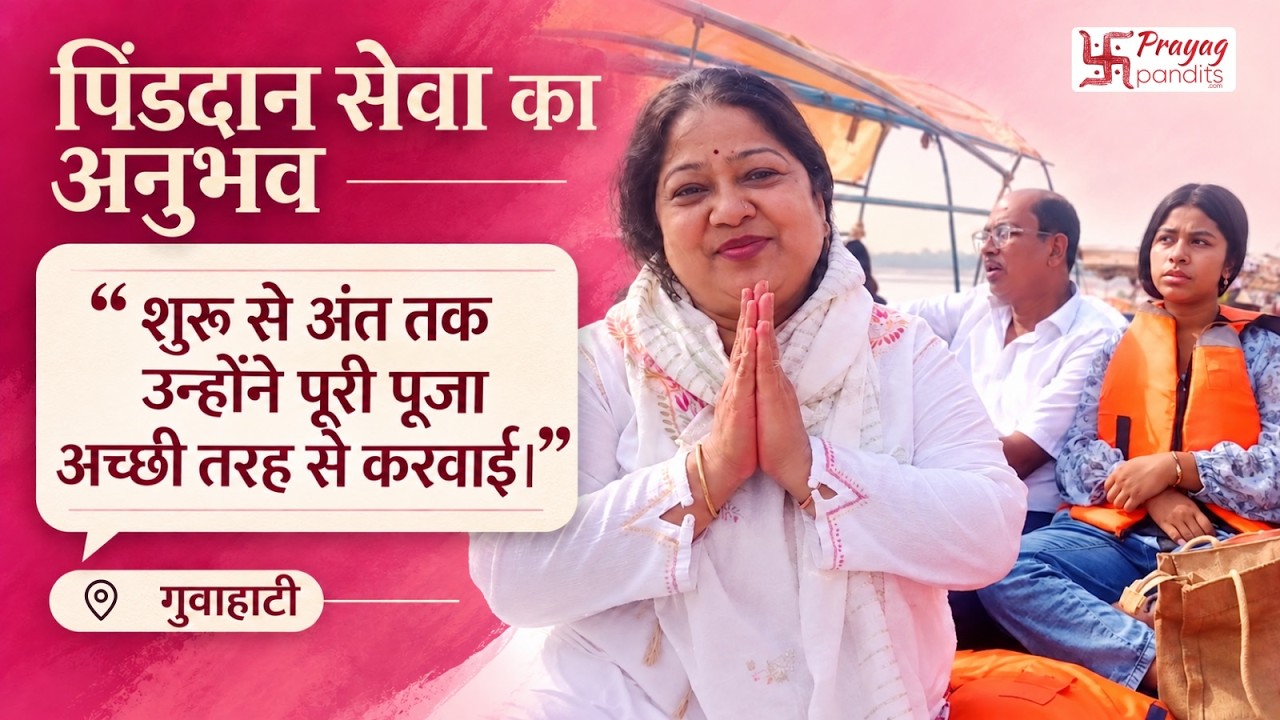
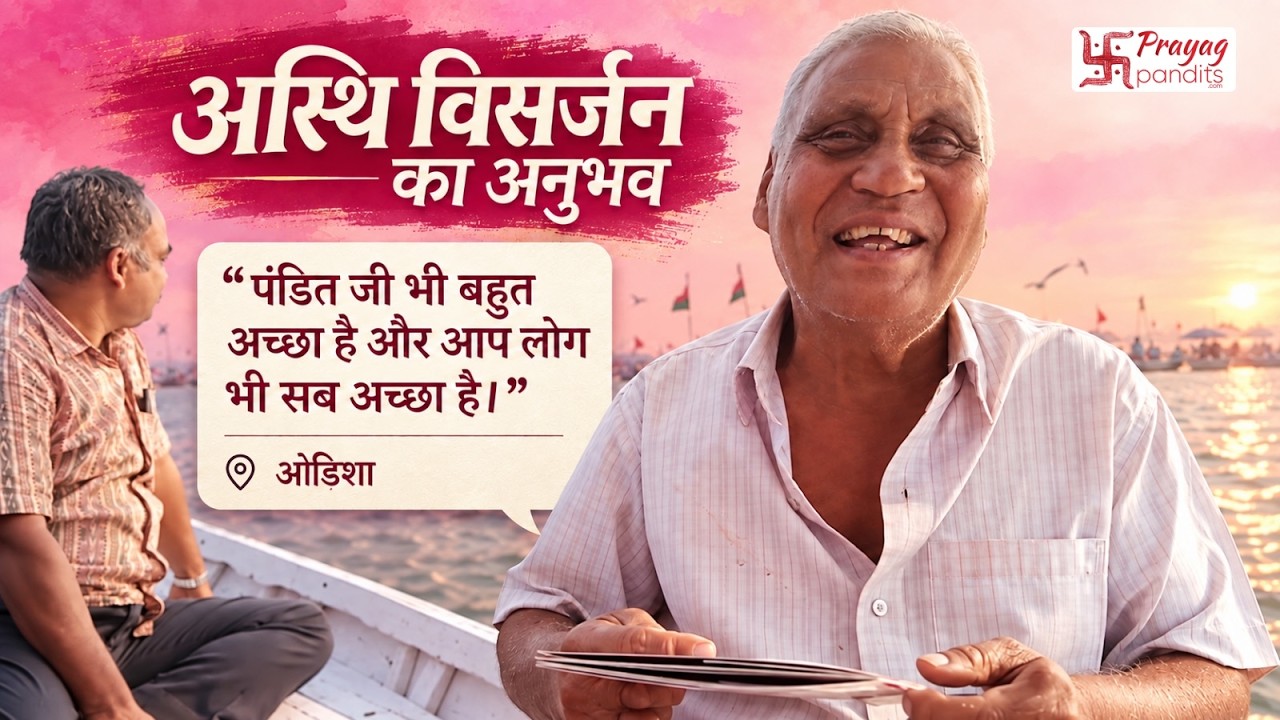
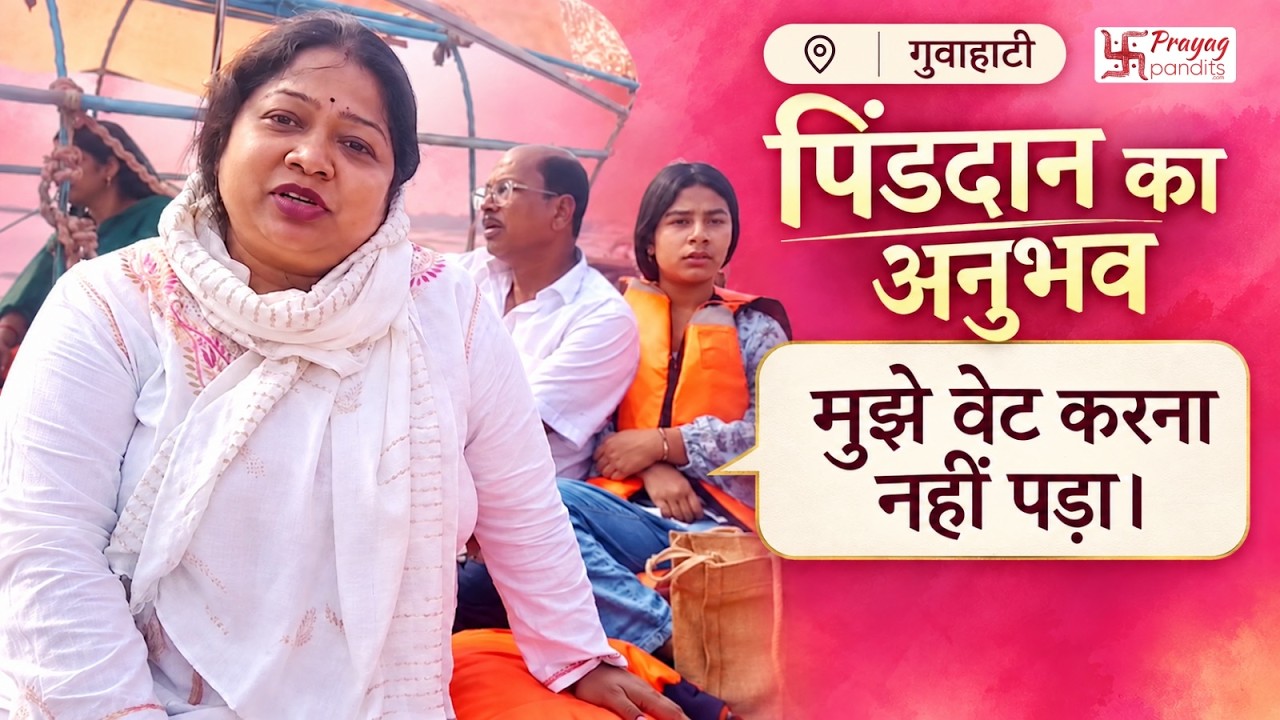

In their words
Quick booking, prompt response, and excellent execution. We were a group of 6 family members and everything was managed well. The pandit was respectful and the ceremony felt genuine.
We are NRI family based in USA. We booked online poojan and it was conducted very sincerely. The video quality was good and we could see everything clearly. The team sent us photos and videos after the ceremony too.
Very professional service. The pandit ji explained every step of the ritual which helped us understand the significance. Everything was arranged well including the samagri. We are grateful to Prayag Pandits for making this spiritual journey meaningful. Dhanyavaad.
First time performing Pind Daan and was nervous about the process. But the team guided us well. They explained what to wear, what to bring, and what mantras to recite. Everything went smoothly. Om Shanti.
Good service overall. The pandit was on time and well prepared. He guided us through each step of the ceremony. The booking process was simple and the team was responsive on WhatsApp. Would recommend to others. 🙏
My family performed Pind Daan through Prayag Pandits and it was a deeply spiritual experience. The location was serene and the pandit's chanting was beautiful. We felt connected to our ancestors throughout the ceremony. Om Shanti.
Booked a rite with us? Tell other families how it went.
Write a reviewQuestions families ask
Pitru Paksha falls in the second fortnight (Krishna Paksha) of the Hindu lunar month of Bhadrapada, usually corresponding to September or October in the Gregorian calendar. It begins on the Purnima (full moon day) or the day after Purnima and ends on the Amavasya (new moon day), known as Sarva Pitri Amavasya or Mahalaya Amavasya. (For current year dates, a specific search is needed closer to the time.)
Effective remedies include performing Shraddha rituals (especially during Pitra Paksha), Pind Daan (offering rice balls), Tarpan (offering water and sesame seeds), Pitra Dosh Nivaran Puja, Narayan Bali Puja, Tripindi Shraddha, feeding Brahmins, donating food/clothes to the needy (especially on Amavasya), worshipping Lord Vishnu or Lord Shiva, chanting specific mantras (like Pitra Gayatri Mantra or Maha Mrityunjaya Mantra), and respecting elders
Yes and no. Both Masikam (Tamil) and Masik Shradh (North Indian) refer to the same concept — the monthly ancestral offering for 12 months following death. However, the specific procedures, mantras, and calendar interpretation differ between the Tamil Dravida tradition and the North Indian tradition. Tamil Masikam follows the Krishna Yajurveda Taittiriya Shakha with specific mantras from the Taittiriya Aranyaka, while North Indian Masik Shradh often follows the Shukla Yajurveda tradition. Both traditions culminate in the Sapindikarana (or Sapindi Shradh) ceremony after 12 months. Our pandits can perform Masikam in the specific tradition of your family — just share your gotra and Shakha, or Vedic lineage, for authentic regional observance.
Sarva Pitru Amavasya 2026 falls on 20 October 2026 (Tuesday). This is the Amavasya tithi in the Krishna Paksha of the Ashwin month — the final day of the 16-day Pitrupaksha period. The Amavasya tithi begins at 4:17 AM on 20 October and extends into the early morning of 21 October. The shubh muhurat for performing Shraddha is during the Aparahna Kaal (afternoon, roughly 12:45 PM to 3:30 PM) — the time specifically prescribed in the Smriti texts for ancestral offerings. Tarpan can also be performed in the morning. Our pandits conduct Sarva Pitru Amavasya Shraddha at Prayagraj, Varanasi, Haridwar, and Gaya with full scriptural authenticity.
The sankalpa (formal vow of intention) is recited at the beginning of Pitru Tarpan to formally commit to the ritual and to specify which ancestors are being honoured. The standard format includes your name, gotra, and the intention to satisfy the father, grandfather, and great-grandfather along with their wives:
Om Adya [Tithi] [Nakshatra] [Date] Asmat Pitri Pitamaha Prapitamaha Sapatnikanam Akshayatripti-sampadanartham Pitri Tarpanam Karishye
Translation: Today, on this [tithi] in the [nakshatra], I, [Name] of [Gotra], perform this Pitru Tarpan rite for my father, grandfather, and great-grandfather along with their wives, to grant them imperishable satisfaction.
Before reciting the sankalpa, the performer (Karta) takes a ritual purification bath (Snan), wears clean white clothes, holds the sacred thread (Yajnopavita) in the Apasavya position (right shoulder, left hip) for ancestral rituals, faces South, and holds water, sesame seeds, and darbha grass in his right hand while the sankalpa is recited by the officiating pandit.
No prior knowledge is required. The pandit conducts the entire ceremony and guides you through each step. Your role is to be present, to repeat after him at the designated moments, and to make the physical offerings. The pandit explains each action in Hindi or English as you go, so you understand what you are doing and why.
A complete Pind Daan ceremony at the ghat typically takes between one and one and a half hours, including the setup, Sankalpa, Pind preparation, Tarpan, and final prayers. If you have a long list of ancestors or request extended rites, it may take slightly longer. We recommend setting aside two hours for the full experience including arrival and departure from the ghat.
Yes. You may bring as many family members as wish to participate. Extended family — siblings, cousins, children — are all welcome at the ghat. The Sankalpa is made in the name of the primary performer, but the merit extends to all family members present. Children who are old enough to understand the significance are often brought along as part of passing on the tradition.
Har Ki Pauri and the surrounding ghats are well-maintained and have stone steps with railings. However, the steps can be uneven in places and may be slippery near the water’s edge. We advise elderly visitors to wear non-slip footwear (removed just at the final approach), take the steps slowly, and if needed, ask our pandit to position the ceremony at a section of the ghat that is most accessible. We will accommodate any mobility considerations — please mention them when booking.
The Sankalpa formula has provisions for incomplete information. The pandit will invoke your ancestors under your Gotram and family line even if specific names are missing. Bring whatever you know — even a single name, or a description of the relationship (paternal grandfather, maternal grandmother) — and the pandit will work with what you have. The sincerity of the intent is what matters most.
Still have a question?
Ask our team on WhatsApp and we will help you plan the ceremony.
We reply on WhatsApp within 1–2 hours.
Ask a pandit (opens WhatsApp)Know your ceremony
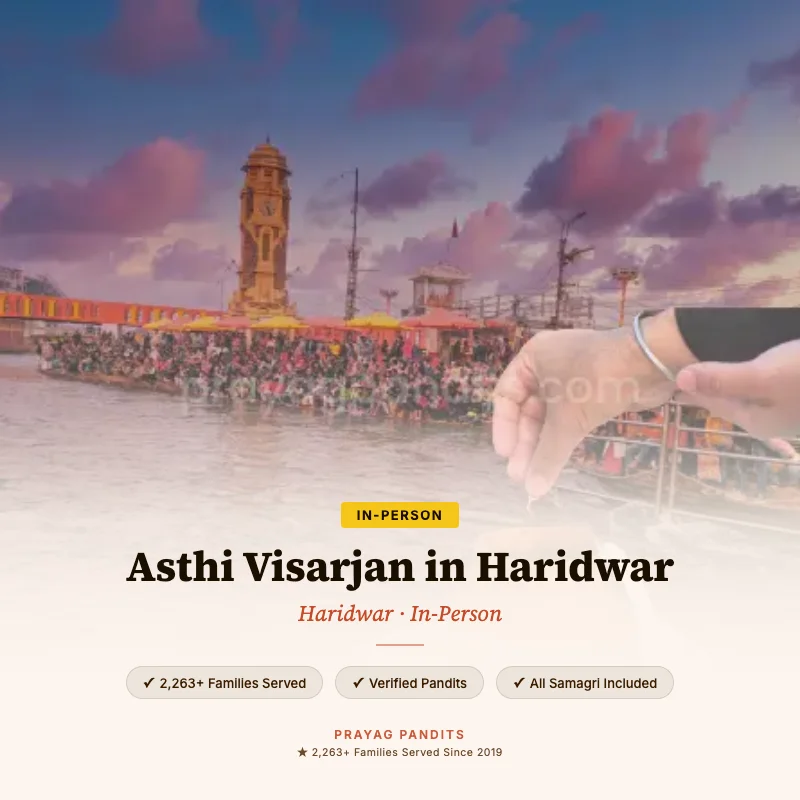
There are few experiences in Hindu pilgrimage life that match what it feels like to stand at the edge of the Ganga in Haridwar during Pitrupaksha. The river is wide, green, and fast-moving. The ghats are crowded with families who have traveled from across India and from abroad. The air carries the sound of Sanskrit mantras recited in unison, the smell of incense and marigolds, and underneath all of it, the steady sound of the Ganga herself. This is where you come when you want the full weight of the tradition to surround you.
Pitrupaksha 2026 falls from September 26 to October 10. This in-person service brings you to Haridwar, to the actual ghats, where our pandit guides you through the complete Pind Daan ceremony. You offer the Pind with your own hands. You touch the Ganga water. You speak your ancestors’ names at the river’s edge. No screen, no distance, no intermediary — just you, your pandit, and the sacred geography of one of India’s holiest cities.
The Ganga at Haridwar is at the precise point where she descends from the mountains and meets the plains. Ancient texts describe this transition as a moment of maximum potency — the river is still cold and pure from her mountain source, but now accessible to the vast population of the Gangetic plains. The Skanda Purana places Haridwar among the most powerful tirthas for ancestral rites precisely because of this liminal quality.
During Pitrupaksha, the entire fortnight is consecrated to the Pitrs — our forebears across multiple generations. The Ganga at Haridwar becomes, during these fifteen days, a direct channel between the living and the departed. Pandits who have spent their lives performing these rites consistently observe that the collective energy of Pitrupaksha at the ghats is unlike any other time of year. Families are present in large numbers, the recitation of Pitru Stotras is continuous, and the atmosphere is one of quiet, deliberate devotion rather than festivity.
The choice of Haridwar over other tirthas for Pind Daan is often a personal or family decision rooted in tradition. Many northern Indian families have a lineage connection to Haridwar and consider it their ancestral tirtha. Others choose it for its accessibility from Delhi and other major cities. And some are drawn to the singular experience of performing the rite at Har Ki Pauri, where the Ganga’s sacred identity is most concentrated.
The primary ghat for ancestral rites in Haridwar is Har Ki Pauri, known in ancient texts as Brahmakund. According to tradition, this is where Lord Vishnu’s footstep touched the earth, and where the Ganga is believed to be most receptive to prayers and offerings. During the Maha Kumbh and Ardh Kumbh, it is Har Ki Pauri that holds the most sacred Shahi Snan. During Pitrupaksha, it draws families who understand that the depth of the ritual is tied to the depth of the location.
Being physically present at Har Ki Pauri during your Pind Daan ceremony changes the nature of the experience. You feel the current of the Ganga against your hands when you perform Tarpan. You place the Pind — the rice ball representing your ancestor — directly into the river. You stand in the exact spot where generations before you have done the same. This continuity of physical presence, across time and across families, is something that cannot be replicated any other way.
Our pandit at Haridwar knows the ghats, knows the protocols specific to each spot, and knows how to guide a first-time pilgrim through every step of the ceremony without letting the complexity of the ritual overwhelm the meaning behind it. Many of our clients come to Haridwar having never performed Pind Daan before. They leave understanding what they have done and why it matters.
If you are planning to travel to Haridwar for Pitrupaksha 2026, some advance preparation will make the experience smoother and more meaningful:
- Travel dates: Pitrupaksha 2026 runs September 26 to October 10. Arrive at least one day before your chosen ceremony date. The city becomes significantly busier in the final three or four days of the fortnight.
- Accommodation: Haridwar has options at every price point, from dharamshalas run by trusts to mid-range hotels near the ghats. Booking two to three weeks in advance is advisable for Pitrupaksha, as the city sees heavy footfall during this period.
- What to bring: Our pandit provides all ritual samagri. You do not need to source or carry any ritual materials. Wear simple cotton clothing in white or light colors if possible — synthetic fabrics are not ideal for ghat ceremonies. Remove footwear before entering the ghat area.
- Timing: Pitrupaksha ceremonies are typically performed in the morning, between sunrise and noon. We schedule your ceremony within this window and confirm the time with you in advance.
- Information to prepare: Bring your Gotram, your ancestors’ names (as many generations back as you know), and the tithi or approximate date of their passing if known.
What surprises most first-time visitors to Haridwar during Pitrupaksha is how profoundly communal the experience is, even when your own ceremony is deeply personal. The ghats are full of other families doing exactly what you are doing. You hear other pandits reciting the same mantras a few feet away. You see elderly parents and young children performing the ritual side by side. The shared intention of so many people gathered in one place, all focused on honoring their departed ancestors, creates an atmosphere of unusual spiritual density.
First-time visitors often describe a feeling of reconnection — not just with their ancestors, but with the broader tradition of which they are a part. Many families make Pitrupaksha at Haridwar a multi-generational practice: grandparents bring children, who will one day bring their children. The ghats become part of the family’s memory, a place they return to because they know what happens there matters.
Our pandit is there not only to perform the ritual but to explain it as it unfolds. If you want to understand why a particular mantra is recited, or what the rice ball represents, or why sesame seeds are the prescribed offering for ancestral rites, he will tell you. The ceremony is not a transaction — it is a transmission of living knowledge, and being physically present is the fullest way to receive it.
Within the Pitrupaksha fortnight, the most auspicious day for your ceremony is the tithi that corresponds to the death date of your ancestor. A few key dates in 2026 to keep in mind:
- Purnima, September 26: For ancestors who passed on a Purnima or whose exact date is not known
- Matru Navami, October 4: Specifically auspicious for mothers, grandmothers, and female ancestors
- Sarva Pitru Amavasya, October 10: The most universally accepted day, suitable for all ancestors — particularly those whose death tithi is unknown, and for families wishing to perform a single comprehensive ceremony for all forebears
If you are unsure which tithi to choose, share the details with our team when booking and we will advise you based on your family’s circumstances.
Pind Daan at Haridwar costs ₹7,100 (regular price ₹11,000). The ceremony is performed at the sacred Har Ki Pauri ghat where the Ganga enters the plains. Full breakdown:
- Experienced Haridwar Purohit — Pandit specialising in ancestral rites at Har Ki Pauri
- Complete Poojan Samagri — All ritual items for pind preparation and tarpan
- Rituals at Har Ki Pauri — The most sacred ghat in Haridwar for Pind Daan
- Narayan Shila Ceremony — Offering at the sacred stone dedicated to Lord Vishnu
- Ganga Puja and Tarpan — Water offering for ancestral liberation
- ceremony photographs and recording — Complete ceremony record
Haridwar is also the gateway to Badrinath and the Char Dham. Many families combine Pind Daan with Asthi Visarjan in Haridwar or the powerful Narayan Bali Puja (₹31,000) for complete ancestral liberation.