



What’s included
Included in your package
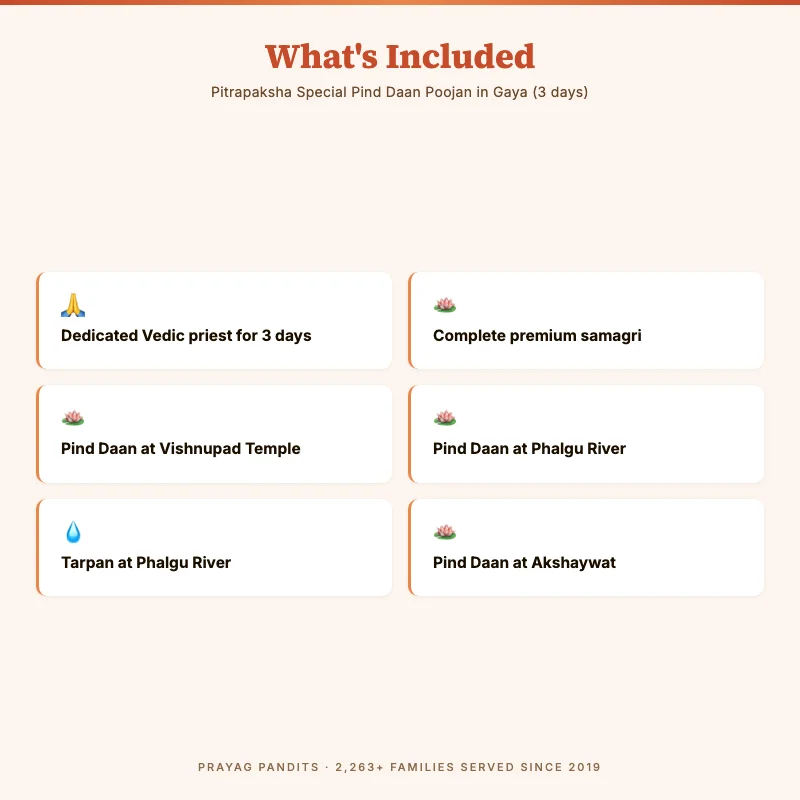
- Dedicated Vedic priest for 3 days
- Complete premium samagri
- Pind Daan at Vishnupad Temple
- Pind Daan at Phalgu River
- Tarpan at Phalgu River
- Pind Daan at Akshaywat
- Pind Daan at Pretshila Hill
- Brahmin Bhoj arrangement
- Gau Daan on your behalf
- Closing Sankalpa for Sapta Pitru liberation
- Local Guidance and Coordination by vedic priest
Not included in your package
- Travel to and from Gaya
- Hotel accommodation
- Family meals (Brahmin Bhoj is separate)
- Personal expenses & tips
- Photography / videography
- Extra Dakshina/Gifts/Donations made to the Priest/Pandit
This is not a Daswa Pind Daan package.
How it works
Choose your pooja
Review your package and any available additions, then add it to your booking.
Share your preferences
Enter your contact details, preferred date and time. Add ancestral details if you wish.
We coordinate with you
Our team confirms the arrangements and shares your coordinator’s details 24 hours before the pooja.
Participate in your pooja
Follow the participation and joining arrangements described in your package and shared by your coordinator.
What families say after the rite
From families who booked Pitrapaksha Special Pind Daan Poojan in Gaya (3 days).
Rated 4.8 out of 5
500+ reviews · Prayag Pandits
This poojarated 4.4 out of 517 reviews
Our pandits


- 2,263+ families served
- Serving since 2019
- GST registered
Families on video
The player loads only when you press play.


In their words
We booked Pind Daan for our late father's shradh ceremony. The pandits were very knowledgeable and performed all rituals with proper Vedic mantras. The whole family felt at peace after the poojan. Highly recommended for anyone looking for authentic rituals. 🙏
हमने गया जी में पिंडदान करवाया। पंडित जी ने विष्णुपद मंदिर से लेकर फल्गु नदी तक सभी स्थानों पर विधि-विधान से पूजा करवाई। बहुत शांति मिली। 🙏
पितृपक्ष में पिंडदान करवाया। पूरी व्यवस्था उत्तम थी। पंडित जी समय पर आए और सभी विधि-विधान पूर्ण भक्तिभाव से सम्पन्न करवाए। प्रसाद वितरण भी अच्छा था। Om Shanti.
Booked this for my mother-in-law's teerth yatra. The arrangements were perfect from pickup to drop. The pandit performed all mantras correctly and with devotion. The poojan materials were all arranged by them. Very satisfied with the service. Om Shanti.
Outstanding service for Pind Daan. The pandit arrived early, set up everything neatly, and began the ceremony right on time. His pronunciation of Sanskrit shlokas was impeccable. Very authentic experience.
Good service overall. The pandit was on time and well prepared. He guided us through each step of the ceremony. The booking process was simple and the team was responsive on WhatsApp. Would recommend to others.
Booked a rite with us? Tell other families how it went.
Write a reviewQuestions families ask
Traditionally, the eldest son is primarily obligated to perform the Shraddha rituals during Pitru Paksha. In his absence, younger sons, grandsons, or other male relatives can perform them. In modern times and certain traditions, if there are no male heirs, daughters or other relatives may also perform the rituals, sometimes with variations.
If someone is unable to perform the detailed rituals on the specific tithi during Pitru Paksha due to unavoidable circumstances, they can perform a collective Shraddha on Sarva Pitri Amavasya (the last day). Alternatively, they can offer prayers, make donations (especially food) in the name of their ancestors, or perform the rituals later at holy places like Gaya, Varanasi, or Prayagraj.
Foods strictly avoided during Pitru Paksha include non-vegetarian items (meat, fish, eggs), onion, garlic, masoor dal (red lentils), hing (asafoetida), certain grains depending on tradition, processed foods, and stale food. Alcohol and tobacco are also prohibited
Pitrupaksha 2026 begins on September 26 (Purnima Shradh) and concludes on October 10 (Sarva Pitru Amavasya). The most important day is October 10 when all ancestors can be honored. Matru Navami for mothers who have passed falls on October 4.
Sarva Pitru Amavasya 2026 falls on Saturday, October 10, 2026. It is the final day of the Pitrupaksha fortnight, which begins on Purnima, September 26, 2026. The most auspicious window for performing the rituals is the morning hours between sunrise and midday.
Yes, the ceremony can be performed for ancestors from both the paternal and maternal lineage of the Karta, as well as for ancestors from the spouse’s family if required. Each set of ancestors is covered by a separate Sankalpa within the ceremony. However, the package is structured for one primary family — if two entirely separate families wish to use the same ceremony, please contact us to discuss appropriate arrangements.
The 3-day Pind Daan ceremony at Gaya is available throughout the year. Gaya is one of the few tirthas where Pind Daan may be performed on any day, regardless of the lunar calendar. However, performing it during Pitrapaksha (the fortnight in Ashwin dedicated to ancestral rites) is considered particularly meritorious. Availability during Pitrapaksha fills quickly — advance booking is strongly recommended.
The package is designed for at least the primary Karta to be present for all three days. If travel constraints make this difficult, the first two days carry the most significant ritual weight — Day 3 (Brahmin Bhoj and Gau Daan) can be performed on the Karta’s behalf by the priest under proper Sankalpa. We request that you discuss your specific situation with us at the time of booking so that the ceremony can be structured appropriately.
This is a common situation and the Vedic tradition has clear provisions for it. When names are unknown, the priest performs the Sankalpa with a general invocation covering all ancestors in a given lineage across seven generations — known and unknown. The mantra specifically states the intent to include all pitrs “known and unknown, named and unnamed.” The ceremony is equally efficacious. Simply share whatever information you have; the rest is handled by the ritual protocol.
The single-day service focuses on the Vishnupad Temple and the Phalgu River — the two most accessible and widely recognized vedis. It is a genuine and complete ceremony that provides real benefit. The 3-day package covers all five principal vedis, adds Brahmin Bhoj and Gau Daan, and provides the level of completion that the Garuda Purana specifically recommends for families with strong Pitru Dosha or ancestors who died without proper rites. If your situation calls for thoroughness rather than brevity, the 3-day package is the appropriate choice.
Still have a question?
Ask our team on WhatsApp and we will help you plan the ceremony.
We reply on WhatsApp within 1–2 hours.
Ask a pandit (opens WhatsApp)Know your ceremony
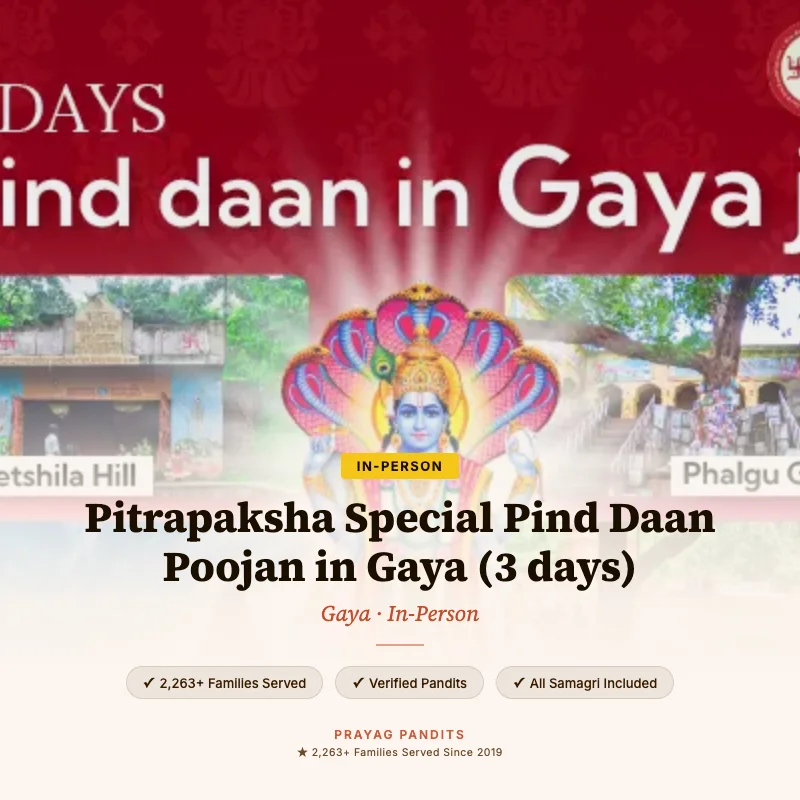
Among all the pilgrimage sites in India where Pind Daan is performed, Gaya holds a singular and irreplaceable position. The Garuda Purana, one of Hinduism’s principal texts on death rites and ancestral liberation, states unambiguously: “Gaya sraddham param punyam, pitrunam moksha-sadhanam” — Pind Daan performed at Gaya is supremely meritorious and serves as the means of liberation for one’s ancestors. What elevates this 3-day package above all others is completeness. Most services cover one or two sacred spots. This package covers all five principal vedis (ritual platforms) of Gaya across three full days of ceremony, fulfilling the scriptural prescription in its entirety.
If your family has been seeking a way to discharge the complete debt of ancestral rites — to ensure that your forefathers receive not partial relief but full moksha — this is the offering that accomplishes it. At ₹71,000, this is our most comprehensive Gaya Pind Daan package, designed for families who wish to do the ritual correctly, thoroughly, and with no aspect left incomplete.
Gaya’s spiritual authority over ancestral rites rests on one of Hinduism’s most profound mythological foundations. The Vayu Purana and Agni Purana both narrate the story of Gayasura, a demon of immense virtue and austerity whose body, by Lord Vishnu’s blessing, became the holy ground of Gaya itself. Vishnu’s sacred feet rest eternally on this earth — which is why the principal temple here is called Vishnupad, the footprint of Vishnu.
When Lord Rama himself visited Gaya with Sita and Lakshmana to perform Pind Daan for King Dasharatha, the earth of Gaya spoke and accepted the offering. This episode, narrated in the Valmiki Ramayana, established Gaya as the supreme Pind Daan kshetra for all time. The Mahabharata reinforces this: it records that even Yudhishthira performed the ancestral rites here.
The Phalgu River, which flows through Gaya, is considered a subterranean sacred river — its sands themselves carry the power to absorb and transmit offerings to the pitrs (ancestors). Across three days, this package takes you through every major vedi and sacred site that Gaya has to offer.
Day 1: Vishnupad Temple and the Sacred Phalgu River
The pilgrimage begins at the Vishnupad Mandir, Gaya’s most sacred structure, built around the actual footprint of Lord Vishnu imprinted in solid rock. Your designated priest will perform the first set of Pind Daan offerings here at the temple’s ritual platform, with full Vedic mantras, invoking the blessings of Vishnu directly for your ancestors’ liberation.
Following the temple ceremony, the second ritual of the day takes place at the banks of the Phalgu River. The Phalgu holds extraordinary significance — it was here that Sita offered Pind Daan to Dasharatha independently (an incident that explains the river’s unusual dry-bed appearance). Pind offerings placed in the Phalgu’s sacred sands are believed to reach the pitrs immediately and without obstruction.
Your priest will guide you through the proper ritual procedures: the Sankalpa (statement of intent), preparation of the pind (rice balls mixed with sesame, honey, and barley), the offering with Tarpan (water libations), and the closing prayers. All samagri (ritual materials) of premium quality are provided — you need bring nothing except your presence and the names of your ancestors.
Day 2: Akshaywat, Pretshila Hill, Ram Kund, and Sita Kund
The second day covers the most spiritually intense sites of the Gaya pilgrimage. Akshaywat — the Undying Banyan Tree — is one of the most mysterious and sacred spots in all of Gaya. The Mahabharata and multiple Puranas describe it as the tree beneath which ancestors await liberation, and offerings made here are described as “akshaya” — inexhaustible and eternal. Pind Daan at Akshaywat is considered particularly effective for ancestors who died in difficult circumstances or whose status in the afterlife is uncertain.
Pretshila, the Hill of the Departed, carries its own unique power. It is here, according to tradition, that departed souls gather before receiving liberation. The climb to the summit is itself considered a form of tapasya (austerity), and Pind Daan performed at the top is said to free ancestors from the pret-yoni (the realm of wandering souls). Many families find this the most emotionally significant part of the pilgrimage.
The afternoon ceremonies take place at Ram Kund and Sita Kund — two sacred water bodies directly associated with Rama’s visit to Gaya. Both are used for the Tarpan rituals and have been sites of ancestral offerings since the age of the Ramayana. Your priest will perform the full ritual set at each kund before concluding the second day.
Day 3: Brahmin Bhoj, Gau Daan, and Final Closing Prayers
The third day fulfills a dimension of the ancestral rite that is often overlooked but scripturally essential. The Vishnu Purana states that no Pind Daan is complete without the feeding of Brahmins, because the Brahmins who receive the meal are considered, in the ritual context, to be the pitrs themselves receiving nourishment. Brahmin Bhoj is arranged on your behalf at an established and respected location in Gaya, with the appropriate Vedic protocols observed.
Gau Daan — the donation of a cow or its equivalent — is the other classical completion ritual for Gaya pilgrimage. The Puranas describe the cow as the vehicle that carries departed souls across difficult passages of the afterlife. This ritual is performed with your name and the names of your ancestors, ensuring the merit passes directly to them.
The final prayers bring together all three days of ceremony in a closing Sankalpa that dedicates the entire three-day Karma to the liberation of your ancestors across all seven generations (Sapta Pitru). Your priest will provide you with a complete description of what was performed and what has been accomplished.
This package is specifically suited for families in the following situations. First, those who wish to fulfill the complete scriptural prescription — the Garuda Purana’s guidance is that Pind Daan at all five vedis of Gaya grants complete and final liberation. Partial coverage is better than nothing, but completeness is the ideal.
Second, families with a strong sense of Pitru Dosha — persistent patterns of misfortune, health issues, or obstacles across generations that jyotish (Vedic astrology) has attributed to unsatisfied ancestral spirits — benefit most from the comprehensive approach. The 3-day ritual addresses not just the surface obligation but the accumulated karmic debt in full.
Third, families who lost an ancestor without being able to perform the last rites, or those whose ancestors died in circumstances that left the death ceremonies incomplete. In these cases, the Garuda Purana prescribes the complete Gaya pilgrimage as the remedy. You can learn more about the full significance of this ceremony at our complete guide to Pind Daan and our step-by-step guide on how Pind Daan is performed.
Fourth, families performing Pind Daan during the Pitrapaksha fortnight — the fifteen-day period in the lunar month of Ashwin when the boundary between the living and the ancestral realms is believed to thin. During Pitrapaksha, even ordinary Pind Daan carries amplified merit; a complete 3-day ceremony at Gaya during this period is considered among the most powerful ancestral rites possible.
The preparation required of the primary Karta (the family member performing the rites) is straightforward. Before departure, you should collect the names and gotras (lineage) of all ancestors you wish to include in the ceremony — ideally covering your father’s side and mother’s side across three generations. If some names are not known, your priest can work with partial information and include all unknown ancestors under a general invocation.
During the three days, the Karta typically observes brahmacharya (celibacy), avoids non-vegetarian food and alcohol, and ideally wears white or light-colored clothing. There is no requirement for strict fasting — the priest will advise on any specific restrictions based on your family’s tradition. Women may participate in the ceremonies and, in cases where there is no male heir, women may serve as the primary Karta without any diminishment of the ritual’s efficacy.
Gaya has 45 recognized sacred spots (vedis) spread across the town and its surroundings. The scriptures, however, identify five as the most powerful for Pind Daan: Vishnupad, Akshaywat, Pretshila, the Phalgu River banks, and the kunds associated with Rama’s own pilgrimage. Together, these five vedis are described in the Gaya Mahatmya section of the Vayu Purana as forming a complete circuit of ancestral liberation.
The rationale is this: each vedi addresses a different class of ancestral need. Vishnupad provides Vishnu’s direct blessing. Akshaywat creates inexhaustible merit. Pretshila frees ancestors from wandering. The Phalgu River transmits offerings through its sacred sands. The kunds connected to Rama sanctify the ritual with royal and divine precedent. When all five are covered, the ancestors receive liberation from every direction, without gaps.
This is why the 3-day package exists as our most premium offering. Not because it involves more time or cost, but because it is the only way to genuinely complete the circuit that the scriptures prescribe.