


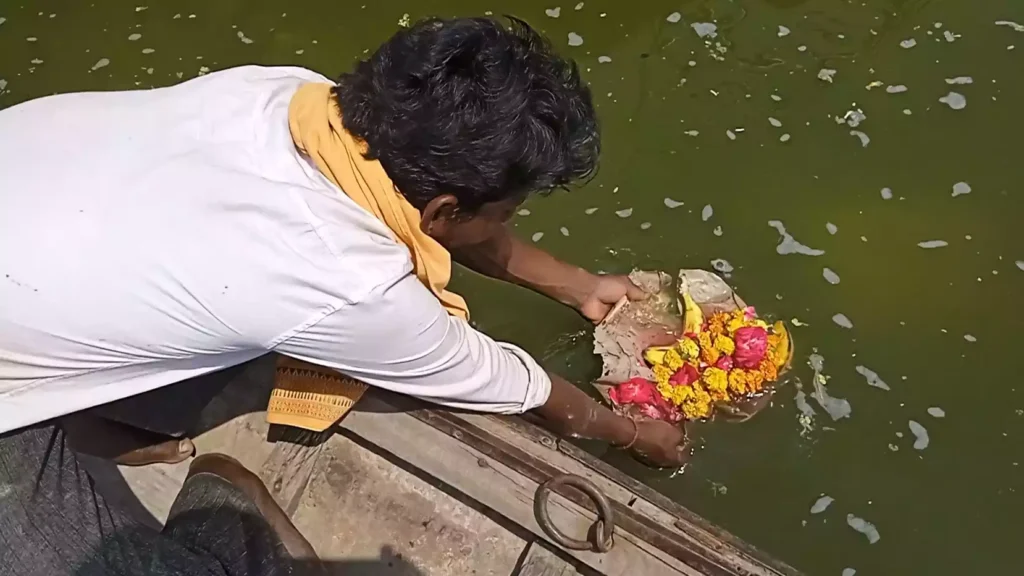
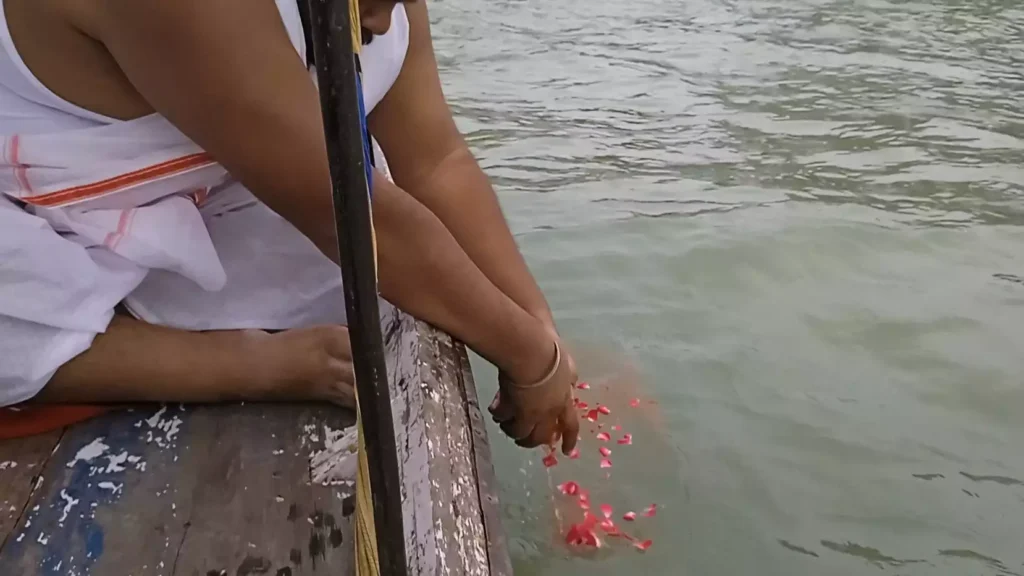
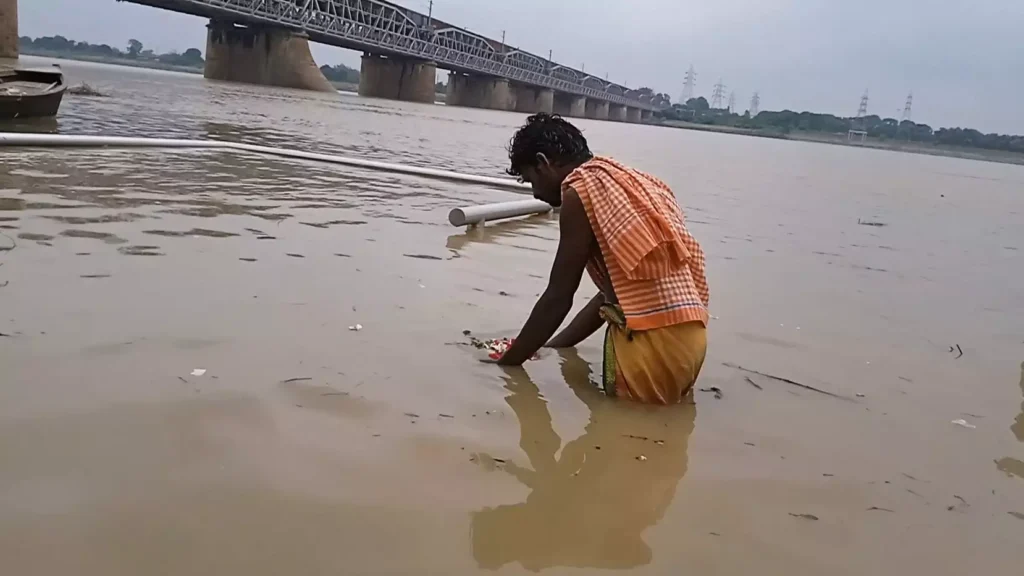
What’s included
Included in your package
- Tarpan at Ganga Ghat, Varanasi
- Experienced Varanasi-based pandit
- All samagri sesame, kusha, Gangajal, flowers
- Tarpan with three-generation ancestral invocation
- Sankalp with family name, gotra & ancestor names
- Pre-ceremony consultation
Not included in your package
- Travel to Varanasi
- Accommodation
- Station / airport pickup & drop
- Pind Daan / Shradh / Asthi Visarjan (separate services)
- Photography / videography
- Extra Dakshina/Gifts/Donations made to the Priest/Pandit
How it works
Choose your pooja
Review your package and any available additions, then add it to your booking.
Share your preferences
Enter your contact details, preferred date and time. Add ancestral details if you wish.
We coordinate with you
Our team confirms the arrangements and shares your coordinator’s details 24 hours before the pooja.
Arrive for your pooja
Our team guides you to the designated pooja area and helps you participate in the ceremony.
What families say after the rite
From families who booked Tarpan in Varanasi.
Rated 4.8 out of 5
500+ reviews · Prayag Pandits
This poojarated 4.5 out of 520 reviews
Our pandits








- 2,263+ families served
- Serving since 2019
- GST registered
Families on video
The player loads only when you press play.



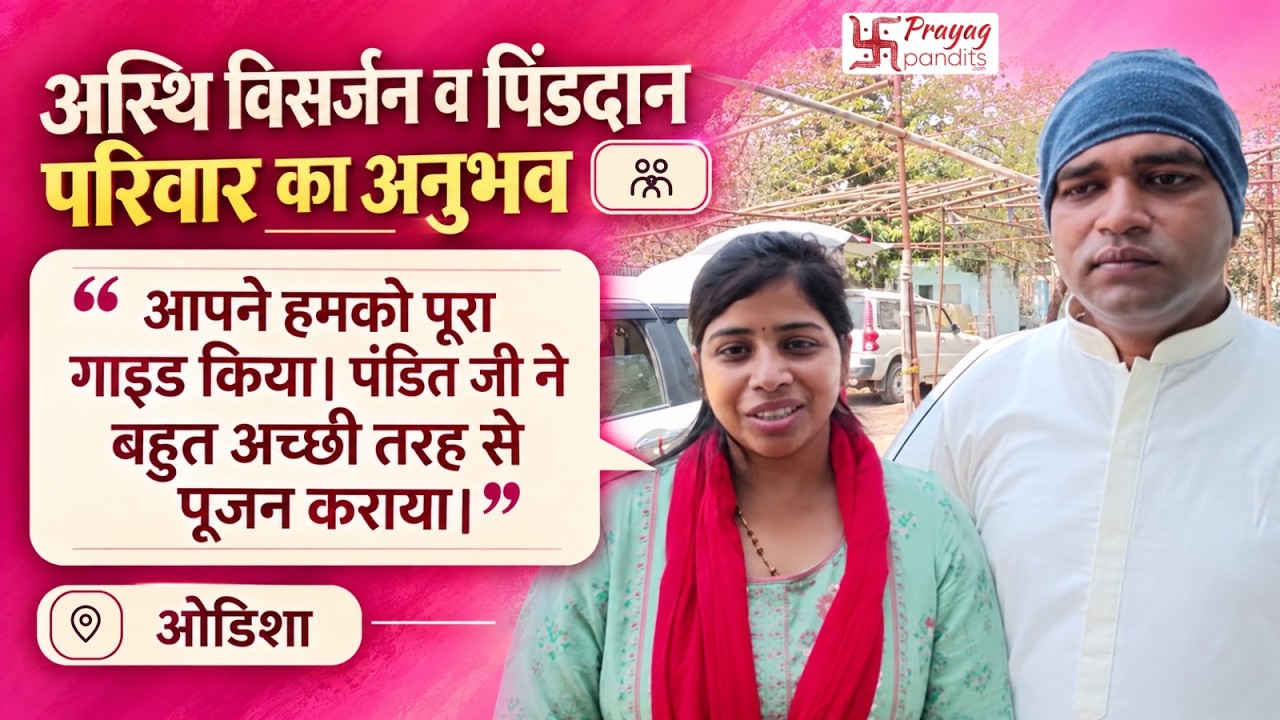


In their words
Booked this for my mother-in-law's teerth yatra. The arrangements were perfect from pickup to drop. The pandit performed all mantras correctly and with devotion. The poojan materials were all arranged by them. Very satisfied with the service. Dhanyavaad.
Very professional service. The pandit ji explained every step of the ritual which helped us understand the significance. Everything was arranged well including the samagri. We are grateful to Prayag Pandits for making this spiritual journey meaningful.
We came from Delhi specifically for this puja. The whole process was smooth and the pandit ji guided us patiently. Highly recommend.
First time performing Pind Daan and was nervous about the process. But the team guided us well. They explained what to wear, what to bring, and what mantras to recite. Everything went smoothly. Jai Shri Ram.
We are settled abroad and wanted to perform the puja in Prayagraj. Prayag Pandits made it possible. Grateful.
बहुत संतोषजनक सेवा। पंडित जी का वेद-शास्त्र का ज्ञान अद्भुत था। उन्होंने गरुड़ पुराण के श्लोकों का पाठ किया जो बहुत मार्मिक था। पूरा परिवार भावुक हो गया। Jai Shri Ram.
Booked a rite with us? Tell other families how it went.
Write a reviewQuestions families ask
The Ganga is central to Tarpan in Varanasi. She is considered a purifier of sins and a direct conduit to the divine. Offering Tarpan water into the Ganga is believed to directly reach the ancestors, quenching their spiritual thirst and washing away negative karmas. Taking a holy dip (snan) in the Ganga before or after Tarpan is an essential part of the purification process
Pandits can often be found directly at the major ghats (like Dashashwamedh, Assi). One can also seek recommendations from their hotel, local contacts, or reputable pilgrimage service providers (online platforms like Prayag Pandits, Mahatarpan, Devaseva, Yatradham list priests or offer booking services). It's wise to discuss the procedure and Dakshina (priest's fee) beforehand.
Local Brahmin priests, often referred to as Pandits, Purohits, or sometimes specifically as Ghat Pandits or Kashi Pandits, guide the Tarpan rituals. They possess knowledge of the specific mantras, procedures, and significance related to performing rites in Kashi by the Ganga. Many are associated with specific ghats or temples.
The cost for Tarpan alone, if performed as a brief, standalone ritual, might range from INR 500 to INR 2000. However, Tarpan is often part of a larger Pind Daan or Shraddha ceremony. Packages for these in Varanasi can range from basic (around INR 2500 - 7000) to more elaborate ones (INR 7000 - 15,000+), depending on the duration, materials, number of priests, specific ghats used, and inclusion of items like Brahmin Bhojan (feeding Brahmins). Online services also offer packages within similar ranges. It's best to clarify costs upfront.
Performing Tarpan in Varanasi is believed to yield specific benefits due to the city's power:
- Facilitates Moksha: Kashi being the city of liberation, Tarpan here greatly aids ancestors in breaking the cycle of rebirth.
- Purification by Ganga: The holy water cleanses the sins of both the performer and the ancestors.
- Blessings of Lord Shiva: Performing rites in Shiva's city invokes his blessings for the ancestors' peace and the family's well-being.
- Removal of Pitru Dosha: Effectively addresses ancestral afflictions due to the potent spiritual energy of the location.
- Deep Ancestral Satisfaction: Offers profound peace and contentment to the Pitrus.
- Overall Well-being: Ancestral blessings received here are believed to bestow health, prosperity, and harmony upon the descendants.
Home Tarpan on Amavasya is valid and recommended as a regular practice. However, Tarpan at a sacred teerth — and particularly in Kashi, where Shiva’s presence is understood to amplify all ritual actions — generates far greater merit and reaches ancestors with greater force. The Kashi Khand specifically states that one act of Tarpan at Kashi equals millions performed at ordinary locations.
Yes. This is actually one of the most important applications of Tarpan in Varanasi. For souls who departed suddenly, whose cremation was incomplete, or who did not receive proper Shraddh after death, Tarpan in Kashi — particularly at Manikarnika Ghat — is considered among the most effective remedies. Shiva’s promise covers all souls departing in Kashi, and the merit of Tarpan here extends even to those who left before receiving proper rites.
A standard Tarpan pooja takes approximately 30 to 40 minutes. If combined with additional rites such as Shraddh or Pind Daan, the time increases accordingly. Our pandit will give you an accurate estimate when you book.
The ritual is designed for those within the Hindu tradition. However, the spirit of honouring and remembering one’s ancestors is universal. Those from other backgrounds who wish to participate respectfully are welcome, and our pandits are experienced in adapting the ritual framing where appropriate.
Yes. Tarpan and Pind Daan can be performed together for a more complete ancestral rite. Visit our full services page to explore our Varanasi Pitru Karma packages, or speak with our team about a customised ceremony that meets your family’s needs.
Still have a question?
Ask our team on WhatsApp and we will help you plan the ceremony.
We reply on WhatsApp within 1–2 hours.
Ask a pandit (opens WhatsApp)Know your ceremony
There are places in this world where the distance between the living and the dead seems to collapse. Varanasi is one such place — perhaps the most profound one. Here, on the banks of the Ganga, in the city that Lord Shiva himself calls home, ancestors receive what you offer with a directness and completeness that no other location can match.
Tarpan in Varanasi is not simply an ancestral offering performed beside a river. It is an act placed at the feet of Mahadev himself, offered in the city where he promised — as the Kashi Khand of the Skanda Purana records — that every soul departing within Kashi’s bounds receives moksha directly from his own lips. When your Tarpan rises from the Ganga’s banks in this city, it rises in the presence of that divine promise.
Our service is priced at ₹5,100 (regular price ₹7,999) and includes a trained Vedic pandit and all ritual materials. This is an opportunity to fulfil your ancestral duty in the most spiritually charged city on earth.
In Sanskrit, tarpan comes from the root tarp — to satisfy, to nourish, to please. The ritual is exactly that: an act of nourishing the souls of those who have departed, through the medium of sacred water offered with specific ingredients and mantras.
The Tarpan offering is made from water mixed with sesame seeds (til), barley (jau), and kush grass (darbha). Sesame is particularly sacred in Pitr Karma — the Garuda Purana states that sesame is the most pleasing food-offering a son can make to his ancestors, and that it repels negative forces from the ritual space. Barley represents abundance. Kush grass purifies both the performer and the offering.
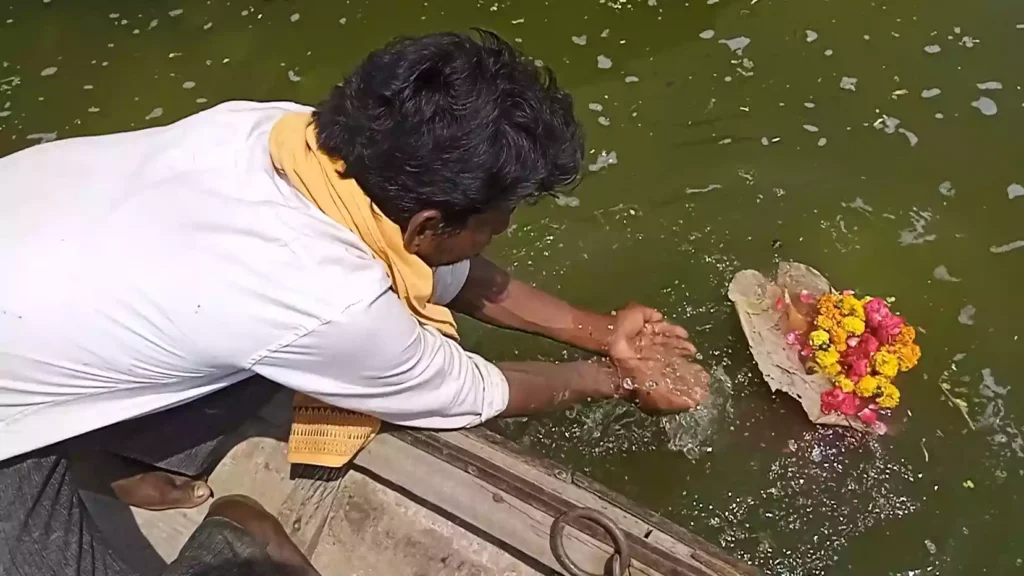
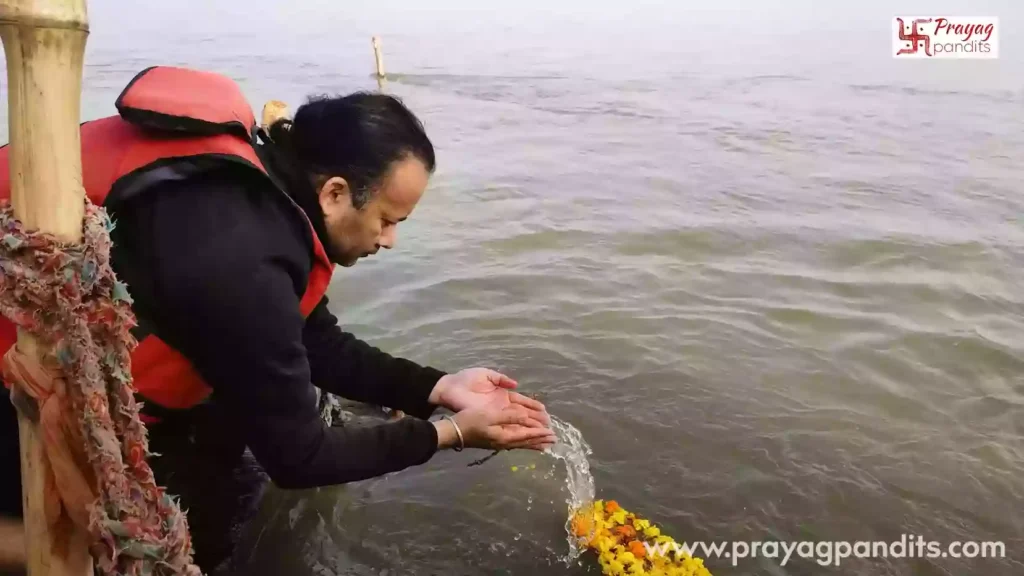
Facing south — the direction of Yama and the realm of the ancestors — the performer cups this water in both palms and allows it to flow through the fingers as an offering to each ancestor by name. The moment the water leaves the hands, it is said in the texts to reach the pitr being honoured, nourishing them wherever they reside between births.
The Pitr Rinn — the debt to one’s ancestors — is among the three foundational debts that every Hindu carries. Tarpan is the primary means of discharging this debt for those who have departed. Neglecting it leaves the ancestors unsatisfied and, according to the Dharmashastra texts, creates what is known as Pitr Dosha — ancestral displeasure that manifests as recurring obstacles in the lives of descendants.
The Kashi Khand of the Skanda Purana — an entire Purana section dedicated to Varanasi — makes a declaration that stands alone in all of Hindu scripture. Lord Shiva says: “In Kashi, I myself whisper the Taraka Mantra — the mantra of liberation — into the ear of every dying soul.” This is the promise that makes Varanasi Kashi: the city where Shiva personally administers the final rite of liberation to every soul that departs within its sacred geography.
This has a direct bearing on Tarpan. When you offer Tarpan in Kashi, you are not simply offering water to the Ganga. You are offering it in the city that is the abode of both Shiva and Parvati, where the Ganga itself flows backward — from south to north, which is considered spiritually significant as the river turning to face the divine source. You are offering it in a city where the entire geography is considered a living deity, where every ghat, every lane (gali), and every stone is imbued with thousands of years of uninterrupted worship.
The Kashi Khand also states that Tarpan performed in Kashi liberates ancestors across fourteen generations — far beyond what most texts ascribe to Tarpan performed at ordinary locations. The concentration of Shiva’s grace in this city acts as a divine multiplier on every act of devotion performed here.
For a deeper understanding of the ghat most intimately connected to death and liberation in Varanasi, read our detailed guide: Manikarnika Ghat — Where Death Meets Divinity.
Varanasi has 84 ghats along the Ganga, each with its own history, deity, and spiritual character. For Tarpan and ancestral rites, certain ghats carry particular significance.
Dashashwamedh Ghat
The most central and well-known of Varanasi’s ghats, Dashashwamedh is where Lord Brahma is said to have performed the Dashashwamedha Yajna — ten horse sacrifices — to welcome Shiva back to Kashi. It is a place of extraordinary accumulated merit, and Tarpan performed here benefits from the continued energy of thousands of daily rituals and the famous Ganga Aarti held every evening. For those coming to Varanasi primarily for Tarpan, this is often the first choice.
Manikarnika Ghat
The most sacred of all Varanasi’s ghats for matters of death and liberation, Manikarnika is where the fires have burned continuously for thousands of years. It is considered the primary cremation ghat of Kashi and is directly associated with Shiva’s promise of liberation. Tarpan performed at Manikarnika is considered to carry the full force of Shiva’s presence and is particularly recommended for souls who may have departed under difficult circumstances or whose liberation is uncertain.
Panchganga Ghat
As the name suggests, Panchganga Ghat is the confluence of five sacred rivers — the Ganga, Yamuna, Saraswati, Dhutapapa, and Kirana. Much like the Triveni Sangam at Prayagraj, the convergence of rivers at a single point creates an amplified field of spiritual merit. Tarpan at Panchganga is considered especially effective for reaching ancestors who may not have received proper last rites.
Assi Ghat
Located at the southern end of the ghat sequence, Assi Ghat is where the Assi river meets the Ganga. It is associated with the goddess Durga and carries an energy of protective strength alongside its ancestral significance.
Our pandit will recommend the most appropriate ghat for your specific situation and the nature of the ancestors you are honouring.
Pitrupaksha
The 15-day fortnight of Pitrupaksha in the Ashwin month (September-October) is the most important period for all ancestral rites. During Pitrupaksha, the ancestors are said to descend toward the earthly realm, and offerings reach them with extraordinary speed and completeness. Varanasi during Pitrupaksha becomes a city of ancestral worship, with ghats filled with families performing Shraddh, Tarpan, and Pind Daan simultaneously. The collective energy during this period is immense.
Monthly Amavasya
Each new moon day is considered a day of the pitrs. Regular Tarpan on Amavasya maintains the ancestral connection through the year and gradually dissolves Pitr Dosha. In Varanasi, Amavasya rituals at the ghats are performed in large numbers, creating an atmosphere of concentrated ancestral devotion.
Death Anniversary (Tithi)
The specific lunar date on which your ancestor departed is considered the most powerful day for individual Tarpan directed to that ancestor. Many families make a point of coming to Varanasi at least once on a parent’s death tithi to perform Tarpan in Shiva’s city.
Makar Sankranti and Other Auspicious Occasions
Makar Sankranti, Ganga Dussehra, and certain other auspicious dates are also considered powerful times for Tarpan. The pandit can advise on the most beneficial timing for your specific circumstances.
Tarpan is traditionally the responsibility of the eldest son, but any member of the family who wishes to honour their ancestors may perform it with the pandit’s guidance. Varanasi is particularly recommended for:
- Those whose ancestors departed under difficult or sudden circumstances — in Shiva’s city, even troubled souls receive grace
- Families carrying longstanding Pitr Dosha — indicated by recurring misfortunes, health issues, or delayed marriages across generations
- Those who were unable to perform the last rites properly at the time of death
- Anyone who wishes to perform a powerful ancestral offering once in their lifetime at the most sacred possible location
- Devotees of Lord Shiva who feel drawn to perform ancestral rites in his own city
- Fast on the day of the ritual, or eat only sattvic food — avoid meat, alcohol, onion, and garlic
- Wear clean, modest clothing — white or undyed fabric is preferred
- Prepare a list of ancestors to be honoured, with names and approximate death dates where known
- Know your gotra — if uncertain, the pandit can use the standard Kashyap gotra as a default
- Arrive at the ghat calmly, with time to spare — do not rush a sacred act
- Bring a sincere intention and a willingness to be present. The quality of attention you bring to Tarpan matters as much as the ritual itself.
Meeting and Preparation
Your pandit will meet you at the designated ghat. After introductions and confirmation of the ancestors to be honoured, you will perform ritual bathing in the Ganga or at minimum achamana — the three-sip purification — to prepare for the ceremony.
Sankalpa
The ritual begins formally with the Sankalpa — a declaration in Sanskrit of your name, gotra, location, the current planetary time, and your intention. The pandit recites; you repeat the key phrases. This declaration focuses the ritual’s energy precisely toward your ancestors.
Deva and Rishi Tarpan
Before reaching the Pitr Tarpan, the ritual first offers water to the gods and to the sages. This is a brief but important preliminary that opens the channel of offering.
Pitr Tarpan
Facing south, you cup water with both palms along with sesame, barley, and kush grass. As the pandit recites each ancestor’s name and lineage, you allow the water to flow from your hands. This is done three times for each ancestor, covering the paternal lineage, the maternal lineage, and then teachers and other honoured souls.
Closing Rites
The ritual closes with prayers to Ganga Mata, to Yama, and to Shiva himself — asking Mahadev to bless the departed with liberation and the living with peace. The pandit offers final blessings and the ceremony concludes.
The Kashi Khand is explicit: those who perform Tarpan in Kashi cause their ancestors to ascend immediately to higher realms, regardless of the nature of their karma. This is the grace that Shiva’s presence bestows on this city — a grace that overrides the ordinary accounting of karma when ancestral rites are performed sincerely here.
For the performer, Tarpan in Varanasi generates merit that protects across multiple lifetimes. The Pitr Dosha that underlies so many family difficulties — inexplicable health problems, financial struggles, delayed marriages — begins to dissolve as the ancestors are truly satisfied. Families who regularly perform Tarpan at sacred teerths report a gradual but unmistakable lightening of the burdens they carry.
Tarpan in Varanasi costs ₹5,100 (regular price ₹7,999). The ceremony is performed at the sacred Ganga ghats of Kashi by an experienced pandit. Covers: pandit fees, complete tarpan samagri, Vedic mantra recitation, water offering ceremony, and documentation. No hidden charges.