
Magh Mela 2027 is on until 6 March 2027. Magh Mela 2027 is on See packages & dates See dates
Pitru Paksha 2027 is on until 29 September 2027. Pitru Paksha 2027 is on See packages & dates See dates
Sarva Pitru Amavasya is today. Sarva Pitru Amavasya is on See packages & dates See dates
Prayagraj ritual guidance
Tarpan in Prayagraj
Three handfuls where Ganga meets Yamuna, on the confluence the Puranas call Tirtharaj.
Tarpan at the Triveni Sangam — the confluence of Ganga, Yamuna, and the mystic Saraswati that the Padma Purana names Tirtharaj, the King of Tirthas. Three handfuls offered with darbha twigs in three directions per Baudhayana. Daily, through Pitrupaksha (Sep 26 — Oct 10, 2026), and on the annual Tithi.
- Verified pandits
- Clear package details
- Vedic vidhi
- All samagri included
- Rated 4.8/5 · 500+ reviews
- 2,263+ families served
- Serving since 2019

Find your package
Three short questions, the right ceremony
Tell us your situation — we will suggest the package that fits the family. No booking pressure; we will explain the choice on WhatsApp first if needed.
Recommended for you
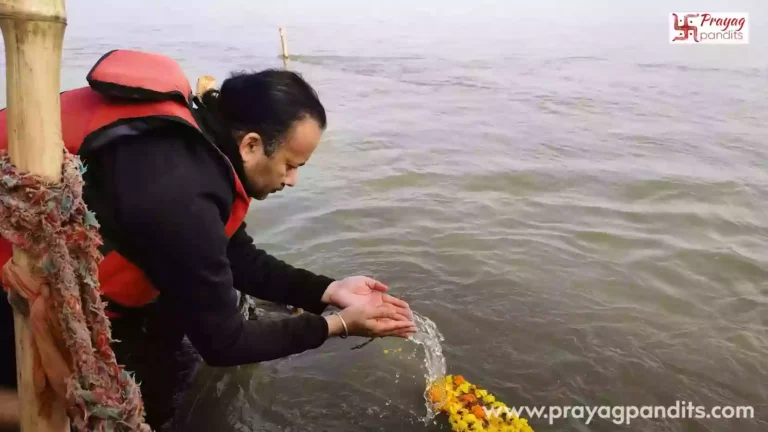
Tarpan in Prayagraj
Price ₹5,100
- Tarpan at Triveni Sangam, Prayagraj
- Experienced Prayagraj-based pandit
Recommended for you
Tarpan in Prayagraj
Price ₹5,100
- Tarpan at Triveni Sangam, Prayagraj
- Experienced Prayagraj-based pandit
Recommended for you
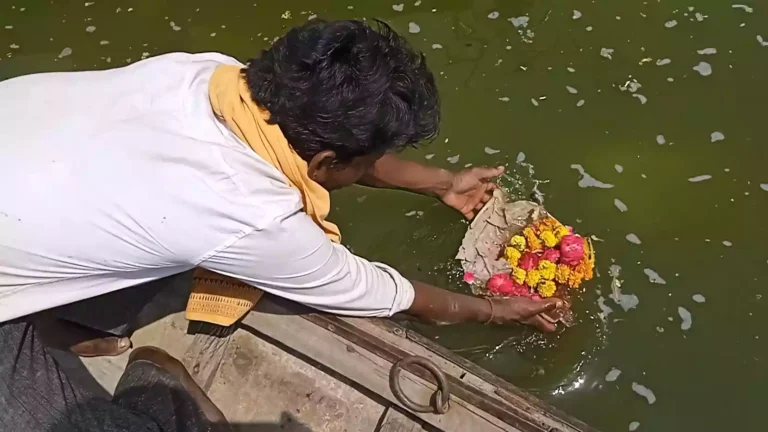
Prayagraj Pitru Tarpan for Odiya Families | Sacred Water Offerings at Sangam
Price ₹10,999
- Odia Vidhi Ceremony
- Pitru Tarpan at Triveni Sangam (Tila-tarpan with Gangajal)
Recommended for you
Prayagraj Pitru Tarpan for Odiya Families | Sacred Water Offerings at Sangam
Price ₹10,999
- Odia Vidhi Ceremony
- Pitru Tarpan at Triveni Sangam (Tila-tarpan with Gangajal)
Recommended for you
Talk to a family advisor
Price on request
No package matches all your needs
Recommended for you
Talk to a family advisor
Price on request
No package matches all your needs
Choose your package
Choose the arrangement that fits your family
Every package includes an experienced Vedic pandit and the required puja samagri. The difference is in boat, location, stay, and tradition.

Prayagraj Pitru Tarpan for Odiya Families | Sacred Water Offerings at Sangam, View & book
- Odia Vidhi Ceremony
- Pitru Tarpan at Triveni Sangam (Tila-tarpan with Gangajal)
- Complete samagri (water vessels, sesame, Gangajal, offerings)
- Vedic mantras & stotrams recitation
Price ₹10,999
Tarpan in Prayagraj, View & book
- Tarpan at Triveni Sangam, Prayagraj
- Experienced Prayagraj-based pandit
- All samagri (sesame, kusha, Gangajal, flowers)
- Tarpan with three-generation ancestral invocation
Price ₹5,100
Prayagraj
More rites at Prayagraj
Asthi Visarjan, Ganga Pooja and Prayaschit, Gau Daan, Magh Mela Daan, Narayan Bali, Pind Daan, Shradh, Tripindi Shradh and Veni Daan, with pandits at Prayagraj.
- 2,263+families served
- 10+ yearspandit experience
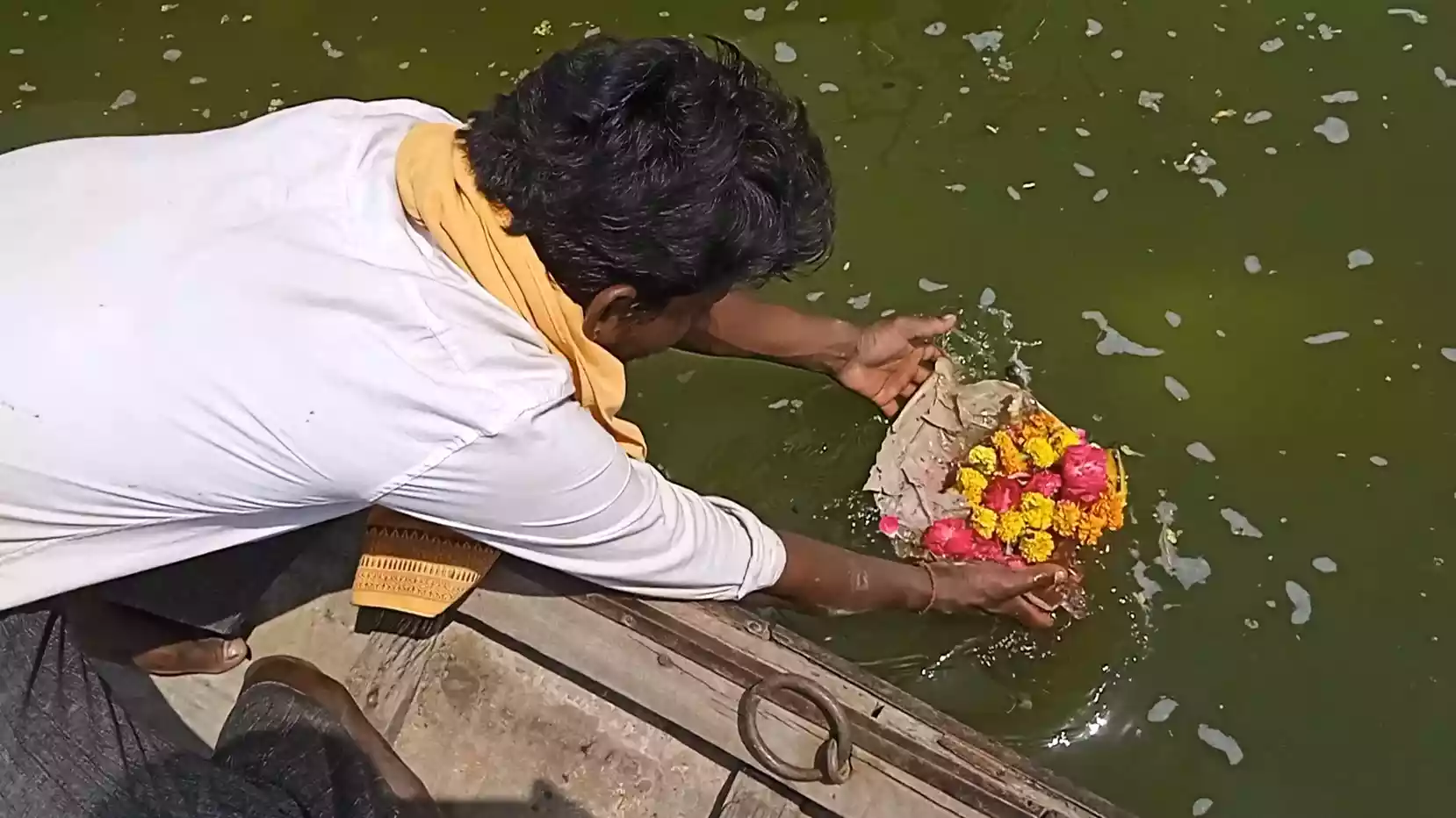

Planning Tarpan during Pitru Paksha?
Compare the Pitru Paksha packages in Prayagraj, online or in person.
Why families choose Prayag Pandits
- Families served
- 2,263+
- Serving since
- 2019
- Average rating
- 4.8/5
- GST registered
- Registered
Sangam Tirth Purohit lineage
qualified for both Vedic and Odia-vidhi tarpan
Darbha & anjali per Baudhayana
directional facing + handful count observed
Tarpan at Tirtharaj
Per the Padma Purana & Mahabharata Vana Parva
Same-day confirmation
WhatsApp message from the Purohit with offerings detail the same evening
Voices from families
What families say after the rite
Rated 4.8 out of 5
500+ reviews
Our pandits








- 2,263+ families served
- Serving since 2019
- GST registered
हमने गया जी में पिंडदान करवाया। पंडित जी ने विष्णुपद मंदिर से लेकर फल्गु नदी तक सभी स्थानों पर विधि-विधान से पूजा करवाई। बहुत शांति मिली।
First time booking online for a religious ceremony. Was skeptical but the service exceeded expectations.
प्रयाग पंडित्स की टीम बहुत सहयोगी है। बुकिंग से लेकर पूजा तक सब कुछ सुव्यवस्थित था। पंडित जी ने मंत्रों के अर्थ भी बताए जो बहुत ज्ञानवर्धक था।
My family performed Pind Daan through Prayag Pandits and it was a deeply spiritual experience. The location was serene and the pandit's chanting was beautiful. We felt connected to our ancestors throughout the ceremony. Om Shanti.
We booked this for our grandfather's annual shradh. The ceremony was performed with great reverence. Pandit ji even shared stories from the Garuda Purana which were very enlightening for the younger generation.
First time performing Pind Daan and was nervous about the process. But the team guided us well. They explained what to wear, what to bring, and what mantras to recite. Everything went smoothly.
Booked for my mother-in-law's shradh. The entire ceremony was conducted with great reverence. Thank you.
After losing my father suddenly we needed guidance on the proper rituals. Prayag Pandits team was very compassionate and helped us through every step. The Pind Daan brought us immense peace. Dhanyavaad.
We are NRI family based in USA. We booked online poojan and it was conducted very sincerely. The video quality was good and we could see everything clearly. The team sent us photos and videos after the ceremony too. Om Shanti.
Not sure which package fits?
Talk to a family advisor — free, no obligation. We reply on WhatsApp within 1–2 hours.
What's included
Every package lists exactly what is included no pressure for "extra dakshina" on the day
We've seen too many families face hidden boat fees, samagri costs, and "dakshina" pressure on the day. Here's exactly what's covered, and what isn't.
Included in your package
- Experienced Sangam Tirth Purohit Vedic Tirth Purohit qualified in Sangam-tarpan vidhi, with gotra-pravara verified. Odia-vidhi variant available for Odisha families through our hereditary Odia Pandit lineage.
- All Tarpan Samagri Darbha (kusha) twigs, til, jau (barley), gangajal, kalash, white cloth — prepared in advance, ready before the family arrives at the boat or at the Sangam ghat.
- Package add-ons available Optional upgrades: the Odia-vidhi tarpan variant (₹10,999) for Odisha families; private boat to the Sangam confluence point on request; combined tarpan + pind-daan + asthi-visarjan packages for families completing the full Prayagraj ancestral circuit.
- Family Coordinator One person on WhatsApp through your entire booking — fluent in Hindi, English, and major regional languages — before and after the ceremony.
- Same-day Confirmation WhatsApp message from the Tirth Purohit the same evening, with details of all tarpan offerings made on your behalf.
- Sangam tarpan coordination Tarpan at the Triveni Sangam confluence — the Puranas name this the Tirtharaj, the King of Tirthas. Directional facing (East for deva-tarpan, South for pitri-tarpan) and the prescribed anjali count are observed per Baudhayana; the karta stands or sits on the boat at the confluence point.
Not included in your package
- Travel to Prayagraj Train, flight, or road travel. Prayagraj Junction + Bamrauli airport well-connected; we can recommend trusted operators.
- Hotel / Accommodation Not bundled with the base packages; stay-inclusive bundles available on request.
- Pind Daan offering (Not included) Tarpan packages cover the water-libation rite only. For the full Pind Daan offering at the Sangam, see Pind daan in Prayagraj. Combined tarpan + pind-daan packages available on request.
How it works
Four steps. We carry the rest.
From your first call to same-day confirmation — we handle every coordination, so the family can focus on what matters.
Book & confirm
Choose a package and complete payment online. We confirm details on WhatsApp within 1–2 hours.
Share ancestral details
Provide gotra, names of departed ancestors (up to three generations), preferred date — the annual Tithi or a Pitrupaksha day — and any special vidhi requirements (Odia families: please specify Odia-vidhi).
Tarpan at the Sangam
Tirth Purohit performs the complete tarpan vidhi at the Triveni Sangam — Sankalp, then water libation with darbha twigs for the deva-tarpan facing East, rishi-tarpan, and pitri-tarpan facing South. Boat ride to the confluence point arranged where the package includes it.
Confirmation & report
Tirth Purohit sends a same-evening WhatsApp confirmation with offerings detail. Online poojas include video delivery (online) within 48 to 72 hours.
- We respond within 1–2 hours · No commitment required
When to perform
When to perform tarpan at the Sangam — daily, monthly, annually, and through Pitrupaksha
Tarpan is a nitya-karma — the Manusmriti, in its Pitri-yajna section, names tarpan one of the five mahayajnas every householder performs daily after the morning bath. At Prayagraj, the rite intensifies: the Padma, Skanda, and Matsya Puranas name the Triveni Sangam — the confluence of Ganga, Yamuna, and the mystic Saraswati — as Tirtharaj, the King of Tirthas, and the Mahabharata Vana Parva names Sangam tarpan as the most meritorious of pitru-rites. Pitrupaksha (Sep 26 → Oct 10, 2026) is the peak fortnight, with Sarva Pitru Amavasya (Mahalaya) as the universal-ancestors day. The annual death-anniversary Tithi is the lifelong family obligation; tarpan at the Sangam is valid year-round.
Daily
Nitya-karma
Pitrupaksha
Most ideal
Amavasya
Monthly
Tithi
Anniversary
Year-round
Always valid
Two ways to perform
In-person at the Sangam, standard or in the Odia-vidhi tradition
Travel to the Sangam
Performed by your own hands at the Triveni Sangam under a Tirth Purohit — boat ride to the confluence point where the package includes it. Sankalp, then tarpan in three directions with the prescribed darbha twigs and anjali count per Baudhayana.
- Karta performs Sankalp & tarpan personally
- Boat to the Sangam confluence point
- Pitrupaksha 2026 dates available (Sep 26 — Oct 10)
- Combine with pind-daan or asthi-visarjan on request
from ₹5,100
Odia-vidhi for Odisha families
Tarpan performed in the Odia-tradition vidhi by a hereditary Odia Pandit lineage at the Sangam. Sankalp, mantras, and the offering sequence follow the Odia-shradh convention familiar to families from Odisha. Includes all samagri and the boat ride.
- Odia-vidhi tradition observed
- Hereditary Odia Pandit at the Sangam
- Boat to the Sangam confluence point
- Sacred Water Offerings at the confluence
from ₹5,100
Complete guide
Tarpan in Prayagraj
everything families ask before booking
An editorial reference covering the ritual, the place, eligibility, timing, and what to keep ready — written for families weighing the decision.
About Tarpan
Book Online and In person Tarpan in Prayagraj Packages
- 2,263+ Families Served Since 2019
- Pooja Samagri Included
- Experienced Pandits
- 4.8/5 Average Rating
- Online Pooja Available
Common questions about the procedure
How is tarpan performed at the Sangam?
The Baudhayana Dharmasutra prescribes the procedure: stand in the river until the water level reaches the navel, or sit on the boat at the confluence point. Face East for the deva-tarpan (offerings to the deities); face South for the pitri-tarpan (offerings to the departed ancestors). Tarpan to the deities is offered with the tips of the fingers, to the sages with the base of the little finger and the third finger, and to the pitris with the middle of the thumb and the first finger. The darbha (dried kusha grass twig) is used in three different forms: the tip alone for deva-tarpan, folded in half for rishi-tarpan, and tip-and-root for pitri-tarpan. Anjali count — one handful for each deity, two for each sage, three for each ancestor; three handfuls each for matrutrayi (mother, grandmother, great-grandmother), one for the other female ancestors.
Why perform Tarpan at the Triveni Sangam specifically?
Tarpan is valid at any river ghat per Baudhayana — every Brahmin householder offers daily tarpan after the morning bath as one of the five mahayajnas. But at Prayagraj, the rite intensifies through the Sangam Mahatmya. The Padma, Skanda, and Matsya Puranas all name the Triveni Sangam — the confluence of Ganga, Yamuna, and the mystic Saraswati — as Tirtharaj, the King of Tirthas; the Mahabharata Vana Parva, in its Tirthayatra section, names Sangam-tarpan among the most meritorious of pitru-rites. The confluence itself adds a unique dimension: three rivers in one offering, mirroring the three classes (deva, rishi, pitri) of the tarpan rite.
Who can perform Tarpan in Prayagraj?
The eldest son holds the first authority to conduct tarpan to the ancestors as part of his shradh-karma obligation. After marriage, the son performs tarpan with his wife. If the eldest son is deceased, the younger son carries out tarpan, pind-daan, and shradh karma. In the absence of a son, the grandson (son’s son); in the absence of male issue from the deceased, the brother; if the departed had only daughters, the daughter’s son holds the right. Women family members traditionally accompany the karta and can participate in the recitation; we coordinate the family-relation verification before the ceremony.
When should Tarpan in Prayagraj be performed?
Tarpan is fundamentally a daily nitya-karma — Manusmriti chapter 3 lists it among the five mahayajnas every Brahmin householder performs after the morning bath. Beyond the daily obligation: (1) Pitrupaksha — the 16-day fortnight in Ashwina Krishna Paksha (Sep 26 — Oct 10, 2026), with Sarva Pitru Amavasya as the universal-ancestors closing day. (2) The annual death-anniversary Tithi — the karta’s lifelong family obligation. (3) Monthly Amavasya — the recurring touchpoint. (4) Parvan Shraddha. The Mahabharata Vana Parva specifically commends Sangam-tarpan during the Kumbh / Magh Mela seasons when families gather at Prayagraj in greater numbers.
What is the difference between Tarpan, Pind Daan, and Shradh at Prayagraj?
Three related but doctrinally distinct rites. Tarpan is the water-libation offered with darbha twigs and the prescribed anjali count — performed daily by every householder, with peak intensity at the Sangam during Pitrupaksha. Pind Daan is the specific pinda-offering — rice-flour balls offered with mantras at the Sangam ghats. Shradh is the broader institution combining tarpan + dakshina + Brahmin bhojan + (in Pitrupaksha) pinda offering. Tarpan can be performed standalone as the daily rite; shradh requires Brahmin bhojan as its sustaining component. Combined tarpan + pind-daan + asthi-visarjan packages for families completing the full Prayagraj ancestral circuit are available on request.
What is the Odia-vidhi variant of Sangam Tarpan?
Families from Odisha hold a hereditary tradition of performing tarpan in the Odia-shradh vidhi — a procedural variant in which the Sankalp, mantras, and offering sequence follow the Odia regional convention rather than the standard north-Indian Vedic form. The doctrinal substance is the same — Baudhayana procedure, three-direction tarpan, prescribed anjali count — but the surrounding ceremonial wording and the offering sequence honour the Odia tradition. We coordinate this through our hereditary Odia Pandit lineage. The Odia-vidhi package is offered at ₹10,999 with sacred water offerings at the Sangam confluence.
Can I combine Tarpan with Pind Daan and Asthi Visarjan at Prayagraj?
Yes — the full Prayagraj ancestral circuit. Tarpan is the daily / annual water-libation; Pind Daan is the pinda offering at the Sangam ghats (see /pind-daan-in-prayagraj/); Asthi Visarjan is the immersion of cremation ashes in the confluence (see /asthi-visarjan-in-prayagraj/). Many families bring the asthi-kalash for visarjan at the Sangam, perform pind-daan for the soul’s release, and offer tarpan to all preceding ancestors — all in a single 1-2 day visit. We coordinate combined packages on request; pricing depends on the rite-mix selected. The Padma Purana describes Prayagraj as the Tirtharaj where the full Pitri-yajna can be completed in a single visit.
What is the role of darbha grass in Tarpan?
The darbha (dried kusha grass twig) is the prescribed medium for water-libation per the Baudhayana Dharmasutra. The three forms — tip alone for the deities (deva-tarpan), folded in half for the sages (rishi-tarpan), and tip-and-root for the ancestors (pitri-tarpan) — physically distinguish the three offerings even when performed in sequence. The grass acts as a conductor between the karta’s hand and the recipient lokas; per shastra tradition, water poured without the darbha is incomplete tarpan. Our packages include all the required darbha twigs prepared in advance before the family arrives at the Sangam.
Spiritual depth & scriptural detail
Drawn from puranic references and pandit consultations — for families who want to understand the ritual’s meaning before booking.
What do the Puranas say about Sangam tarpan?
Three Puranas independently name the Triveni Sangam as Tirtharaj — the King of Tirthas — and elaborate on tarpan as the rite the confluence was named for. The Padma Purana, in its Mahatmya sections on Prayagraj, places the Sangam at the head of all tirthas where pitru-tarpan is performed. The Skanda Purana elaborates the Sangam-Mahatmya with the doctrinal claim that the three rivers (Ganga + Yamuna + Saraswati) mirror the three classes of the tarpan offering (deva + rishi + pitri). The Matsya Purana adds the Kalpa-vatasrama (immortal banyan) at Sangam as a tirtha-marker. The Mahabharata Vana Parva, in its Tirthayatra section, names Sangam-tarpan among the most meritorious of pitru-rites — a passage Brahmins have cited in support of Prayagraj as the canonical Sangam-tirtha for over a millennium.
How is daily tarpan different from Sangam tarpan?
Daily tarpan is jala-tarpana to the three classes (deva / rishi / pitri) — the karta’s mahayajna obligation, performed after the morning bath at any river or with prepared water. The Manusmriti, in its Pitri-yajna section, names this as one of the five obligatory daily rites every Brahmin householder must perform. Sangam tarpan intensifies the daily rite in three ways: (1) Mahatmya merit — the Padma + Skanda + Matsya Puranas attribute multiplied merit to tarpan performed at the Tirtharaj confluence. (2) Three-river dimension — the Sangam’s tri-veni structure mirrors the three-class tarpan offering, adding a doctrinal symmetry absent at single-river ghats. (3) Calendar amplification — Pitrupaksha tarpan at the Sangam is the karta’s most direct path to pitri-tushti; the Mahabharata Vana Parva specifically commends the rite during the Magh Mela seasons.
Why is the Sangam called Tirtharaj?
The Sanskrit Tirtha-raja — “the King of Tirthas” — is the epithet the Padma, Skanda, and Matsya Puranas reserve for Prayagraj alone. The doctrinal logic: the Sangam combines three rivers — Ganga (the river of the deities), Yamuna (the river of the ancestors per a Vedic tradition), and the mystic Saraswati (the river of knowledge) — in a single confluence. No other tirtha holds this tri-veni structure. The Padma Purana elaborates: every other tirtha derives its sanctity from one river or one deity; Prayagraj alone is “the meeting-place of all” — and therefore the King of Tirthas in whose presence all other tirthas are deemed to be present. For tarpan specifically, this means a single Sangam offering carries the merit that would otherwise require visiting each river’s own tirtha individually.
Can women perform Tarpan at the Sangam?
The traditional shastra-position assigns the eldest son the primary authority to perform tarpan as part of his shradh-karma. Women family members traditionally accompany the karta and participate in the recitation; in modern practice, when no son is available, daughters and daughters-in-law perform the full rite under Tirth Purohit guidance and the rite is fully valid. The Manusmriti recognises the daughter’s son as a valid karta when the deceased had no male issue, and this principle extends to the daughter herself in contemporary observance at all major tirthas including Prayagraj. We coordinate the family-relation verification and the Sankalp wording to honour the karta’s position whoever they may be.
What is the Magh Mela and how does it amplify Sangam tarpan?
The Magh Mela is the annual gathering at Prayagraj during the month of Magha (January–February), when the Sun enters Capricorn — the second-most-important pilgrim window at the Sangam after Pitrupaksha. The Padma Purana names Magh-snan at the Sangam as carrying multiplied tirtha-merit; the Mahabharata Vana Parva commends tarpan during the Mela as among the most meritorious pitru-rites. The Magh Mela operates on a 6-year cycle: every 6th year is the Ardh Kumbh, every 12th year the Maha Kumbh — when crowds expand from millions to tens of millions. Outside Pitrupaksha, the Magh Mela window is the karta’s strongest annual opportunity for Sangam-tarpan; we offer Magh-Mela bookings 6 months in advance during cycle years.
What are the Pitrupaksha 2026 dates and how should families plan Sangam tarpan?
Pitrupaksha 2026 runs from September 26 (Saturday — Purnima Shraddha) through October 10 (Saturday — Sarva Pitru Amavasya / Mahalaya). The fortnight is daily-tithi-specific: families typically perform tarpan on the tithi corresponding to the ancestor’s death day (Pratipada through Chaturdashi), with Maha Bharani Nakshatra (Sep 30) and Matru Navami (Oct 4, dedicated to women ancestors) as additional high-merit days. Mahalaya Amavasya (Oct 10) is the catch-all closing day. Families who cannot determine the exact death tithi should plan for Mahalaya. We recommend booking 2-3 weeks in advance during Pitrupaksha as Sangam-ghat coordination and boat arrangements are dense during the fortnight.
Frequently asked
FAQs
Questions families ask us on WhatsApp and over the phone.
Tarpan is the sacred Hindu ritual of offering water, typically mixed with black sesame seeds (til) and barley (jau), to gratify deities, sages, and primarily, departed ancestors (Pitrus). Performing Tarpan in Prayagraj holds exceptional significance because it is done at the Triveni Sangam, the holy confluence of the Ganga, Yamuna, and the mystical Saraswati rivers. This location is revered as ‘Tirtharaj’ (King of Pilgrimage Sites), making the offerings immensely potent for ancestral peace and liberation (Moksha).
Usually, the performer (Karta) and their family hire a boat with a Prayagwal Panda (priest). After reaching the Sangam point and often taking a purificatory dip, the Karta, facing south, follows the Panda’s guidance. Using Kusha grass, they offer water from the Sangam (mixed with black sesame, barley) from their palms while chanting mantras and invoking the names and gotra of ancestors. The offering is poured directly into the confluence
Prayagwal Pandas can be found near the main ghats leading to the Sangam (like Kila Ghat, Saraswati Ghat). They often have distinct flags or signs (‘Nishan’) identifying their specific lineage or ‘Takht’. Many families have hereditary Pandas whose details are recorded in the family ‘Bahis. Recommendations from hotels, local contacts, or verified online pilgrimage platforms (like Prayag Pandits, 99Pandit, Mahatarpan) that specifically mention Prayagraj services can also help. It is crucial to confirm their authenticity
- Prayagraj (Sangam): Focus is on the unparalleled purifying and liberating power of the Triveni Sangam (‘Tirtharaj’). Rituals leverage the combined energy of Ganga, Yamuna, and Saraswati. Considered the starting point by some traditions (e.g., Lord Rama performed initial rites here).
- Gaya (Vishnupad): Supreme importance for Pind Daan specifically, due to Vishnu’s footprint and Gayasur’s boon, ensuring direct Moksha via Pindas. The Phalgu River is key. Considered the culmination point by some traditions.
- Varanasi (Ganga/Kashi): Significance from Lord Shiva’s abode (Kashi) and the holy Ganga. Focus on liberation within Shiva’s city and Ganga’s purification.
Simple, clean, traditional attire is best. Men usually wear a white dhoti (often without upper stitched garments). Women wear a simple saree (light colors are common). The emphasis is on purity, modesty, and avoiding overly elaborate or black clothing.
Still have a question?
Ask our team on WhatsApp and we will help you plan the ceremony.
We reply on WhatsApp within 1–2 hours.
Ask a pandit (opens WhatsApp)Free consultation
Talk to a family advisor today
We’ll listen, understand your family’s situation, and recommend the right package — never push. We reply on WhatsApp within 1–2 hours.
- Clear package details before you book
- The ceremony in the language you choose
- 2,263+ families served
- Serving since 2019
- GST registered