
Vishnupad Temple Gaya: History, Architecture, and Darshan Guide
The temple beside the Phalgu holding the footprint of Vishnu — a right foot, about 40 cm long, set in stone and enclosed in silver. Built in its present form by Ahilyabai Holkar around 1787.

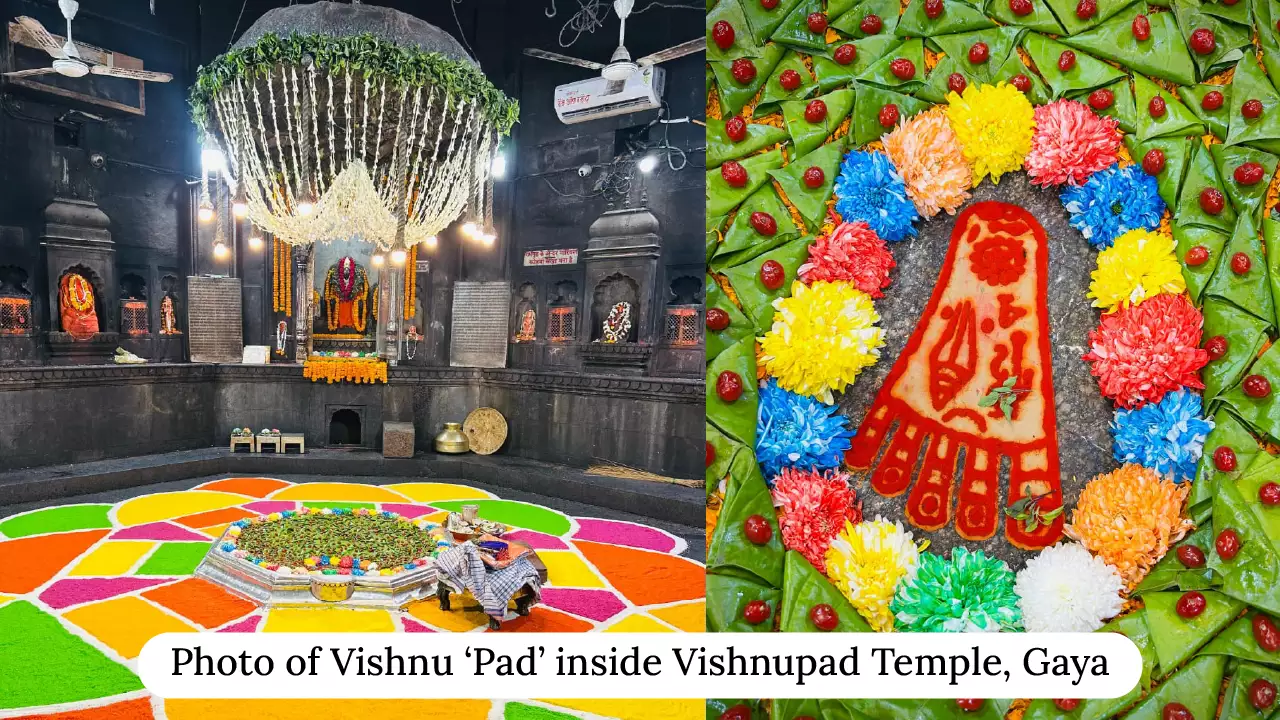
Vishnupad stands beside the Phalgu in the old part of Gaya, and what is in its sanctum is a footprint: a right foot, around forty centimetres long, impressed in stone and set within a silver basin. The tradition is that Vishnu pressed his foot here to hold Gayasur steady, and that the mark is the reason Gaya became the site for ancestral rites.
Why Vishnu’s foot is at Gaya
The Vayu Purana tells it this way. Gayasur was born of asura lineage but was devoted to Vishnu and performed austerities for an age. Brahma granted him his wish: that his body become so pure that anyone who saw or touched him would be liberated at once.
The boon was well meant and it broke the law of karma. People who had not earned moksha received it, Yama’s realms emptied, and the cycle of existence stalled. The Devas went to Vishnu.
Vishnu, who knew Gayasur’s devotion, asked for his body as the altar for a great yajna. Gayasur took it as an honour and laid his form down, his head where Gaya now stands. As Brahma conducted the yajna the body began to stir, so Vishnu set a stone slab on him; when the slab was not enough, he placed his own right foot on it, and Gayasur was still.
Pinned there, Gayasur asked that the spot become the place where shradh and Pind Daan grant liberation to the ancestors they are performed for. Vishnu granted it, named the place Vishnupad, and promised that rites performed here would carry.
Ahilyabai Holkar’s temple
The site is ancient; the building is not. By the eighteenth century the earlier structures needed replacing, and Maharani Ahilyabai Holkar of Indore — who rebuilt temples across much of the subcontinent — commissioned the present one around 1787.
It was built from large blocks of dark grey stone, reported to have come from quarries near Patharkatti, joined with iron clamps. That is why it has lasted, and why it looks the age it does.
The building
- Height. Around thirty metres, a hundred feet, in solid grey mass beside the river.
- Stone. Hard dark granite or basalt in large dressed blocks, closely fitted.
- The mandapa. A large pillared hall before the sanctum, open at the sides, with pillars in the same dark stone — carved, but plainly, with strength as the point.
- The shikhara. The feature that makes it recognisable. Instead of the usual curved tower it rises pyramidally from an octagonal base, tapering to a gilded kalash and a saffron flag. Nothing else on the Gaya skyline looks like it.
- The garbhagriha. Compact relative to the hall, deliberately, so that everything narrows onto the footprint.
- The courtyard. Walled and paved, with room for parikrama and smaller shrines to Shiva as Gopaleshwar Mahadev, Parvati, Ganesh and Surya Narayan.
The footprint
An impression of a right foot in a solid block of stone, about forty centimetres long. Devotees hold that it carries the auspicious marks of Mahavishnu — the conch, the discus, the mace, the lotus — though wear and the weight of offerings make them hard to pick out.
Around it is a basin of solid silver, octagonal or near it, which marks off the impression and holds what people bring: flowers, tulsi, milk, water. Putting an offering into the basin is how a devotee touches the foot.
Darshan
Inside, close to the sanctum, there is continuous chanting from the pandas, bells from devotees entering, and the smell of incense, camphor, ghee lamps and marigolds. Devotees queue for their turn in the garbhagriha, make their offering under the priests’ direction, and come out with prasad.
The moment at the footprint is brief in a crowd. Most people find it is enough.
The Gayawal pandas
The temple’s priests — Gayawals, or pandas — belong to specific brahmin families who have served here for generations, and they are the authorised guides for the shradh rites at Gaya. They facilitate darshan and perform pujas on a devotee’s behalf.
They also keep genealogical registers of the pilgrim families they serve, their jajmans, which is how a family’s earlier visits to Gaya are matched to a current one. If you are coming only for darshan, your dealings with them are brief and confined to the sanctum. If you want rites performed, that is a separate arrangement and worth settling in advance.
The Akshayavat and the Phalgu
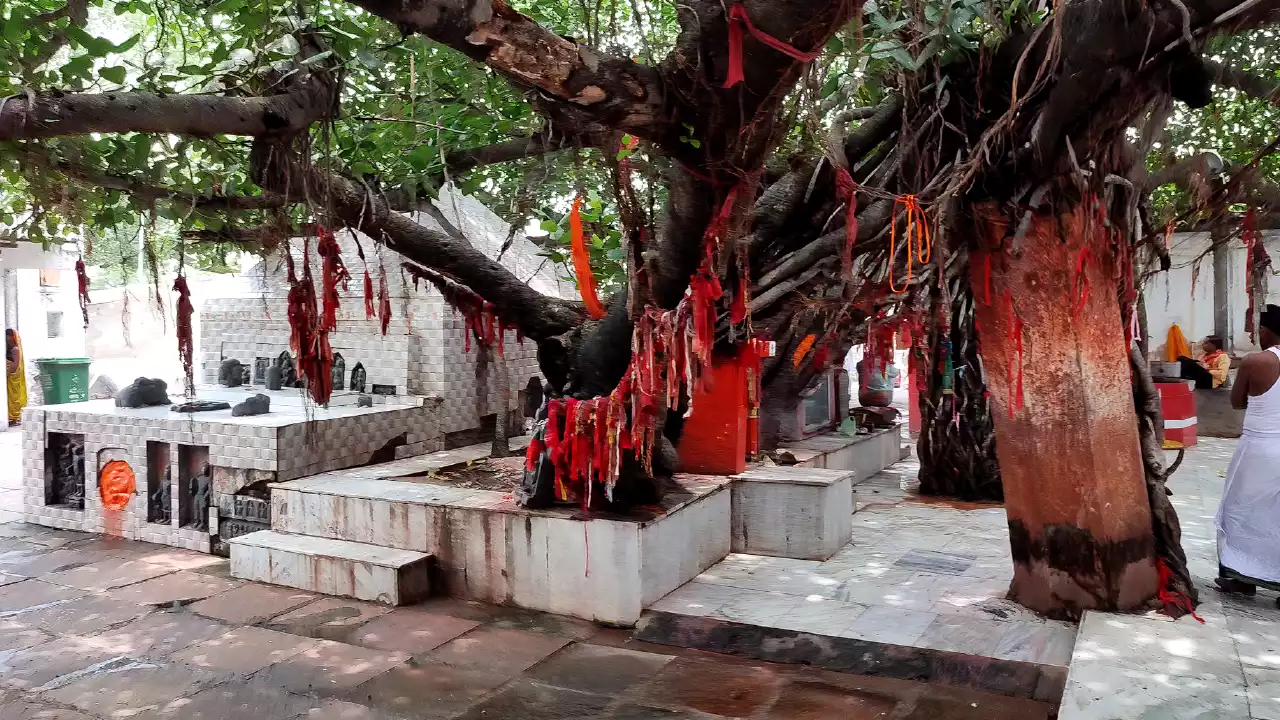
The Akshayavat grows in the temple courtyard — the banyan held to be undecaying, which is what the name means. Rites performed under it are counted as especially meritorious, and the tradition holds that the Gaya pilgrimage is not finished without them. Our note on the Akshayavat covers its place in the sequence.
The Phalgu runs immediately beside the temple, and for most of the year beneath its own sandy bed — antahsalila. The sand is holy regardless, and digging a shallow pit brings up water. Bathing ghats line the bank by the temple, and the river’s water and sand are both used in the Pind Daan, which is why the temple standing where it does matters. Our note on the Falgu explains the river and Sita’s curse.
Visiting
- Where. The older part of Gaya town. Autos and cycle rickshaws go there, and the last stretch is through narrow streets busy with pilgrimage trade.
- Hours. Generally open from around 6 am until eight or nine in the evening, often with an afternoon closure. Confirm locally on the day — the timings move, particularly during Pitru Paksha.
- Dress. Modest. Dhoti, trousers or kurta for men; saree, salwar kameez or a long skirt with shoulders covered for women. Footwear off before the main temple area, with storage usually available for a small fee.
- Photography. Not permitted inside the garbhagriha. Watch for the signs, and keep phones silent.
- Offerings. Flowers, tulsi garlands, fruit or sweets from the vendors outside.
Rites at Vishnupad
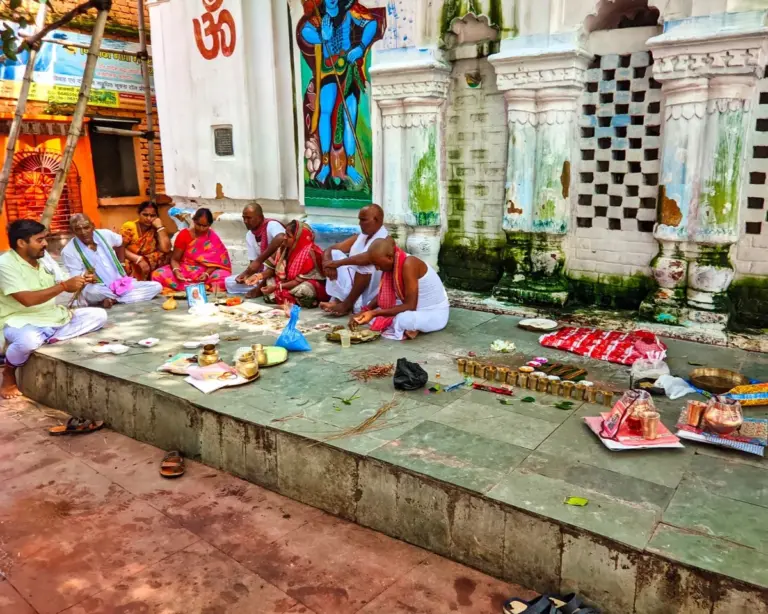
This is the main vedi of the Gaya rite. The sequence runs from the Phalgu bank, to the temple, to the Akshayavat, and our step-by-step guide to the Gaya vidhi sets out each stage. Pretshila is the other site families ask about — see Pretshila Hill.
| Package | Price | What it covers |
|---|---|---|
| Pind Daan in Gaya | ₹7,100 | Vishnupad and the Phalgu ghat, with a Gayawal pandit |
| Pind Daan Gaya Platinum | ₹11,000 | The extended circuit of vedis |
| Online Pind Daan in Gaya | ₹11,000 | Performed on your behalf with a live video link |
For price context across the packages, see the Gaya cost guide.
Arranging a visit
Tell us your gotra, the ancestors the rites are for and when you can travel, and we will confirm the Gayawal pandit, the sites and the total before anything is paid.
Keep reading


Blog
6 min read
Ancestral Rites at Gaya for Families Living Abroad
Questions families ask
The Vishnupad Temple houses the footprint of Lord Vishnu imprinted on rock (Dharmashila). It's a central point of pilgrimage in Gaya. Performing Pind Daan and seeking blessings here is a crucial part of ancestral rites performed in Gaya, often included in the itinerary for Narayan Bali or Pind Daan pilgrims, as Lord Vishnu is the ultimate bestower of Moksha
The Vishnupad Temple, housing Lord Vishnu's footprint, is the spiritual epicenter of Gaya. While Tarpan itself is mainly performed by the Phalgu river, the overall Shraddha ceremony, of which Tarpan is a part, often culminates or includes rites within or near the Vishnupad temple complex. It signifies performing the rituals directly in the presence of Lord Vishnu, enhancing their efficacy
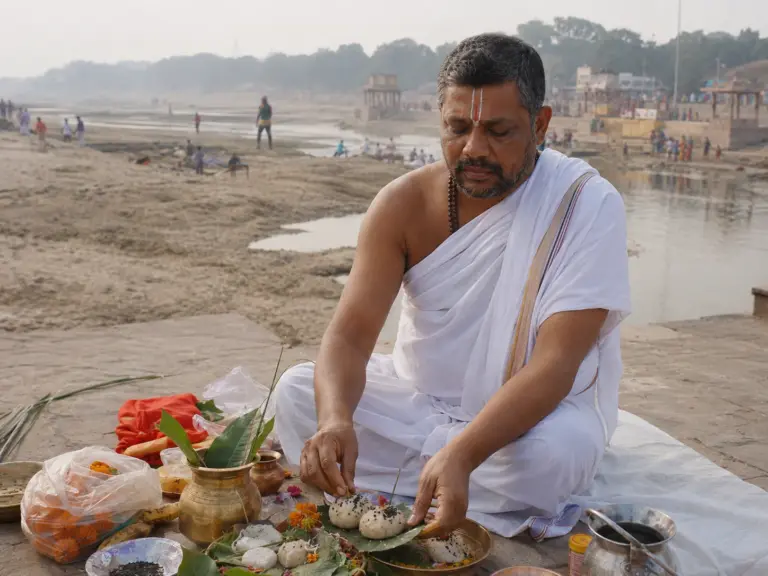
Pind Daan is a vital Vedic ritual wherein offerings called Pinds (rice balls mixed with sesame, barley flour, honey, and ghee) are given to departed ancestors. The aim is to provide peace and liberation (moksha) to the soul. Gaya Ji in Bihar is mentioned in sacred texts like the Garuda Purana and Vayu Purana as the most powerful tirtha for Pind Daan because it is believed Lord Vishnu Himself granted mukti to demon Gayasura’s soul here. The Vishnupad Mandir—where Lord Vishnu’s footprint is present—is the central site where the rituals are conducted. Offering Pind Daan here is said to free even souls trapped in preta-yoni (ghostly form) or suffering in pitru loka.
Pind Daan in Gaya usually spans 1 to 3 days and includes:
Purification rituals (Snan, Sankalp)
- Pind Daan at key sacred spots like Vishnupad Mandir, Phalgu River, Pretshila, Akshay Vat, and Narayan Shila
- Tarpan (water and sesame offerings)
- Brahmin bhojan & dakshina
- Shraddha karma with proper Vedic chanting The ritual must be performed under the guidance of a knowledgeable Gaya Purohit (Gayawal Brahmin).
Pind Daan in Gaya involves performing rituals for the peace of ancestors' souls. It's advisable to contact a local priest or pundit who guides you through the process, which includes offering pind (a rice flour and milk mixture) at specific locations. The ritual is detailed and requires adherence to traditional steps, so having a knowledgeable guide is essential.
While Pind Daan can be done anytime as per family need (especially after a death), the most spiritually potent time is during:
Pitru Paksha (15 lunar days before Sarvapitri Amavasya, usually in September–October)
- Amaavasya days
- Eclipses (Grahans)
- Gaya Mahatmya days (as prescribed in lunar calendar) Performing Pind Daan during these times ensures maximum spiritual merit (punya) and relief for the souls.
Any day throughout the year is valid for Gaya Pind Daan, but certain dates are considered especially auspicious: (1) Pitrupaksha (the 16 days of Bhadrapada Krishna Paksha) is the most spiritually powerful window — during this period, all ancestors are believed to descend to earth to receive offerings, (2) Sarva Pitru Amavasya (the last day of Pitrupaksha) carries maximum merit, (3) Mahalaya Amavasya, Somvati Amavasya, and Mauni Amavasya are also highly auspicious, (4) Solar and Lunar eclipses are traditionally used for ancestral rites, (5) Annual death tithi (Mrityu Tithi) of the departed. Our pandits can guide you to the best date based on your gotra and the nakshatra of the departed soul.
According to the Gaya Mahatmya and Padma Purana, Gaya is named after Gayasura, a powerful demon who performed such intense penance that he earned blessings making his body so pure that anyone touching it would attain moksha. The Devas, unable to manage the flow of liberated souls, requested Lord Vishnu to intervene. Lord Vishnu, in a divine act, pressed Gayasura into the earth with His lotus foot, creating the sacred imprint now worshipped at Vishnupad Mandir. Gayasura requested that Gaya become a place where people could offer Pind Daan to liberate their ancestors. Lord Vishnu granted this boon, thus sanctifying Gaya as the most sacred Pitru Kshetra.
Finding your family's traditional Gayawal Panda is ideal. We Gayawals maintain records (pothi) of families (based on ancestral village/district) who have visited Gaya over generations.
- Ask elders: Check if your family has records or knows the name of your ancestral Panda in Gaya.
- Inquire upon arrival: At the station or near Vishnupad temple in Gaya, there are offices or associations of Gayawal Pandas. You can inquire there, providing your native place details, and they might help locate your family Panda or assign a trustworthy one.
- Recommendations: Ask friends or relatives who have recently performed Shraddh in Gaya.
- Be Cautious: Be wary of random touts. It's best to connect with a Panda through established channels or references for your Shraddh in Gaya. A genuine Gayawal will focus on the ritual propriety first.
Vishnu’s right foot, in the tradition — the foot he placed on the slab over Gayasur to hold him still. The impression is about forty centimetres long.
The present building was commissioned by Maharani Ahilyabai Holkar of Indore around 1787. The site itself is far older.
Roughly 6 am to eight or nine in the evening, usually with an afternoon break. Confirm on the day, especially during Pitru Paksha.
Yes, in the courtyard, which is why the closing pinda of the Gaya rite is offered without leaving the complex.
Still have a question?
Ask our team on WhatsApp and we will help you plan the ceremony.
We reply on WhatsApp within 1–2 hours.
Ask a pandit (opens WhatsApp)Book Your Sacred Ritual
Authentic ceremonies performed by Veda-trained pandits at sacred sites across India.
- Clear package details before you book
- The ceremony in the language you choose
- 2,263+ families served
- Serving since 2019
- GST registered