
Asthi Visarjan in Prayagraj: When to Perform It, and How
Prayag Pandits has performed Asthi Visarjan in Prayagraj for thousands of families across India and abroad. All rituals follow the exact Shastriya vidhi. Pandit Ji contacts you within 2 hours of booking.

Asthi Visarjan is traditionally performed before the tenth day after cremation, and ideally on the third day once the remains have been collected. If more time has passed, the rite is still valid and still worth doing. Families bring remains to the Triveni Sangam months and sometimes years later, and the scriptures make provision for exactly that. At Prayagraj the ceremony takes about ninety minutes and starts at ₹3,100, or ₹5,100 for Asthi Visarjan at the Triveni Sangam with a private boat.
Contents
- When should Asthi Visarjan be performed?
- Why families choose Prayagraj
- What Asthi Visarjan is
- Where at Prayagraj the ceremony is performed
- How the ceremony unfolds
- What to know before you come
- Booking Asthi Visarjan in Prayagraj
- Performing the rite from abroad
- Getting to Prayagraj
- Arranging the ceremony
- Questions families ask
When should Asthi Visarjan be performed?
The short answer is before the tenth day after cremation. The longer answer matters more, because most families asking this question have already passed that window.
The traditional window
The remains, called phool in much of north India, are collected on the third day after cremation. Immersion should follow before the tenth day, while the household is still observing asaucha, the period of ritual impurity after a death. Performing the immersion inside this window completes the antyesti sanskar, the last of the sixteen rites, in its proper sequence.
If more than ten days have passed
This is the most common question we are asked, and the answer is reassuring. The rite remains valid. Where the immersion happens after the tenth day, it should be preceded by a tirtha shraddha ceremony, which we perform at the ghat beforehand. The remains may be kept in a clean vessel, traditionally copper or an earthen pot, for up to a year. Families living abroad routinely wait months for a date when everyone can travel. Delay is not failure, and no one should carry guilt about it.
The most auspicious days
Asthi Visarjan can be performed on any day of the year at Prayagraj. Some days carry particular weight:
- Pitrupaksha and Mahalaya Amavasya. The fortnight of the waning moon in Ashwin, usually September or October. The most meritorious period in the year for every ancestral rite.
- Akshaya Tritiya. The third lunar day of Vaishakh Shukla, in April or May. Merit earned on this day is said to be inexhaustible.
- Somavati Amavasya. A new moon falling on a Monday, considered especially powerful for ancestral worship.
- Kumbh and Magh Mela. During these gatherings the Sangam draws saints and pilgrims from across India, and immersions performed then are held to carry added power.
- Ganga Dashami. The tenth day of Jyeshtha Shukla Paksha, marking the Ganga’s descent from the Himalayas.
Among ordinary tithis, Purnima, Amavasya, Ekadashi and Dwadashi are preferred. Chaturthi and Navami are usually avoided for beginning such rites. If your dates are fixed by travel rather than the calendar, tell us and our pandit will find the best available muhurat inside them.
Why families choose Prayagraj
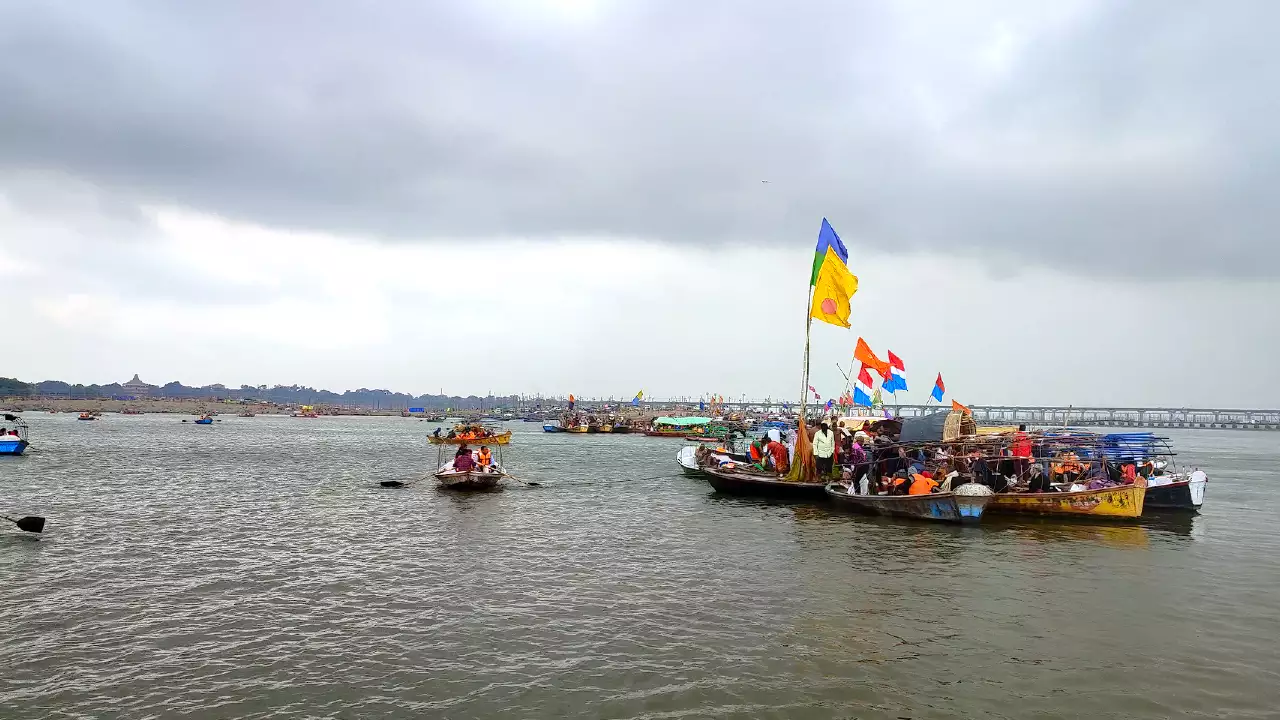
Prayagraj is called Tirthraj, the king of pilgrimage places, and the Matsya, Padma and Skanda Puranas all give it that title. Four things set it apart for this rite.
The confluence of three rivers is the first. The Ganga from the Himalayas, the Yamuna from Yamunotri and the Saraswati, held to flow unseen beneath them, meet at one point. Second, the Brahma Purana places Prayagraj as the ground where Brahma performed the first sacrifice at the beginning of creation. Third, the Akshaya Vat, the undying banyan within the fort, is named in the Puranas as granting liberation to those who perform ancestral rites near it. Fourth, the Ganga turns briefly northward at the Sangam before resuming its course south, and that uttarvahini stretch is treated as especially potent.
Our Prayagraj services cover the full range of ancestral rites at the Sangam, not only immersion.
What Asthi Visarjan is
Asthi means bones, and refers to the partially burnt bone and ash left after cremation. Visarjan means immersion or release. The rite returns those remains to sacred water, completing the last duty a family owes the body their relative lived in.
It is not the same as Pind Daan, and the two are often confused. Asthi Visarjan concerns the physical remains. Pind Daan concerns the subtle body, and is offered through rice-flour balls over a longer sequence. Many families perform both, and they can be done on the same visit.
Where at Prayagraj the ceremony is performed
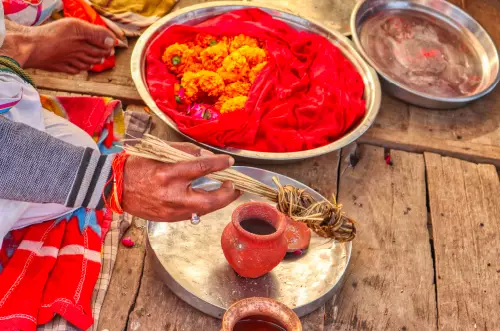
The whole of Prayag Kshetra is sacred, but three choices come up in practice.
The confluence point itself. A boat takes the family to the spot where the currents of the Ganga and Yamuna visibly meet. This is the most sought-after location and the one our boat packages are built around. The ride takes ten to fifteen minutes each way.
The banks near the Sangam. When weather, river conditions or crowds make the mid-stream point difficult, the rite is performed from the bank of either river close to the confluence. This is fully valid. The sanctity of the confluence extends to the banks around it.
Wherever the pandit judges best on the day. River levels at the Sangam change through the year, and during Magh Mela and Kumbh the area is managed differently. Our pandit chooses the appropriate spot for the conditions that morning.
How the ceremony unfolds
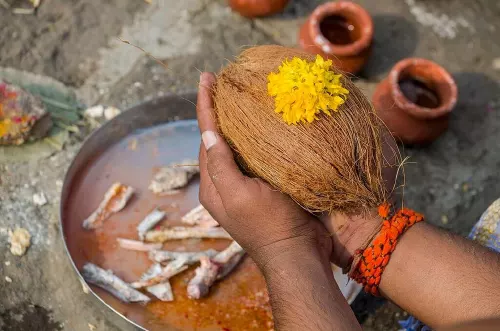
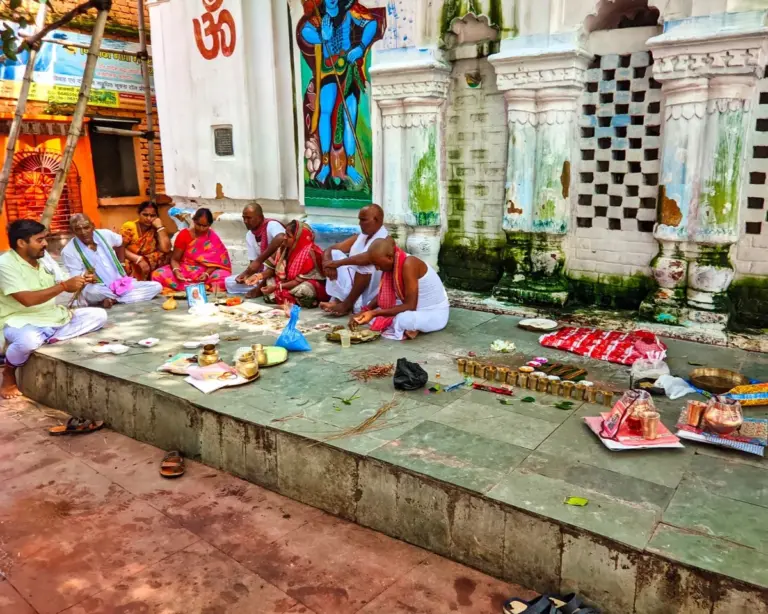
Allow about ninety minutes from meeting the pandit to the closing aarti. This is what happens, in order.
- Before you travel. Our pandit calls you within two hours of booking to confirm your date, the name of the deceased and the gotra. All puja samagri is arranged in advance so nothing has to be bought on the day.
- Meeting at the ghat. He meets you at Sangam Ghat, or at Dasaswamedh Ghat for packages that include a boat. Packages with transfers include pickup from the station or airport.
- Sankalpa. The family member performing the rite, usually the son or eldest male relative, makes the formal declaration of intent, naming the deceased and the purpose. The pandit guides the Sanskrit line by line. Nobody is expected to know it.
- Purification. Achamana and dehavishuddhi, the short purification steps that precede the rite proper.
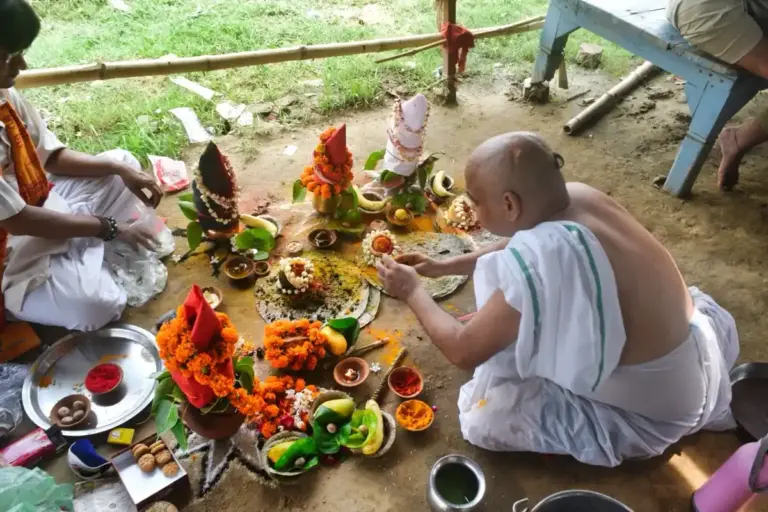
- Pind Daan at the ghat. Rice-flour pindas with sesame, honey and ghee are offered with the appropriate mantras.
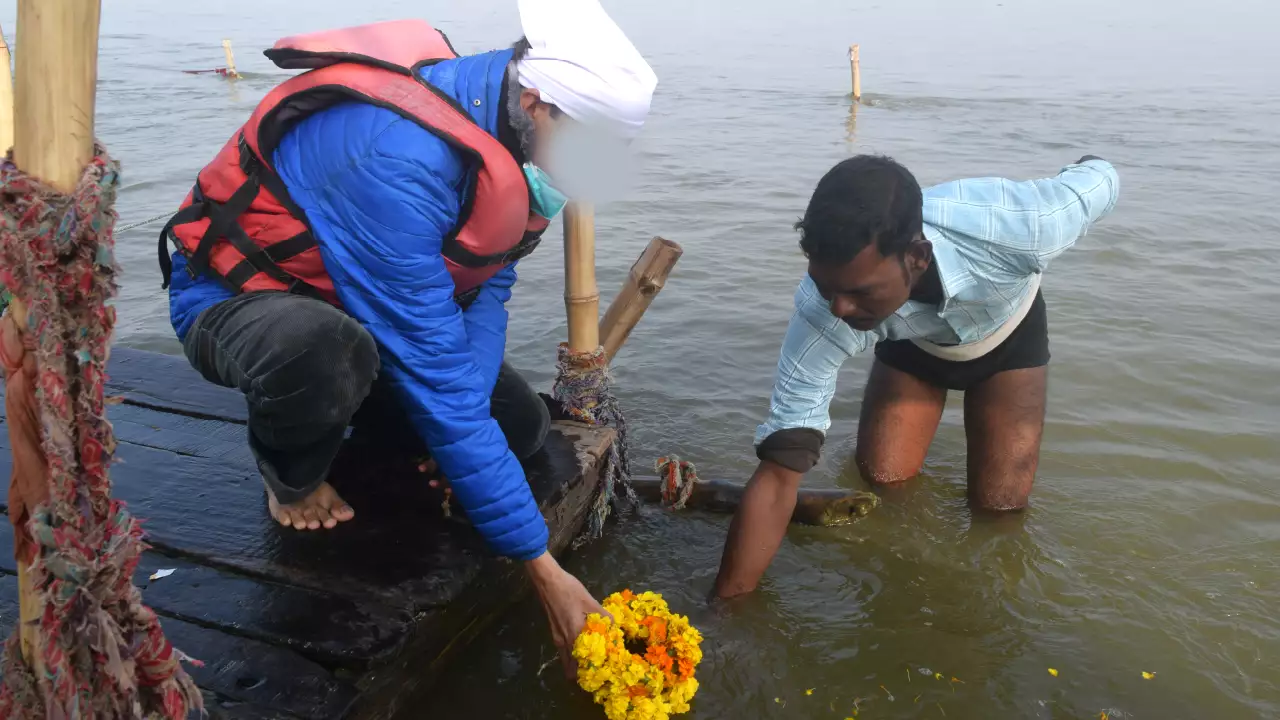
- The boat to the confluence. On boat packages the family goes out to the meeting point of the rivers, ten to fifteen minutes each way.
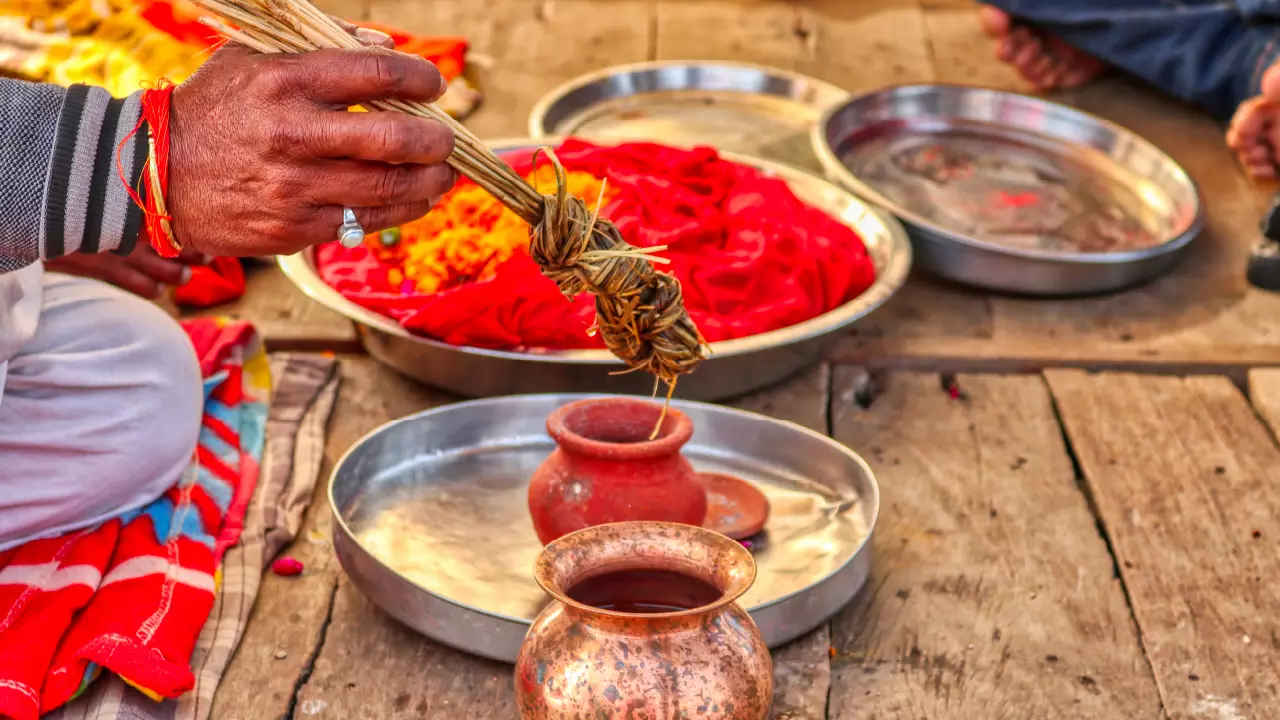
- The immersion. The remains are released into the water with flowers and offerings, to mantras from the Garuda Purana. This part is done slowly. There is no reason to hurry it.
- Tarpan. Water with sesame and kusha grass is offered, the name and gotra repeated, inviting the departed to receive it.
- Aarti and close. The ceremony ends with Ganga aarti and a final prayer.
- Photographs. We send photographs of the ceremony to the family afterwards.
What to know before you come
What to wear. Simple, modest clothing. White is usual for mourning rites, though it is not required.
What to bring. The remains, and the names and gotra of the deceased. We arrange everything else.
The vessel. If the container holding the remains is to be immersed as well, it should be earthen or otherwise biodegradable. Please do not bring plastic to the river, and keep non-biodegradable wrapping out of the offerings.
Grief at the ghat. There is no correct way to hold yourself. Families weep, and families stand silent. Our pandits have sat with both.
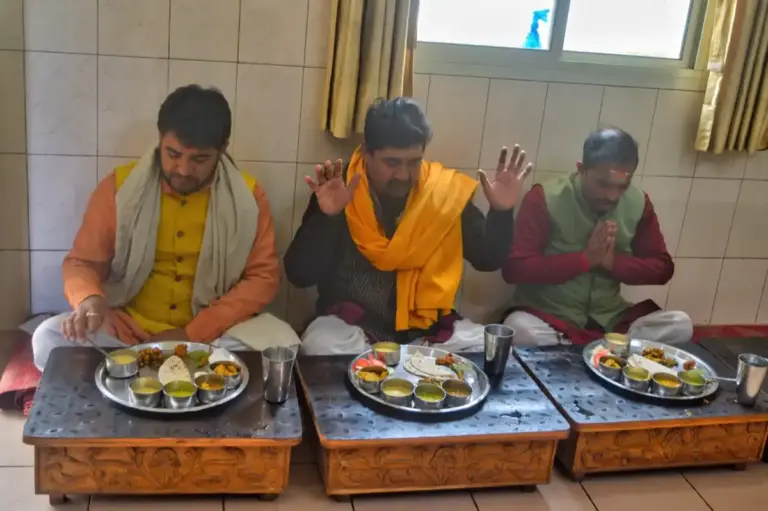
Many families give daan after the rite, feeding the poor or donating cloth or grain. It is customary rather than required, and our pandit can arrange it if you ask.
Booking Asthi Visarjan in Prayagraj
Every package includes the pandit, all puja samagri and photographs of the ceremony. The most commonly chosen is Premium Asthi Visarjan with a private boat at ₹5,100.
| Package | Price | What is included |
|---|---|---|
| Basic, no boat | ₹3,100 | Ghat-side ceremony, samagri, pandit, photographs |
| Premium, private boat | ₹5,100 | Boat to the confluence, full ritual, samagri, photographs |
| Odia families, with boat | ₹5,100 | Odia-speaking pandit, private boat, rite in the Odia tradition |
| Online, for families abroad | ₹9,999 | Send the remains to us, live video, photographs and video |
| Package 2D/1N | ₹13,500 | Two-day itinerary, ritual, accommodation, local travel |
| Silver Seva | ₹14,999 | Ritual, one night’s stay, station or airport transfer |
| Gold Seva | ₹17,999 | Better accommodation, ritual, transfers, meals |
| Platinum Seva | ₹20,999 | Premium stay, all meals, private car, pandit escort |
Odia-speaking families travelling from Odisha can also book our dedicated service for Odisha pilgrims, with the sankalpa spoken in Odia.
To book, choose a package and check out on the site, or call us on +91 77540 97777. Our pandit calls you within two hours to confirm the details. What we do not do is quote one price and ask for more at the ghat.
Performing the rite from abroad
Families who cannot travel can have the ceremony performed on their behalf for ₹9,999. You courier the remains to our Prayagraj address and we guide you through the customs paperwork for international shipments. You join the sankalpa by video call, so the declaration is made in your own voice, and watch the ceremony live on the day. Photographs and video follow afterwards.
We have done this for families in the United States, the United Kingdom, Canada, Australia, Malaysia, Singapore and across the Gulf.
Getting to Prayagraj
Prayagraj Airport is about 12 km from the Sangam, with direct flights from Delhi, Mumbai, Bengaluru and Hyderabad. Prayagraj Junction, station code ALD, is about 7 km away and is served from every major city. By road it is 120 km from Varanasi, 200 km from Lucknow and Kanpur, and 640 km from Delhi.
Autos, e-rickshaws and taxis run from both the station and the airport to the Sangam. On Gold and Platinum packages we collect you and take you to the ghat or your hotel, so there is no city to navigate on a hard day.
Arranging the ceremony
If you are ready, book the Triveni Sangam ceremony or call +91 77540 97777 and we will talk it through. If you are still deciding when to come, tell us the dates you can travel and we will find the muhurat inside them.
Keep reading


Blog
10 min read
Barsi: The Hindu First Death Anniversary, and When It Falls
Questions families ask
The Triveni Sangam itself — the exact confluence point of the Ganga, Yamuna, and the mystical Saraswati — is the most sacred spot for Asthi Visarjan at Prayagraj. Access to the Sangam requires a boat ride (typically 15-20 minutes from the shore). Among the ghats, Arail Ghat and Saraswati Ghat (on the Yamuna side) and Ram Ghat (Ganga side) are the main departure points. Daraganj Ghat, closer to the Allahabad Fort, is another ancient ghat used for Asthi Visarjan. The Kila Ghat near the historic Prayagraj Fort is also scripturally significant. Our pandits can guide you to the exact Sangam point via private or shared boat for the ritual immersion.
Any day is scripturally valid, but certain days carry exceptional merit at Prayagraj. Amavasya (especially Mauni Amavasya, Somvati Amavasya, Mahalaya Amavasya), Purnima, Makar Sankranti, and all days during Pitrupaksha are considered especially auspicious. Mondays (Shiva's day), Thursdays (Brihaspati's day), and Ekadashi days are also recommended. Per Yama cited in the Nirnayasindhu, Sundays, Tuesdays, and Saturdays should be avoided for bone handling if possible — but when the 10-day window is urgent, timeliness takes priority. For delayed Asthi Visarjan, we can choose the most auspicious date based on your family's nakshatra and the departed soul's tithi.
Yes — and in fact Kumbh Mela is considered the most spiritually powerful time for Asthi Visarjan at Prayagraj. During the Purna Kumbh Mela (every 12 years) and the Ardh Kumbh (every 6 years), the spiritual potency of the Sangam is believed to multiply thousands of times. The 2025 Maha Kumbh was the most recent major Kumbh. Many families specifically preserve their relatives' ashes and travel to Prayagraj during Kumbh for the liberation ceremony. During Kumbh, however, crowds are enormous, boat arrangements must be booked months in advance, and prices surge 3-5x. Our pandits handle Kumbh-period Asthi Visarjan with pre-booked boats, dedicated pandits, and priority ritual timing to avoid the chaos.
Yes — to reach the actual Triveni Sangam (the confluence point), a boat ride is essential. The Sangam is located roughly 1 km from the shore, where the distinct colours of the Ganga (clear) and Yamuna (darker) visibly meet. Immersion at the shore does not carry the same scriptural merit as immersion at the confluence itself. Boat rides are of two types: shared public boats (₹50-150 per person, 30-45 minutes wait) and private pandit-arranged boats (₹800-2,500 per boat, immediate departure, seats 6-10 people). Our Prayagraj Asthi Visarjan packages include private boat arrangement, trained pandit on the boat and the complete scriptural vidhi performed at the exact Sangam point.
The cost of asthi visarjan in Prayagraj can vary depending on the services and the package chosen.
It usually ranges from INR 5,100/- (basic asthi visarjan package including pandit charges and pooja material) to INR 12,000/- (premium package including airport transfers, hotel stay for 2, pandit ji charges, boat ride to sangam, pooja samagri).
The cost typically includes the services of a pandit, pooja materials, boat ride to reach Sangam, and other rituals associated with the ceremony. Some service providers offer customized packages based on the devotee's requirements and availability.
Yes. The scriptures do not impose an upper time limit on Asthi Visarjan — ashes preserved for 5, 10, 20, or even 50+ years can be immersed at Prayagraj with full scriptural validity. When significantly delayed, the ceremony is typically combined with Shraddha and Pind Daan to restore the soul's spiritual balance. Some families bring ashes preserved through generations — grandparents' or great-grandparents' ashes that could never be immersed due to partition, war, migration, or other circumstances. Our pandits conduct these multi-generational Asthi Visarjan ceremonies with the proper scriptural procedure, treating them as "combined ancestral liberation" rituals. No judgment, no surcharge for delay — only compassion and complete Vedic observance.
Pind Daan is a sacred ritual that requires adherence to certain rules and guidelines as per Hindu traditions. Here are some key rules to follow:
- Eligibility: Pind Daan is typically performed by the eldest son or a male relative of the deceased. In the absence of a male heir, the daughter or the wife can perform the ritual.
- Dress code: Wear clean, simple, and preferably white or light-colored clothes. Men should ideally wear a dhoti and kurta, while women can wear a saree or a suit.
- Fasting: The person performing the Pind Daan is expected to fast on the day of the ceremony until the rituals are completed. Some also observe a partial fast the day before.
- Offerings: The main offerings for Pind Daan include black sesame seeds, barley, kusha grass, and water. These are offered along with the pind (rice balls) to the ancestors.
- Rituals: The ceremony may involve multiple rituals such as tarpan (offering water), pind daan (offering rice balls), and shraadh (invoking ancestors). Follow the pandit's instructions carefully during each step.
- Timing: Consult with the conducting organization regarding the timings. Pind daan can be done from early morning up until early evening. Contact us to know more.
- Respect and devotion: Maintain a respectful and devoted attitude throughout the ceremony. Focus on the prayers and the significance of the ritual.
It's important to consult with the pandit or the organization conducting the Pind Daan for any specific rules or customs that need to be followed. Adherence to these rules and performing the Pind Daan with sincerity and devotion is believed to bring peace and salvation to the departed soul.
View our pind daan pooja package here.
Pind daan in Praygaraj
- Pind Daan can be performed anytime during the year in Prayagraj, but the most auspicious time is considered to be during the Pitru Paksha period, which is a 15-day period before Navratri. This year in 2024, it is falling between 17 September to 2 October.
- Pitru Paksha usually falls in the Hindu month of Ashwin (September-October). Many Hindus flock to Prayagraj during this time to perform the sacred ritual for their ancestors.
- While Pitru Paksha is considered the most favorable, Pind Daan can also be done on the death anniversary (tithi) of the deceased or on any other date as per the Hindu calendar.
- The specific muhurat (auspicious time) for the ritual on the chosen day is usually suggested by the pandit based on the birth star of the deceased.
So in summary, while Pind Daan can be done anytime, Pitru Paksha in the month of Ashwin is deemed the most opportune period. One can also choose the death anniversary date or consult a priest to determine a suitable date and muhurat.
View our pind daan in prayagraj package here.
Yes. It is better done sooner, but families bring remains after several years and the rite is performed in full, preceded by a tirtha shraddha.
Yes. The rite is traditionally performed by a son, but where there is no son, a daughter, grandson, brother or nephew may perform it. Our pandits conduct it either way.
No. Asthi Visarjan immerses the physical remains. Pind Daan is a separate rite for the subtle body. Both can be done in one visit.
A family can immerse remains themselves. A pandit matters for the sankalpa and the mantras, which carry the intent of the rite, and for dealing with the ghat so the family does not have to.
Still have a question?
Ask our team on WhatsApp and we will help you plan the ceremony.
We reply on WhatsApp within 1–2 hours.
Ask a pandit (opens WhatsApp)Book Your Sacred Ritual
Authentic ceremonies performed by Veda-trained pandits at sacred sites across India.
- Clear package details before you book
- The ceremony in the language you choose
- 2,263+ families served
- Serving since 2019
- GST registered