
Tarpan Mantras: Sanskrit, Meaning and How to Offer
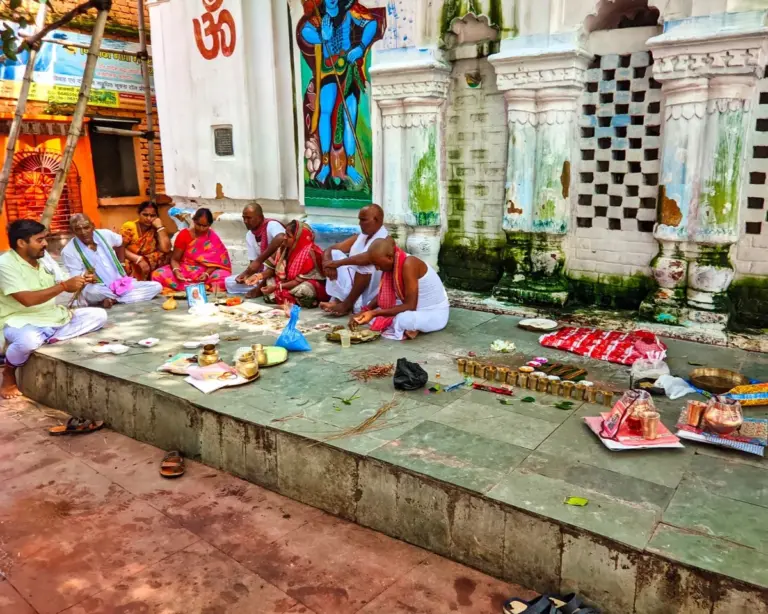
Prayag Pandits has performed tarpan at the Triveni Sangam, Gaya, Kashi and Haridwar since 2009. If you are performing it at home and want the sankalpa taken correctly, send your gotra and your ancestors’ names on WhatsApp and a pandit will write it out for you.

Tarpan is the offering of water to the ancestors, made with black sesame and kusha grass held in cupped hands and poured while reciting the mantras below. The word means to satisfy. The core mantra of the rite is Om Sarva Pitru Devataabhyo Namah — salutations to all ancestor deities — offered three times for each ancestor, facing south.
This page gives the sankalpa that opens the rite, the three hand positions the shastras prescribe, each of the principal mantras in Sanskrit with transliteration and meaning, the materials you need, the full procedure, and how the practice differs by region. For the stage-by-stage vidhi — rishi, divya manushya, pitru and yama tarpan as separate offerings — see the tarpan vidhi guide.
The sankalpa, before any offering
Every tarpan opens with the sankalpa, the formal vow of intention. Without it the offering has no address. The karta holds water, sesame and darbha grass and recites:
Om Adya [tithi] [nakshatra] Asmat Pitri Pitamaha Prapitamaha Sapatnikanam Akshayatripti-sampadanartham Pitri Tarpanam Karishye
“Today I perform this tarpan for my father, grandfather and great-grandfather, and their wives, to grant them imperishable satisfaction.”
The sankalpa carries your own name and gotra, and the names of the ancestors where the family knows them. Where the gotra is not known, say so to the pandit rather than guessing — there is an established way of handling it.
The three tirthas — how to hold your hand
Water is poured from a different part of the hand depending on who receives it. This is the detail most often got wrong when families perform tarpan at home, and it is the one a pandit corrects first.
| Tirtha | Poured from | Facing | For |
|---|---|---|---|
| Deva tirtha | The fingertips | East | The gods |
| Kaya tirtha | The base of the little finger | North | The rishis, with water mixed with barley |
| Pitru tirtha | Between thumb and index finger | South | The ancestors, with water mixed with black sesame |
Pitru tirtha is the position that matters most during Pitru Paksha. Three anjalis — cupped handfuls — are offered for each ancestor.
The tarpan mantras
Pitru Gayatri mantra
The principal invocation, calling the ancestors to the rite and offering them peace. Chanted eleven times.
ॐ पितृगणाय विद्महे जगत धारिणी धीमहि तन्नो पितृो प्रचोदयात्।
Om Pitriganaya Vidmahe Jagat Dharini Dhimahi Tanno Pitro Prachodayat.
“We meditate on the assemblage of ancestors, the sustainers of the world. May the ancestors inspire and enlighten us.”
Pitru Dosha Nivarana mantra
Recited where a family has not kept the ancestral rites for some years and wishes to begin again.
ओम श्रीं सर्व पितृ दोष निवारणाय क्लेशं हं हं सुख शांतिं देवि फट् स्वाहा।
Om Shreem Sarva Pitru Dosh Nivaranaaya Kleshm Ham Ham Sukh Shantim Devi Phat Swaha.
“Om, we bow to all ancestors. May all afflictions and disturbances caused by ancestral neglect be removed, bringing peace and tranquillity.”
The general tarpan mantra
Recited while the water and sesame are poured. This is the mantra most families use.
ॐ सर्व पितृ देवताभ्यो नमः।
Om Sarva Pitru Devataabhyo Namah.
“Om, salutations to all ancestor deities.”
The Swadha mantra
Repeated three times, reinforcing the offering so that it is received. Swadha is the word by which an oblation is given to the ancestors, as svaha is for the gods.
ॐ सर्व पितृ देवा नमः। तस्मै स्वधा नमः। तस्मै स्वधा नमः। तस्मै स्वधा नमः।
Om Sarva Pitru Devaaya Namaha. Tasmai Swadha Namaha. Tasmai Swadha Namaha. Tasmai Swadha Namaha.
“Om, salutations to all the deified ancestors. Salutations to them with the offering of Swadha.”
What you need
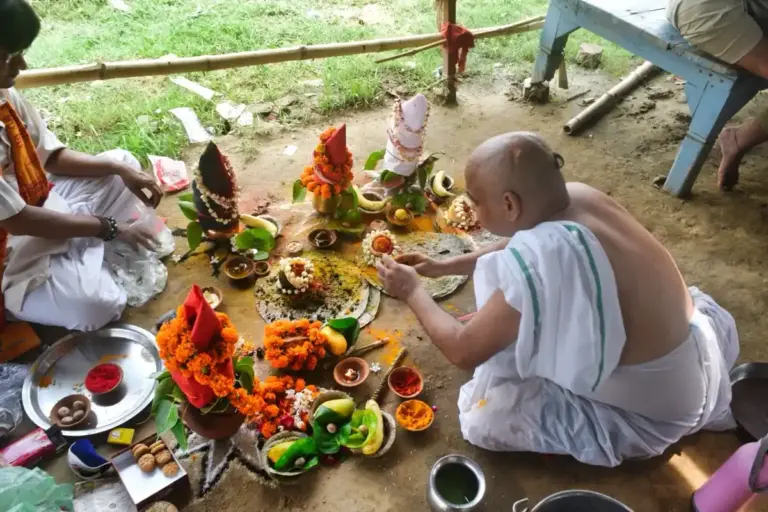
- Water — from the Ganga where you have it, otherwise clean water in a copper vessel
- Black sesame (kala til) for the pitru offerings
- Kusha grass (darbha), held in the hand throughout
- Barley (yava) for the rishi offerings
- White flowers and a little rice
- A copper or brass vessel and a plate to receive the poured water
- Unstitched cloth for the karta — traditionally a white dhoti
How tarpan is performed
- Bathe and dress. Rise before sunrise, bathe, and put on clean unstitched cloth. At a tirtha the bath is taken in the river itself.
- Sit facing the right way. East or north for deva and rishi tarpan; south for pitru tarpan, with the thread on the right shoulder.
- Take the sankalpa. Water, sesame and darbha in the hand, and the vow recited as above with your gotra and your ancestors’ names.
- Deva tarpan. Water from the fingertips, facing east.
- Rishi tarpan. Water mixed with barley, from the base of the little finger, facing north.
- Pitru tarpan. Water with black sesame, from between thumb and index finger, facing south — three anjalis for each ancestor, with the mantras above.
- Close. Offer the remaining water, bow to the ancestors, and give what you can to someone in need.
The full vidhi guide sets out each stage with the mantras that belong to it, including yama tarpan.
When tarpan is performed
Daily, by householders who keep the practice. On the annual death tithi. On amavasya each month. And above all through the sixteen days of Pitru Paksha — 26 September to 10 October in 2026 — when many families offer tarpan every morning rather than only on their own tithi. The Shradh dates calendar gives the tithi-by-tithi schedule, and the Pitru Paksha guide covers the fortnight itself.
Regional practice
In north India tarpan is offered at the river, most often the Ganga, and the Gangetic tirthas draw families from across the plains. In Bengal the great occasion is Mahalaya, the amavasya that closes Pitru Paksha, when families gather at the ghats before dawn — the single largest day of tarpan anywhere in the country. In the south the rite is tharpanam, kept with particular regularity on amavasya and often performed at home; see the Tamil guide to pithru tharpanam. In the west, families commonly combine tarpan with shradh on a single day rather than keeping it as a daily observance.
Beneath the regional pattern, every family has its own kulachar — the number of offerings, the ancestors named, the order. Where an elder has given you the family’s way, follow that before anything on this page.
Having tarpan performed for you
| Where | Price | Note |
|---|---|---|
| Prayagraj — Triveni Sangam | ₹5,100 | Sankalpa in your gotra and ancestors’ names |
| Varanasi | ₹5,100 | At the Kashi ghats |
| Haridwar | ₹5,100 | At Har Ki Pauri |
| Gaya — the Falgu | ₹11,000 | Performed with the Gaya shradh tradition |
Families abroad join by live video while the pandit performs at the ghat, with the sankalpa taken in your name. A recording follows. See the guide for families abroad.
Keep reading


Blog
10 min read
Barsi: The Hindu First Death Anniversary, and When It Falls
Questions families ask
According to the Manual of Hindu Funeral and Ancestral Rites, Pitru Tarpan for direct ancestors is performed using Pitru Tirtha (water offered through the space between thumb and index finger), facing South, with the sacred thread on the right shoulder (Apasavya). Three anjalis (handfuls) of water mixed with black sesame seeds are offered for each ancestor:
For the Father (Vasu form): Om Adya Asmatpita [Gotra] [Name] Sharma/Varma/Gupta Vasuswarupah Idam Satilam Gopuchchodakam Tasmai Svadha Namah
For the Grandfather (Rudra form): Om Adya Asmatpitamaha [Gotra] [Name] Sharma/Varma/Gupta Rudraswarupah Idam Satilam Gopuchchodakam Tasmai Svadha Namah
For the Great-grandfather (Aditya form): Om Adya Asmatprapitamaha [Gotra] [Name] Sharma/Varma/Gupta Adityaswarupah Idam Satilam Gopuchchodakam Tasmai Svadha Namah
For the Mother (Vasu form): Om Adya Asmanmata [Gotra] [Name] Devi Vasuswarupa Idam Satilam Gopuchchodakam Tasyai Svadha Namah
Replace [Gotra] with your family gotra and [Name] with the ancestor"s name. For Sharma/Varma/Gupta, use the appropriate varna suffix. Each ancestor form (Vasu for parents, Rudra for grandparents, Aditya for great-grandparents) reflects the scriptural understanding of their progression toward liberation.
The sankalpa (formal vow of intention) is recited at the beginning of Pitru Tarpan to formally commit to the ritual and to specify which ancestors are being honoured. The standard format includes your name, gotra, and the intention to satisfy the father, grandfather, and great-grandfather along with their wives:
Om Adya [Tithi] [Nakshatra] [Date] Asmat Pitri Pitamaha Prapitamaha Sapatnikanam Akshayatripti-sampadanartham Pitri Tarpanam Karishye
Translation: Today, on this [tithi] in the [nakshatra], I, [Name] of [Gotra], perform this Pitru Tarpan rite for my father, grandfather, and great-grandfather along with their wives, to grant them imperishable satisfaction.
Before reciting the sankalpa, the performer (Karta) takes a ritual purification bath (Snan), wears clean white clothes, holds the sacred thread (Yajnopavita) in the Apasavya position (right shoulder, left hip) for ancestral rituals, faces South, and holds water, sesame seeds, and darbha grass in his right hand while the sankalpa is recited by the officiating pandit.
The Hindu tradition prescribes three specific hand positions called Tirthas for offering water during Tarpan, each used for a different category of beings:
1. Deva Tirtha (Fingertips): Used for offering water to Devas (gods). The performer faces East with the sacred thread in normal position (Savya), holding water in the right hand with the tirtha at the fingertips. Water is offered with one anjali per deity.
2. Kaya Tirtha (Base of the little finger): Used for Rishis and Divya Manushya (divine beings). Facing North, the sacred thread is worn like a necklace (Kanthi). Water mixed with barley is offered from the base of the little finger. Rishi mantras include: Om Marichistripyatam, Om Atristripyatam, Om Angirastripyatam, Om Pulastyastripyatam, Om Pulahastripyatam, Om Kratustripyatam, Om Vashisthastripyatam, Om Prachetastripyatam, Om Bhrigustripyatam, Om Naradastripyatam.
3. Pitru Tirtha (Space between thumb and index finger): Used for ancestors (Pitrus) and Yama. Facing South, with the left knee touching the ground and sacred thread on the right shoulder (Apasavya), water mixed with black sesame seeds is offered through the space between the thumb and index finger. Three anjalis each are offered for the father, grandfather, and great-grandfather forms. This is the most important position during Pitrupaksha Tarpan.
Yes, specific Vedic mantras are chanted during Tarpan and Pind Daan rituals in Pitru Paksha. These mantras invoke the ancestors, request them to accept the offerings, and pray for their peace and liberation. Mantras often vary based on the specific ritual and family tradition. Consulting a priest or prayer book is recommended for correct pronunciation and usage.
Mantras are spiritual vibrations that link the devotee, the soul of the ancestor, and the divine. During Pind Daan, key mantras include:
- Shraddha Mantras
- Pitru Sukta
- Gayatri Mantra
- Vishnu Sahasranama These mantras:
- Uplift the soul from Bhuvar Lokas to higher realms
- Create a sanctified space
- Purify the performer’s karma It is essential that the Purohit recites them clearly and you listen with focus and devotion.
Yes, the Pandit chants specific Vedic mantras appropriate for the occasion. While the Karta may not chant complex mantras, they will repeat prayers and intentions as guided by the Pandit. Some key elements involve:
- Mantras invoking Ganga, Yamuna, Saraswati, and the Triveni Sangam.
- Prayers to Lord Vishnu, Lord Yama, and Agni (who consumed the body).
- Mantras seeking peace and liberation for the departed soul (e.g., mentioning their name and Gotra).
- Specific mantras during the act of immersion for purification and safe passage of the soul.
- Mantras for Tarpan.
Trust the Pandit to chant the appropriate mantras; your role is to participate with faith and devotion.
Yes, chants like the "Gayatri Mantra" and "Yama Suktam" from the Vedas are often recited to appease ancestors.
Mantras like the Pitra Gayatri Mantra ("Om Pitra Ganaya Vidmahe, Jagat Dharine Dheemahi, Tanno Pitro Prachodayat"), Maha Mrityunjaya Mantra, Vishnu Mantras (like "Om Namo Bhagavate Vasudevaya"), or specific Pitra Dosh Nivaran Mantras ("Om Shreem Sarva Pitra Dosha Nivaranay klesham Han Han Sukh Shantim Dehi Phat Swaha") are recommended. The Pitra Gayatri is set out in full on our Pitra Gayatri Mantra page, and where the dosh traces to an unnatural death the rite prescribed is Narayan Bali.
Yes. Where there is no son, or where the family chooses it, a daughter or another woman of the family performs the rite, and the purohits at Prayagraj and Gaya conduct it without qualification.
Yes, and most families do. A tirtha carries greater scriptural merit; it is not a requirement.
Offer on the next amavasya. The annual tithi comes round again, and there is no penance owed for a lapse — begin again and continue.
Shradh is the whole ceremony; tarpan is the water offering within it, and pind daan the offering of the rice balls. Tarpan can stand alone as a daily practice; the other two cannot.
Keep a sattvic diet for the fortnight — no meat, fish, eggs, alcohol, onion or garlic — and eat only after the day’s offering is complete.
Offer at home into a clean vessel and pour the collected water at the root of a tree, or into any flowing water afterwards. The offering is made valid by the sankalpa and the mantras, not by the location.
Still have a question?
Ask our team on WhatsApp and we will help you plan the ceremony.
We reply on WhatsApp within 1–2 hours.
Ask a pandit (opens WhatsApp)Book Your Sacred Ritual
Authentic ceremonies performed by Veda-trained pandits at sacred sites across India.
- Clear package details before you book
- The ceremony in the language you choose
- 2,263+ families served
- Serving since 2019
- GST registered