
Narayan Bali Puja: Who Needs It, Vidhi and Cost
Narayan Bali Poojan liberates souls trapped in preta state due to unnatural death. Learn the 3-day vidhi, sacred locations, and how to arrange this powerful ritual at Prayagraj.

When a family member departs this world through unnatural means — an accident, suicide, drowning, snake bite, or any sudden violent death — the soul often cannot complete its onward journey. It remains trapped between worlds as a preta (wandering spirit), unable to receive the nourishment of Shradh offerings or attain sadgati (liberation). The family, in turn, may experience the afflictions of Pitru Dosha — persistent misfortune, health troubles, financial setbacks, and obstruction in marriages and childbirth.
Contents
- What is Narayan Bali Poojan? The Scriptural Foundation
- When Should Narayan Bali Poojan Be Performed?
- The Three-Day Procedure: Narayan Bali Poojan Vidhi
- Watch: Narayan Bali Poojan at Prayagraj
- Where to Perform Narayan Bali Poojan: Sacred Locations
- Narayan Bali vs. Regular Pind Daan: Understanding the Difference
- Narayan Bali or Tripindi Shradh — which does your family need?
- The Benefits and Spiritual Outcomes of Narayan Bali Poojan
- What it costs
- Narayan Bali Poojan for NRI Families: Remote Arrangements
- What Does the Prayag Pandits Package Include?
- Preparing for the Poojan: What Families Should Know
- What happens after the puja
- Can it be done at home?
- Narayan Bali at Prayagraj vs. Trimbakeshwar: Which Should You Choose?
- Connect With Prayag Pandits to Book Your Narayan Bali Poojan
- Book Narayan Bali
- Questions families ask
Narayan Bali Poojan is the sacred Vedic remedy prescribed specifically for these souls. Described in the revered Garuda Purana, it is one of the most powerful and comprehensive rituals in the Hindu tradition — a three-day ceremony that recreates the full funeral rites for a soul that never received them properly, freeing it permanently from its earthly bonds. At Prayag Pandits, we guide families through this profound ritual with reverence, scriptural precision, and deep compassion for the pain behind the need.
What is Narayan Bali Poojan? The Scriptural Foundation
The Garuda Purana, one of the eighteen Mahapuranas, dedicates several chapters to the subject of ancestral rites and the plight of souls who die in unnatural circumstances. According to these sacred texts, a soul that departs through akal mrityu (untimely death) is denied the normal post-death rituals — cremation rites, the thirteen-day mourning period, Shradh ceremonies, and tarpan offerings. Without these, the soul cannot proceed to Pitru Loka (the realm of ancestors) and instead wanders as a preta, causing distress to its descendants through what is collectively called Pitru Dosha.
Narayan Bali is the ritual solution. The name itself reveals the essence: Narayan refers to Lord Vishnu, the sustainer of the universe and the presiding deity of liberation, and Bali means an offering. The ritual invokes Lord Narayan as the supreme liberator and offers a symbolic body — made of wheat flour (atta) — as a replacement vessel for the trapped soul. Through Vedic mantras and precise ritual procedures, the soul is invited to inhabit this symbolic body, which then receives complete cremation rites. The soul is thereby liberated.
The ritual is often performed together with Nag Bali — a companion ceremony for those who have committed the brahma hatya equivalent of killing a serpent (snake). When performed together, the combined ceremony is known as Narayan Nag Bali, which spans three days and involves five learned priests (pandits), multiple offerings, and recitation of specific Vedic hymns.
When Should Narayan Bali Poojan Be Performed?
Families typically seek Narayan Bali Poojan when they notice persistent patterns of misfortune that conventional remedies have not resolved, or when they know or suspect a family member died unnaturally. The Garuda Purana prescribes this ritual in all cases of the following types of death:
- Accident — road accidents, workplace injuries, falls
- Drowning — in rivers, wells, or any body of water
- Suicide — death by one’s own hand in any manner
- Murder — killing by another person
- Snakebite — death from venomous creatures
- Lightning strike
- Fall from height — mountain, tree, building
- Starvation — death from hunger or severe deprivation
- Animal attack
- Arson or fire
- Curse (shaap) — death attributed to a divine or ancestral curse
- Epidemics or sudden infectious disease — including untimely deaths from illnesses like COVID-19
Beyond these specific causes, Narayan Bali is also prescribed for those who died as great sinners, those for whom proper last rites were never performed (perhaps due to a body not being found or lost at sea), and those whose souls manifest as troubled presences disturbing the family. When in doubt, consulting a learned pandit who can examine the family’s astrological chart and ancestral history is always advisable.
The Three-Day Procedure: Narayan Bali Poojan Vidhi
The Narayan Bali Poojan is an elaborate three-day ritual conducted on the banks of a sacred river. It requires five experienced Brahmin priests who are versed in the specific Vedic hymns and procedural sequences. Here is how the three days unfold:
Day 1 — Narayan Bali: Liberation Rites for the Unnatural Death
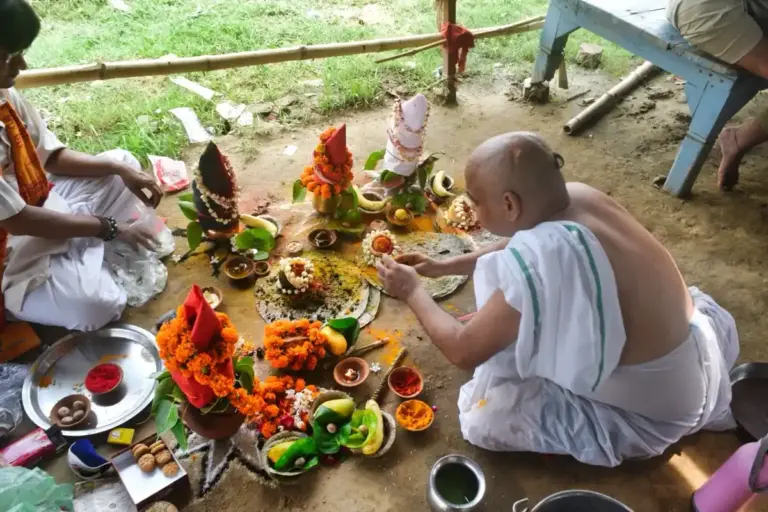
The first day is dedicated to the Narayan Bali proper. The family begins with Sankalp — a solemn declaration of intent before the presiding deities, naming the deceased ancestor and the purpose of the ritual. A symbolic body is then fashioned from wheat flour (atta ki moorti), representing the departed soul. This effigy is treated with full reverence, as if it were an actual human body.
The priests invoke the trapped soul through specific mantras, requesting it to take residence in the symbolic body. Five separate offerings (bali) are made to the presiding deities: Brahma, Vishnu, Shiva, Yama (the god of death), and the Preta (the departed soul itself). The symbolic body is then carried in a ceremonial procession to the riverbank and cremated with full Vedic rites — including the lighting of the pyre with proper mantras and the performance of the Antyesti (last rites) as if for a real body. This act formally liberates the soul from its preta state.
Day 2 — Nag Bali: Expiation for the Sin of Serpent Killing
The second day is reserved for Nag Bali, which addresses the sarpa dosha — the spiritual debt incurred through the killing of a snake, particularly a cobra, which is considered a sacred creature associated with Lord Shiva and the Naga deities. A golden or clay image of a serpent (nag pratima) is created and worshipped with full puja. Mantras are chanted for expiation of this specific sin, and the image is then ceremonially immersed in the sacred river. The Nag Pujan performed on this day also invokes the blessings of the Naga clan, seeking their forgiveness and protection for the family.
Day 3 — Ganesh Pujan, Punya Wachan, and Consolidation
The third and final day is one of consolidation and blessing. It begins with Ganesh Pujan, invoking Lord Ganesha as the remover of all obstacles and the deity who seals the successful completion of any sacred act. This is followed by Punya Wachan — the recitation of auspicious Vedic hymns that sanctify the family and announce to the divine realm that the rites have been completed with proper intent and procedure.
The third day also includes the five Gau Daan (cow donations), which are an integral part of the complete ceremony. Gau Daan is considered one of the most meritorious acts in Hinduism — the offering of a cow (or its equivalent monetary value) to a Brahmin on behalf of the departed soul is believed to ease its journey through the subtle realms. The merit of the Gau Daan travels with the soul, providing it sustenance and divine grace on its onward path.
Watch: Narayan Bali Poojan at Prayagraj
Where to Perform Narayan Bali Poojan: Sacred Locations
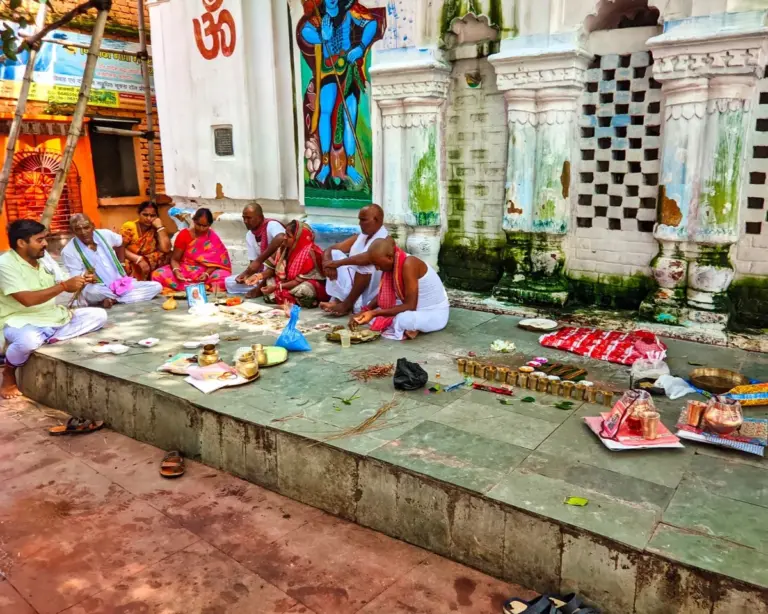
Narayan Bali Poojan must be performed at a teerth sthal — a sacred pilgrimage site, preferably on the banks of a holy river. The ritual cannot be conducted at home or in a general temple setting; it requires the sanctifying power of a sacred geography. There are three primary locations recommended in the scriptures and recognised by tradition:
Prayagraj (Triveni Sangam)
Prayagraj — the ancient Prayag, where the Ganga, Yamuna, and the invisible Saraswati converge at the Triveni Sangam — is one of the holiest sites in all of Hinduism. The Padma Purana declares Prayagraj to be the Teerth Raj, the king of all pilgrimage sites. The sacred confluence amplifies the power of any ritual performed here manifold. Narayan Bali Poojan at Prayagraj is performed directly on the banks of the Sangam, and the symbolic body is immersed in the confluent waters — a deeply auspicious act. Prayag Pandits has conducted this ritual at Prayagraj for many families and is uniquely positioned to facilitate it with full scriptural adherence.
Gaya (Bihar)
Gaya is the foremost Pitru Teerth in Hinduism — the city specifically consecrated for ancestral rites. The Vishnu Padam temple at Gaya enshrines the footprint of Lord Vishnu himself, and the Falgu river here is considered particularly powerful for all Pitru-related rituals. The Garuda Purana specifically mentions Gaya as a site where Narayan Bali is especially efficacious. Families who perform Pind Daan in Gaya often combine it with Narayan Bali Poojan in the same visit for a comprehensive ancestral rites ceremony.
Trimbakeshwar (Nashik, Maharashtra)
Trimbakeshwar in the Nashik district of Maharashtra is particularly renowned for Narayan Bali — it is, in fact, the location where certain aspects of the ritual (particularly the offering to Brahma) can be performed in a form that Brahmin priests from other teerths may not be fully trained to perform. The Godavari river originates near Trimbakeshwar, and the sanctity of this Jyotirlinga location makes it exceptionally powerful for liberation rituals. Families from Maharashtra and Western India typically prefer this location. For a complete guide to what this ceremony involves at Trimbakeshwar — the vidhi, the eligible cases, and the cost — see our detailed article on Narayan Nagbali Puja at Trimbakeshwar. For a city-by-city Narayan Bali Puja cost breakdown across Prayagraj, Gaya and Haridwar, see our dedicated cost guide.
Narayan Bali vs. Regular Pind Daan: Understanding the Difference
Many families ask whether regular Pind Daan is sufficient, or whether Narayan Bali is specifically required. The distinction is important:
Regular Pind Daan and Shradh are annual rituals performed during Pitrupaksha for ancestors who have already completed the death process — who died naturally, received proper cremation rites, and have transitioned to Pitru Loka. These rituals provide nourishment and merit to the ancestors in their current state.
Narayan Bali Poojan is specifically for souls who have not been able to make that transition — because their death was unnatural, their body was not found, or their last rites were incomplete. For these souls, standard Pind Daan does not reach them, because they are not yet in Pitru Loka to receive the offerings. Narayan Bali first completes the transition (by performing surrogate last rites), and only then can the soul receive the benefit of Shradh offerings. In some cases, families perform Narayan Bali followed by Pind Daan in the same visit, ensuring the complete package of care for the departed soul.
It is also worth noting that Tarpan — the offering of water to ancestors — similarly cannot reach a preta. Narayan Bali must precede all such offerings for souls caught in the preta state to derive benefit.
Narayan Bali or Tripindi Shradh — which does your family need?
These two names are often heard together and they are not interchangeable. Performing the wrong one, or the right ones in the wrong order, is a costly mistake.
| Narayan Bali | Tripindi Shradh | |
|---|---|---|
| What it is for | A soul held back by an unnatural or violent death | Ancestors whose shradh has been neglected for three or more generations |
| What triggers it | The manner of death — accident, suicide, drowning, snakebite, fire, weapon | Years of missed annual shradh |
| Scriptural basis | Garud Puran, Agni Purana, Skanda Purana | Vishnu Purana, Brahma Purana, Markandeya Purana |
| Duration | Two to three full days | One day |
| Pandits | Five, for the Panch Sukta Path | Two or three |
| Cost at Prayagraj | ₹31,000 | ₹21,000 |
| If both are needed | Narayan Bali comes first | After Narayan Bali is complete |
If the death in your family was ordinary and the problem is simply that the rites lapsed over the years, Tripindi Shradh is the rite you want and this page is not for you.
The Benefits and Spiritual Outcomes of Narayan Bali Poojan
The Garuda Purana and ancillary texts describe numerous benefits that accrue from the sincere performance of Narayan Bali Poojan:
- Liberation of the trapped soul — the purpose of the rite, and the whole of what the Garuda Purana promises from it. The preta is released from the intermediate state and takes its place among the pitrus.
- Completion of a duty the scripture places on the family. The Garuda Purana puts the obligation on the sons and sapindas; performing it discharges that obligation.
- Peace of mind for the family, particularly where there is guilt about not being present at the death, or about rites that could not be performed at the time.
- Punya for those who arrange and take part in the poojan.
What the rite does not do is fix your life. You will find pages — including, until today, this one — listing improved health, better marriages and financial prosperity among the outcomes. We have removed that. The scripture describes a rite for the departed, not a remedy for the living, and a family grieving a sudden death should not be sold one as the other.
It is essential to approach this ritual with genuine devotion and a pure heart. The Garuda Purana emphasizes that the sincerity of the performing family — their shraddha (faith) and bhakti (devotion) — amplifies the efficacy of the ritual far beyond the mere mechanical performance of the rites.
What it costs
| Where | Price | Note |
|---|---|---|
| Varanasi — Pishach Mochan | ₹25,000 | The lowest-priced option on the site |
| Prayagraj — Triveni Sangam | ₹31,000 | Three days, five pandits, all samagri |
| Haridwar | ₹31,000 | Three days, five pandits, all samagri |
| Gaya | ₹35,000 | Performed with the Gaya shradh tradition |
| Online — Prayagraj, Haridwar or Gaya | ₹35,000 | Full rite at the tirtha, family joins by video |
The Narayan Bali service page lets you compare all the cities, and the cost breakdown sets out what each package includes.
Narayan Bali Poojan for NRI Families: Remote Arrangements
For Non-Resident Indian families living in the USA, UK, Canada, Australia, Singapore, Malaysia, or other countries, physically travelling to India for a three-day ritual can be logistically challenging. Prayag Pandits understands this reality and offers a fully supported arrangement where the ritual is performed by our experienced pandits on behalf of the family.
The process works as follows: You provide us with the details of the departed soul — name, gotra (lineage), the nature and approximate date of the unnatural death, and the names of the performing family members. Our pandits take a formal Sankalp on your behalf, naming you and your family as the yajmaan (patron) of the ritual. The complete three-day ceremony is performed with full rigour. Prasad is dispatched to your international address.
This arrangement is consistent with scriptural provisions that allow a proxy performer (pratihari) to conduct rites on behalf of the actual beneficiary family when the family cannot be present. What matters most is the Sankalp — the formal declaration of intent in your name — and the qualifications of the performing priest. Our pandits are trained specifically in these rituals and have conducted them for hundreds of families across India and abroad.
What Does the Prayag Pandits Package Include?
When you book Narayan Bali Poojan through Prayag Pandits, you receive a complete, end-to-end service that covers every aspect of the three-day ceremony:
- Five experienced, Vedic-trained Brahmin priests for all three days
- Complete puja samagri (ritual materials) including wheat flour for the effigy, flowers, incense, oil lamps, fruits, sacred threads, clay pots, and all other required items
- Gau Daan (five cow donations) as prescribed in the vidhi
- Ganesh Pujan and Punya Wachan on Day 3
- Sankalp taken in the yajmaan family’s name with full gotra and ancestral details
- Location arrangements at the Sangam ghat in Prayagraj
- for families who cannot be present
- Prasad dispatched to your address
- Pre-ritual consultation with our head pandit to ensure all necessary ancestral details are captured
Preparing for the Poojan: What Families Should Know
Whether you are attending the ritual in person at Prayagraj or arranging it remotely, certain preparations and information will be needed:
Information Required for Sankalp
- Name and gotra of the departed soul — if gotra is unknown, “Kashyap gotra” is used as a default
- Name and gotra of the yajmaan (the family member on whose behalf the Sankalp is taken)
- Relationship of the yajmaan to the departed (son, daughter, nephew, etc.)
- Nature of the unnatural death (accident, suicide, drowning, etc.) — this determines specific mantras used
- Approximate date or year of death — even an approximate date is sufficient
Auspicious Timing
While Narayan Bali Poojan can be performed year-round, certain periods are considered especially auspicious. Pitrupaksha (the 16-day lunar fortnight dedicated to ancestral rites, falling in September-October each year) is the most powerful time. The Mahalaya Amavasya (Sarva Pitru Amavasya), the final day of Pitrupaksha, is particularly effective. Beyond Pitrupaksha, Amavasya (new moon days) throughout the year, and Magha Purnima (the full moon in the month of Magha), are also traditionally favourable. Our pandits can advise on the best upcoming dates based on your situation.
For Attending Families
If you are travelling to Prayagraj for the ritual, plan for a minimum three-night stay. Wear white or off-white clothing during the ceremony as a mark of purity and mourning respect. Observe a light sattvic diet (avoid meat, alcohol, onion, and garlic) from the day before the ritual begins. The ritual begins in the morning on each of the three days, typically between 6 AM and 8 AM, and may extend to midday or beyond. Our team will provide complete logistics guidance upon booking.
What happens after the puja
The days following the ceremony carry their own observance. These are not arbitrary restrictions — the household has been through a ritually intense period and returns to ordinary order gradually.
- During the ceremony days the karta keeps strict vegetarian food, with no onion, garlic, meat or alcohol.
- For eleven days afterwards the household stays vegetarian. Where these are the first rites after a death, many families keep it for the full thirteen.
- Daily tarpan for at least eleven days, offered by the karta in the name of the soul the rite was performed for.
- No auspicious events in the family during the observance — no wedding, mundan or griha pravesh, typically for eleven to thirteen days.
- No haircut or shaving for the karta through the ritual period, as in shradh.
Can it be done at home?
Honestly: not properly. The rite needs five qualified pandits who know the complete Panch Sukta Path and can perform prana pratishtha correctly, and it needs the samagri — the metal idols, the kalasha equipment, the havan kund — none of which are household items. Assembling that at home in most Indian cities is not realistic, and what usually gets arranged instead is an abbreviated version the Garud Puran does not accept as a substitute.
If travelling genuinely is not possible, the online arrangement is the better answer: the full rite is performed at the tirtha by the five pandits while your family joins by video and the sankalp is taken in your name.
Narayan Bali at Prayagraj vs. Trimbakeshwar: Which Should You Choose?
A common question is whether to perform the ritual at Prayagraj or Trimbakeshwar. The answer depends largely on your location and family tradition:
Choose Prayagraj if: Your family is from North India (UP, Bihar, MP, Rajasthan, Delhi, Haryana, Punjab, Bengal). The Triveni Sangam at Prayagraj is the undisputed Teerth Raj and the most powerful location for all ancestral rites. The Pind Daan at Prayagraj can also be combined in the same visit, making it a comprehensive ancestral rites journey. Prayag Pandits is based here and has the deepest expertise in conducting these rituals at the Sangam.
Choose Trimbakeshwar if: Your family is from Maharashtra or Western India, or if a qualified astrologer has specifically recommended Trimbakeshwar based on your horoscope. Trimbakeshwar does have a special tradition for Narayan Nag Bali that is unique to that location.
Choose Gaya if: You are simultaneously performing Pind Daan during Pitrupaksha and wish to combine both rituals in a single Gaya trip. Gaya is specifically ordained for Pitru rites and the combination is very powerful. See our guide on Pind Daan in Gaya for more information.
Connect With Prayag Pandits to Book Your Narayan Bali Poojan
Narayan Bali Poojan is one of the most significant rituals a family can undertake for a departed soul. Its proper performance requires not just procedural knowledge but deep spiritual understanding, genuine compassion, and experience with the specific demands of each family’s situation. At Prayag Pandits, we bring all of this to every ceremony we conduct.
Our head pandit will speak with you personally before the ritual to understand the circumstances of the departed soul, verify the ancestral details for the Sankalp, and ensure every aspect of the ceremony is aligned with scriptural requirements. We have performed this ritual for families from across India and from NRI communities worldwide — each one a story of healing, resolution, and the deep peace that comes from fulfilling one’s sacred duty to those who came before.
To learn more about related ancestral rites services, we recommend reading our complete guides on Pind Daan at Prayagraj, Tarpan Poojan, Gau Daan at Prayagraj, and Pitru Dosha Remedies. For Asthi Visarjan at Prayagraj, which is often combined with Narayan Bali for families who are also immersing the physical ashes of the departed, please see our dedicated guide.
Contact us today by phone, WhatsApp, or through our online enquiry form. Our team is available to answer your questions with sensitivity and guide you through every step of this sacred process.
Book Narayan Bali
- Narayan Bali in Varanasi — ₹25,000, at Pishach Mochan Kund
- Narayan Bali in Prayagraj — ₹31,000, three days at the Triveni Sangam
- Narayan Bali in Haridwar — ₹31,000, three days at Kankhal
- Narayan Bali in Gaya — ₹35,000
- Online Narayan Bali — ₹35,000, for families who cannot travel
Compare every city on the Narayan Bali service page, or see the full cost breakdown for what each package includes.
Keep reading


Blog
10 min read
Barsi: The Hindu First Death Anniversary, and When It Falls
Questions families ask
Narayan Bali is an expiatory death rite (Prayashchit) performed for souls who suffered an unnatural, untimely, or incomplete death — known as Durmaran. According to the Garuda Purana, when a person dies by weapon strikes, drowning, fire, snakebite, lightning, wild animal attack, dark magic, or Brahmin's curse, the soul becomes trapped in the atmosphere (Antariksha) as a wandering spirit. Standard Shraddha and Pind Daan offerings are destroyed in space before reaching such a soul. Narayan Bali spiritually cleanses the taint of the unnatural death, grants the soul eligibility to receive subsequent ancestral offerings, and enables it to attain Uttamlok (the higher realms). Without Narayan Bali, no amount of regular Shraddha can liberate a soul that died unnaturally.
The Garuda Purana and related scriptures classify these as Durmaran (requiring Narayan Bali): death by weapon strike or violence, suicide, drowning, fire, accident, sudden illness outside the normal life-span, snakebite, attack by wild animals (lions, tigers) or horned animals (bulls), lightning strike, black magic or sorcery (Maran, Mohan, Uchchatan), Brahmin's curse (Brahmadand), being touched by an untouchable at the moment of death, and any death where the scriptural last rites (Antyeshti) could not be completed properly. Families whose ancestors suffered any such death are traditionally advised to perform Narayan Bali at least once, ideally within the first year but any time afterward is also valid.
These are two distinct rituals that are often performed together but address different problems. Narayan Bali is specifically for souls who died an unnatural death — it liberates the trapped soul and makes subsequent Shraddha effective. Kaal Sarp Dosha Nivaran is for the living person whose birth chart has Rahu and Ketu aligned on opposite ends with all other planets between them — this chart position causes delays, obstacles, financial loss, and relationship problems. In practice, Narayan Nagbali combines Narayan Bali (for the ancestor) with Nagbali (offerings to serpent deities) and is commonly performed together with Kaal Sarp Dosha puja because families believe the afflictions may be interlinked across generations. The combined ceremony is typically 3 days.
The Garuda Purana explicitly states that "the well-wishing sons, grandsons, and sapindas (close blood relatives)" must perform Narayan Bali to avoid Lokagarha — the spiritual condemnation that befalls a family when an ancestor dies unnaturally and is not liberated. When a son is unavailable, the hierarchy extends to grandsons, great-grandsons, the wife, daughter, daughter's son (Dauhitra), brother, and other sapinda relatives. If no family member can perform the ritual, a qualified Vedic priest may perform it on behalf of the family through a formal sankalpa naming the deceased and the gotra. We regularly conduct Narayan Bali on behalf of families — in person and for NRI families via remote arrangement.
At Prayagraj, our complete Narayan Bali Poojan package is priced at ₹41,000 and includes the full 3-day ritual, all puja samagri, dakshina for five pandits, Brahmin bhoj for 11 Brahmins, documentation. The package covers Narayan Bali on Day 1, Nagbali on Day 2, and the concluding ceremonies on Day 3. Trimbakeshwar (near Nashik, Maharashtra) is the other famous site specifically associated with Narayan Nagbali, where prices typically range from ₹25,000 to ₹60,000 depending on the pandit and package. Haridwar also offers Narayan Bali in a similar range. Visit our Narayan Bali service page or WhatsApp +91 77540 97777 for current packages and custom arrangements.
Yes. Our Vedic-trained pandits perform Narayan Bali Puja on behalf of NRI families living abroad. You share the deceased's name, gotra, date and cause of death (particularly whether it was unnatural — Durmaran), and the family's details via WhatsApp or email. We perform the full 3-day ceremony at Prayagraj (or Trimbakeshwar on request), conduct the Sankalpa in your absence but in your name, and provide video recording of each day of the ritual within 48 hours of completion. Many families from the USA, UK, Canada, Singapore, Australia, and UAE trust us to perform this expiatory rite on behalf of their unnaturally-departed relatives. Physical presence is not required for the ritual to be spiritually effective.
Yes, the performing family member(s) usually observe certain rules:
- Maintain purity (physical and mental).
- Often wear simple, traditional white clothing (like Dhoti-Kurta for men).
- May need to abstain from certain foods (like non-vegetarian food, onion, garlic) for a specific period before and during the ritual.
- Follow the specific instructions given by the pandit regarding fasting or other observances.
Narayan Bali can be performed even years after an unnatural death if the family faces persistent issues attributed to Pitru Dosha stemming from that event, or if it's realized that proper rites were not performed. Performing it in a powerful location like Gaya is considered highly effective regardless of when the death occurred
Still have a question?
Ask our team on WhatsApp and we will help you plan the ceremony.
We reply on WhatsApp within 1–2 hours.
Ask a pandit (opens WhatsApp)Book Your Sacred Ritual
Authentic ceremonies performed by Veda-trained pandits at sacred sites across India.
- Clear package details before you book
- The ceremony in the language you choose
- 2,263+ families served
- Serving since 2019
- GST registered