
Odia Shraddha Paddhati: Barsika, Dashaha, Mahalaya and the Mantras
Prayag Pandits has served hundreds of Odia families from Bhubaneswar, Cuttack, Puri, Sambalpur and the diaspora. Our pandits follow Odia custom — the panjika tithi, the banana or peepal leaf, the payasa where it belongs. Send us the English date of the death on WhatsApp and we will work the tithi out for you at no charge.
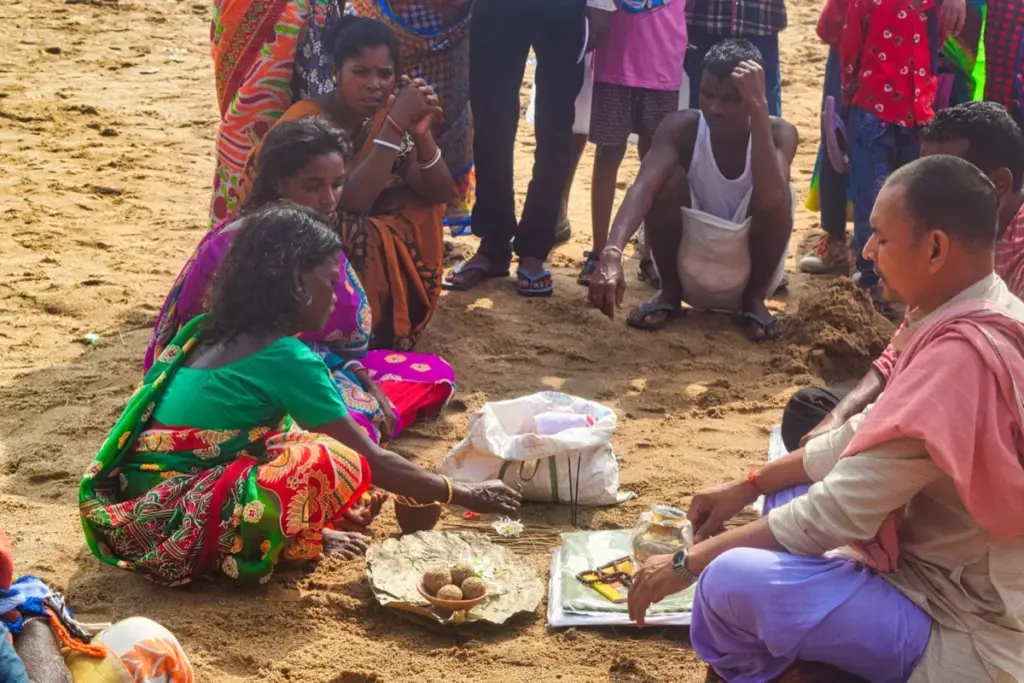
Shraddha (ଶ୍ରାଦ୍ଧ) in English is simply the ancestral rite — the ceremony performed for departed parents and forebears — and barsika (ବାର୍ଷିକ) is its annual form, the death anniversary. The Odia shraddha paddhati is the prescribed method for performing these, Vedic in substance with regional customs of its own. This guide covers barsika, mahalaya, the ten-day dashaha, paya shraddha, the tarpan mantra, and the nimantrana patra format, with the Odia terms alongside.
Contents
- The terms, in Odia and English
- Shraddha Barsika — the annual rite
- Mahalaya Shraddha, during Pitru Paksha
- Dashaha — the ten days after a death
- Paya Shraddha — the milk-rice offering
- The tarpan mantra
- The nimantrana patra — the invitation card
- Who may be the karta, and the rules they keep
- At Gaya and Prayagraj
- Questions families ask
The terms, in Odia and English
Families in the diaspora often need the English word for a form, an employer or a relative who does not read Odia. These are the ones that come up.
| ଓଡ଼ିଆ | Roman | What it is in English |
|---|---|---|
| ଶ୍ରାଦ୍ଧ | Shraddha | The ancestral rite itself. Named for shraddha, faith |
| ଶ୍ରାଦ୍ଧ ବାର୍ଷିକ | Barsika | The annual death anniversary ceremony |
| ପ୍ରଥମ ବାର୍ଷିକ | Prathama Barsika | The first death anniversary, the largest of them |
| ଦଶାହ | Dashaha | The ten days of rites immediately after a death. Also dashkriya |
| ମହାଳୟା | Mahalaya | The shraddha performed during Pitru Paksha |
| ପାୟ ଶ୍ରାଦ୍ଧ | Paya Shraddha | The milk-rice ceremony, where payasa replaces the pinda |
| କର୍ତ୍ତା | Karta | The person performing the rite |
| ପିଣ୍ଡ | Pinda | The rice ball offered to the ancestors |
| ତର୍ପଣ | Tarpana | The water offering, made with black sesame |
| ନିମନ୍ତ୍ରଣ ପତ୍ର | Nimantrana Patra | The invitation card sent before a tirtha ceremony |
Shraddha Barsika — the annual rite
Barsika is the central annual obligation in an Odia household, and it falls on the tithi the person died on, never on the English calendar date. If someone died on Kartika Krishna Dashami, barsika falls on Kartika Krishna Dashami every year.
The Odia Panjika — Kohinoor, or the Utkal Jyotish Parishad — maps the tithi to the English calendar each year. If you do not have a panjika, or nobody is sure of the tithi, give us the English date and year of death and we will work it back. It is a short calculation and we do not charge for it.
A barsika properly done contains five things: the sankalpa, the vow naming the ancestor, their gotra and the purpose, taken facing south; pinda daan, the rice balls with til and barley, placed in Odia families on a banana or peepal leaf; tarpana, water with black sesame from a copper or silver vessel, again facing south; brahmana bhojana, feeding at least one brahmin, the food sattvic with no onion, garlic or masoor dal; and daan.
Mahalaya Shraddha, during Pitru Paksha
Mahalaya is the shraddha performed in the sixteen days of Pitru Paksha, which in 2026 runs from 26 September to Sarvapitri Amavasya on 10 October. Offerings made in the fortnight are held to carry further, and the Garuda Purana holds that a soul which did not receive its rites in the year after death can still be reached here.
For Odia families it is also a public occasion. In the weeks before Durga Puja, families gather at the Mahanadi bank at Cuttack and at the Bindusagar tank in Bhubaneswar for collective tarpan. Many who keep barsika at home through the year choose to perform Mahalaya at a tirtha instead — Gaya or Prayagraj — for the additional merit.
Dashaha — the ten days after a death
Dashaha, or dashkriya, is the ten-day period following a death. It is not passive mourning: each day carries its own rite, and the Garuda Purana describes the pindas offered across those days as building the subtle body the departed will travel in, one part at a time — the head first, then the senses, and downward to the feet by the tenth.
The eleventh and twelfth days carry ekodishta, the rite addressed to that one soul alone, and sapindikaran, which joins their pinda to the ancestral three and moves them from the transitional state into the company of the forebears. In some Odia families sapindikaran is kept here; in others it waits for the first barsika. Which your family does changes what the prathama barsika contains, so it is worth knowing which happened — the fuller account is in the sapindikarana guide.
Paya Shraddha — the milk-rice offering
Less widely known and worth knowing. In paya shraddha the offering is payasa — rice cooked in milk, sweetened — rather than the plain rice pinda. No separate pinda is required; the payasa is itself the offering. The karta sets three small portions on a banana or peepal leaf and sprinkles til over them.
The Dharma Sindhu prescribes it in three situations, and only one of them is about death:
- In the third, sixth or ninth month after a death, as an intermediate offering between the monthly masika rites.
- At the birth of a child, asking the ancestors’ protection over the newborn.
- At a family milestone — a son’s upanayana, a daughter’s marriage — where ancestral blessing is sought for the passage.
The payasa is made with rice, full-fat cow’s milk and jaggery or sugar, and no salt. Paya shraddha can be kept at home by a karta who knows the sankalpa and the tarpan mantras, with a local pandit reciting the full vidhi. At Prayagraj our pandits fold it into the pind daan ceremony for families who ask on the day.
The tarpan mantra
Water mixed with black sesame is poured from a copper or silver vessel, facing south, while the mantra is said:
ॐ [गोत्र] गोत्राय [नाम] शर्मणे / वर्मणे / गुप्ताय वसु-रूपाय पितृ-तृप्त्यर्थं जलं तर्पयामि।
Om [Gotra] gotraya [Name] sharmane / varmane / guptaya vasu-rupaya pitri-triptyartham jalam tarpayami — “for [Name] of [Gotra], in the form of the Vasus, for the satisfaction of the ancestors, I offer this water.”
Tarpayami is said three times for each ancestor as the water is poured — once addressing them as pitru, once as matamaha, and once as one of the wider ancestral body. The variants for the mother, the maternal grandparents and for anapatya pitru, ancestors who died childless, are in the tarpan vidhi.
The nimantrana patra — the invitation card
When an Odia family performs shraddha at Gaya or Prayagraj — particularly for the prathama barsika — it is customary to send a nimantrana patra to relatives and the community. The format is recognised across Odisha and pandits will expect it. These are its elements, in order:
- Header — an invocation at the top, commonly ଶ୍ରୀ ଜଗନ୍ନାଥ ସ୍ମୃତି (Sri Jagannath Smriti), or another to Jagannath or Vishnu.
- The deceased’s name in Odia script, with gotra and the relationship to the karta — ସ୍ୱ. [Name], [Karta]ଙ୍କ ପ୍ରିୟ ପିତୃ, “Late [Name], beloved father of [Karta]”.
- The tithi and the English date, with the place — Triveni Sangam, Prayagraj, or Falgu Ghat, Gaya.
- Which ceremony it is: barsika, mahalaya, prathama barsika, or pind daan at a tirtha.
- The karta’s name and address, then the immediate family named as co-performers.
- The brahman bhojan invitation — time and venue for the meal afterwards, where one is held.
- Closing line, usually ସମସ୍ତ ଆସ୍ଥାବନ୍ଧୁ ଓ ସ୍ୱଜନଙ୍କ ଉପସ୍ଥିତ ପ୍ରାର୍ଥନୀୟ — “the presence of all well-wishers and relatives is respectfully requested”.
Printed in Odia script, on cream or white, with a saffron or maroon border. Families abroad preparing a card for relatives in India can hand this format to any Odia press or digital card service.
Who may be the karta, and the rules they keep
The eldest son is the traditional karta. The Dharma Sindhu permits a younger son, a son-in-law, a paternal nephew, or the daughter of the deceased, and a widow may perform shraddha for her husband. A daughter performing these rites is not a substitute making do — the scriptures provide for her and the offering carries the same weight. The full order of eligibility is in who can perform pind daan.
The karta fasts until the ceremony is complete, bathes beforehand, wears undyed cloth, and faces south throughout. The Dharma Sindhu makes one exception worth knowing: a karta who is gravely ill or elderly, for whom fasting is a health risk, may take a light meal of rice and milk beforehand, provided the deviation is declared in the sankalpa. Families put elderly relatives through unnecessary fasting for want of knowing this. Afterwards the karta resumes ordinary activity once the brahmin has been fed and the ashirvad received, and prasad is distributed to the family.
At Gaya and Prayagraj
Odia families have gone to Gaya for pind daan for generations, and the practical side of that journey — route, timing, where to stay — is in the Gaya from Odisha guide. These are what we perform, with pandits who know Odia custom:
| Ceremony | Price | What it includes |
|---|---|---|
| Pind daan at Gaya | ₹7,100 | At Vishnupad and the Falgu, with the full vidhi and an Odia-familiar pandit |
| Pind daan at Prayagraj | ₹7,100 | At the Triveni Sangam, with sankalpa, pinda, tarpan and brahman bhojan |
| Pitru tarpan at Prayagraj | ₹10,999 | Three days of tarpan at the Sangam, with full pinda and brahman bhojan |
| Asthi visarjan at Prayagraj | ₹5,100 | Immersion at the Sangam with Ganga puja and boat arrangements |
| Online pind daan at Gaya | ₹11,000 | Performed in your name with a live video link, for families in the diaspora |
If you are unsure which ceremony your family owes — whether sapindikaran was done at the twelfth day or is still pending, whether a missed barsika needs making good at Mahalaya — tell us the circumstances and a pandit will say. The year’s full calendar, with the Odia panjika correspondences, is on the shradh dates page.
Keep reading
Questions families ask
The core Vedic mantras and pinda offering procedure are the same across all traditions, but Odia families follow specific customs from the Utkala Brahmin paddhati. Key differences include: the Mahalaya Amavasya is given special importance (more than individual tithi shradh), the dashaha (10-day post-death rites) follows the Odia panjika calendar, and families from certain parts of Eastern Odisha may follow Shaiva rather than Vaishnava invocation sequences. Our Odia-speaking pandits at Prayagraj are trained in the Utkala paddhati and perform the ceremony exactly as your family tradition requires.
Yes. Our Odia-speaking pandits at Triveni Sangam Prayagraj perform the full Sankalpa (sacred vow) using your family gotra name as pronounced in the Odia tradition. The Sankalpa format includes your ancestor's name, gotra, the tithi, and the purpose of the ceremony — all recited in a way that feels familiar to families from Odisha. The mantras follow the standard Vedic format but the explanatory guidance and instructions to the karta are given in Odia, ensuring you understand each step of the ritual.
The most common gotras among Odia Brahmin families performing Pind Daan at Prayagraj include Kashyap, Bharadwaj, Vashishtha, Atri, Vishwamitra, Shandilya, Parashara, Gautam, Jamadagni, Kaushika, Mudgala, and Vatsa. During the Sankalpa, the pandit will confirm the correct pronunciation of your gotra in the Odia tradition. If your family is unsure of the gotra name, the pandit can help identify it based on your kula devata (family deity) and ancestral village records.
Traditionally, no — each ancestor should ideally be honoured on their specific death tithi during Pitrupaksha. However, when a family cannot observe individual tithi Shraddhas due to practical constraints, scriptures explicitly permit consolidating all ancestral offerings into a single Sarva Pitru Amavasya Shraddha. The benefit is nearly equivalent, especially when the ceremony is performed at a sacred tirtha like Prayagraj or Gaya with proper gotra invocation. For families who cannot remember every ancestor's exact death date, Sarva Pitru Amavasya is the recommended annual observance. Our Sarva Pitru Amavasya Shraddha package specifically invokes all ancestors of the family lineage in a single comprehensive ceremony.
For Akal Mrityu victims, Shraddha should ideally be performed on Chaturdashi (14th day of Krishna Paksha) during Pitrupaksha — this specific day, called "Ghata Chaturdashi," is scripturally designated for souls who died unnaturally. Performing Shraddha on Chaturdashi is believed to be especially effective for: accident victims, suicide victims, those killed in violence, those who died in fire or drowning, and any Durmaran cases. Additionally, the Mahalaya Amavasya (Sarva Pitru Amavasya) at the end of Pitrupaksha can be used for all ancestors including Akal Mrityu victims. For ongoing annual observance, Shraddha should be performed on the actual death tithi each year. Our Chaturdashi Shraddha package specifically targets Akal Mrityu ancestral liberation with the correct scriptural mantras and Brahmin Bhoj.
Prathama Barsika is the first death anniversary ceremony, performed exactly one year after death on the original death tithi. In Odia tradition, this ceremony follows the Ekodishta format — the pinda is offered individually to the recently departed soul, who has not yet merged with the ancestral collective (Pitru Gana). From the second year onwards, the ceremony transitions to Parvana format, where the deceased joins the three-generation ancestral line and receives collective offerings alongside the father, grandfather, and great-grandfather. The Dharma Sindhu prescribes this transition as the moment when the soul formally completes its journey from Preta to Pitru status.
Paya Shraddha is a specific ceremony in the Odia tradition performed on the 3rd, 6th, or 9th month after death, or when a significant family event occurs such as the birth of a child. The offering is payasa (kheer or rice cooked in milk) rather than the plain rice pinda used in regular Shraddha. The name comes from the Odia word for milk-based preparation. Unlike Barsika or Mahalaya Shraddha, Paya Shraddha can be performed at home by the karta without a pandit if they know the basic mantra, though engaging a pandit ensures the full vidhi is observed correctly per the Dharma Sindhu.
A Ganga Shraddha invitation card (Ganga Shraddha Nimantrana Patra) is a formal invitation sent by Odia families when performing Barsika or Ganga Shraddha at a sacred tirtha like Prayagraj or Gaya. The standard format includes six elements: (1) the departed persons full name in Odia script along with their gotra, (2) the tithi and Gregorian date of the ceremony, (3) the venue such as Triveni Sangam Prayagraj or Falgu Ghat Gaya, (4) the type of ceremony whether barsika mahalaya or prathama barsika, (5) the kartas name and relationship to the departed, and (6) a request for blessings and attendance from relatives. The card is printed in Odia script on cream or white paper with a saffron or maroon border and typically opens with Sri Jagannath Smriti at the top.
The Dashaha Vidhi covers the ten days immediately following death when the family observes mourning (ashaucha). Days 1 through 9 involve daily pinda offerings at the cremation site or home altar, with each day believed to form a different part of the departed souls subtle body as described in the Garuda Purana Preta Kalpa: head, neck, shoulders, chest, back, navel, thighs, knees, and feet. On Day 10, kshur karma (head-tonsure) is performed by the karta and male family members, followed by Shayyadan — donation of a bed and bedding to a Brahmin. Day 11 involves Ekodishta Shraddha (the individual offering to the departed alone), and Days 12 through 13 complete the Sapindikarana — the formal merger of the departed soul with the ancestral Pitru Gana, marking the transition from Preta to Pitru status.
Still have a question?
Ask our team on WhatsApp and we will help you plan the ceremony.
We reply on WhatsApp within 1–2 hours.
Ask a pandit (opens WhatsApp)Book Your Sacred Ritual
Authentic ceremonies performed by Veda-trained pandits at sacred sites across India.
- Clear package details before you book
- The ceremony in the language you choose
- 2,263+ families served
- Serving since 2019
- GST registered