Key Takeaways
- The order of eligibility
- Can a daughter perform pind daan?
- If one parent is still alive
- When no family member can do it
In This Article
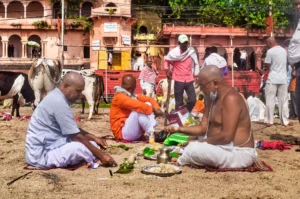
The eldest son has the first duty to perform pind daan, but the right does not stop with him. The scriptures set out a long order that runs through grandsons, the wife, the daughter, the daughter’s son, brothers and nephews, and ends with a priest performing it on the family’s behalf when no relative remains. A daughter may perform it, and we arrange it for daughters regularly. This page gives the order, and answers the questions families actually ask around it.
The order of eligibility
The hierarchy below is drawn from the Grihya Sutras, the Dharma Sutras, the Smritis and the Puranas, and is widely accepted with regional variation. One becomes eligible chiefly in the absence or incapacity of those above — but “absence” is read practically, and a family that simply cannot get the eldest son to Gaya does not need to leave the rite undone.
| Who | Order | When it falls to them |
|---|---|---|
| Son — eldest first, then younger brothers | 1st | The primary duty. All sons share it even when the eldest leads, and they may perform it jointly or separately |
| Adopted son | 1st | Identical standing to a natural-born son once the adoption follows the Dattaka Vidhi; he takes the adoptive father’s gotra |
| Grandson, then great-grandson | 2nd | Where no son survives. The duty passes down the male line and the rite continues for three descending generations |
| Wife | 3rd | For her husband, chiefly where no son or grandson can perform it. The Garuda Purana states her eligibility plainly |
| Daughter | 4th | For her parents. Married or unmarried makes no difference — see the section below, which is the question most families arrive with |
| Daughter’s son (dauhitra) | 5th | For his maternal grandfather, and the texts praise his offering particularly — several treat it as equal to a grandson’s |
| Brother, then nephew | 6th | Where the deceased left no descendants |
| Other sapindas and gotra relatives | 7th | Paternal uncles and cousins, then the wider gotra; maternal relatives where no paternal relative remains |
| Priest, disciple or friend | Last | Where no relative survives or none is able. A ritwik performs it on the family’s behalf and the rite is complete |
The short version is in must it be the eldest son. The one thing the order does not do is make the rite impossible — somebody is always eligible, down to a priest acting for a family with no one left.
Can a daughter perform pind daan?
Yes. This is the question more readers arrive with than any other, so it deserves a plain answer rather than a qualified one: a daughter may perform pind daan for her parents, married or unmarried, and whether or not she has brothers.
The traditional emphasis on the son comes from the patrilineal gotra system, not from any prohibition on daughters. The Garuda Purana permits daughters, daughters-in-law and granddaughters. The Vishnu Smriti permits a daughter where no son is present. And the tradition’s own best-known instance of pind daan at Gaya is a woman’s — Sita offered the pinda to Dasharatha on the banks of the Phalgu when Rama and Lakshmana were away.
In practice the rite is identical. The pandit guides a daughter through the same sankalpa, the same gotra invocation and the same mantras, and the offering has the same standing. The detail is in whether a married daughter may perform it, in a family of daughters with no sons, and in what the Mahabharata records.
If one parent is still alive
This question arrives in two different forms and they have opposite answers, so it is worth separating them.
One parent has died and the other is living. You may perform pind daan for the parent who has died. There is no rule requiring you to wait. Some families in Bengal, Bihar and eastern Uttar Pradesh hold that a mother’s Gaya shradh should follow the father’s, so if that is your family’s custom, mention it to the pandit and he will advise on the order — but it is a regional practice, not a bar. The rite for the departed parent stands on its own.
Can pind daan be performed for someone who is alive? No. Pind daan is for the departed. While your parents are living, the observances that correspond are matru and pitru puja, daan and seva — and if grandparents or other ancestors have already died, their annual shradh and tarpan continue as normal. The fuller answer is in whether pind daan is needed while parents are alive.
A related case: where a child has died before the parents, both parents may take part. The father ordinarily leads, and the mother may hold the water vessel during tarpan and make her own offering — see whether both parents can perform shradh for a departed child.
When no family member can do it
The scriptures close the hierarchy deliberately so that nobody is left without the rite. A disciple may perform it for a guru. The family purohit, or a ritwik engaged for the purpose and given dakshina, may perform it on behalf of the family. In the last case a close friend, an employer, or historically the ruler of the land could arrange it — the point being that the rite was never to be left undone for want of a relative.
This is what we do for families settled abroad who cannot travel, and for the many who come to us with an ancestor nobody in the current generation ever met. The sankalpa names the family and the gotra; the pandit makes the offering. See NRI puja services for how the remote arrangement works.
When to perform it
Pind daan can be performed at any time of year. These are the occasions the tradition treats as strongest, roughly in order:
- Pitru Paksha — the sixteen days of Bhadrapada Krishna Paksha, when the ancestors are held to descend. The strongest window of the year for every ancestral rite.
- Sarva Pitru Amavasya, the last day of Pitru Paksha — the single most powerful day, and the one to use when the death tithi is not known.
- The ancestor’s death tithi, each year.
- Amavasya generally, and Somvati, Mauni and Mahalaya amavasya in particular.
- Chaturdashi during Pitru Paksha — reserved for those who died by accident or any unnatural cause.
- Within the first year of the death, for the first barsi.
Where a family has carried unresolved ancestral trouble for generations, the date matters less than finally doing it; a Gaya pind daan can be arranged at any time. The full list with this year’s dates is on the shradh dates calendar, and the timing question is answered in when pind daan should ideally be performed.
How soon after a death, and can it be done again
The first offerings belong to the thirteen days after the death, and the pinda offered on the tenth and eleventh days is part of the funeral sequence rather than a separate journey. The pind daan families travel to Gaya or Prayagraj for is a different thing: it can be done once the thirteen days are complete, and most families do it in the first year, around the first barsi.
There is no deadline. A great many of the families we take to Gaya are performing it for an ancestor who died decades ago, sometimes for someone nobody living met. The rite is not weaker for the delay.
Can it be done more than once? Yes. Pind daan is not a one-time discharge that is spoiled by repetition. Families perform it again at a different tirtha, or on a later Pitru Paksha, or when a second person in the family wants to make the offering themselves. Gaya in particular is often done once as the definitive rite while annual shradh continues at home. If someone tells you a second pind daan undoes the first, that is not the tradition.
What actually makes the offering valid
Families worry about eligibility far more than they need to, and worry about the things that genuinely matter far less. What the rite depends on is narrow and practical:
- The right gotra, correctly invoked. This is the single most common thing families get wrong, and the one worth checking before you travel.
- A proper sankalpa — the declaration naming the ancestor, the performer, the place and the purpose.
- The mantras said correctly, which is what you are engaging a qualified pandit for.
- Shraddha itself — the faith the rite is named after. An offering made with real feeling by someone further down the order is worth more than a mechanical one by the person at the top of it.
- Capability and purity. The performer should be able to carry out the rite, with guidance, and observe the ordinary rules of shaucham on the day.
Family custom can modify all of this, and where it does, it generally wins. If your kula has a settled practice, follow it and tell the pandit. If nobody living remembers what the practice was — which is common — the pandit will work from the standard order above.
🙏 Pind Daan at the Triveni Sangam
- Performed for sons, daughters, wives or by our pandit on your behalf
- All samagri, ghat booking and dakshina included — nothing added on the day
- Gotra and sankalpa checked with you before the rite
- Online option at the same price, with a live video link
Where we perform it
Pind daan at Prayagraj is at the Triveni Sangam and is the most accessible of our sites by rail and air. Pind daan at Gaya is the older tradition for this rite specifically, and the Gaya cost guide sets out what a trip there involves. Both are ₹7,100 for one ancestor, and the online rite is the same, with our pandit performing it in your name and a video link for the sankalpa.
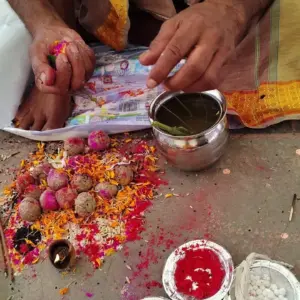
If you are unsure what you are actually offering and why, what the pindas are made of explains the rice-ball offering itself. Families who have gone generations without performing these rites often ask about pitra dosh; a pandit will tell you honestly whether that applies to your situation or whether you simply need to perform the shradh you have missed.
Book Your Sacred Ritual
Authentic ceremonies performed by Veda-trained pandits at sacred sites across India.