Key Takeaways
- What the rite actually does
- When it is performed
- The fiftieth shraddha
- The ceremony, step by step
In This Article
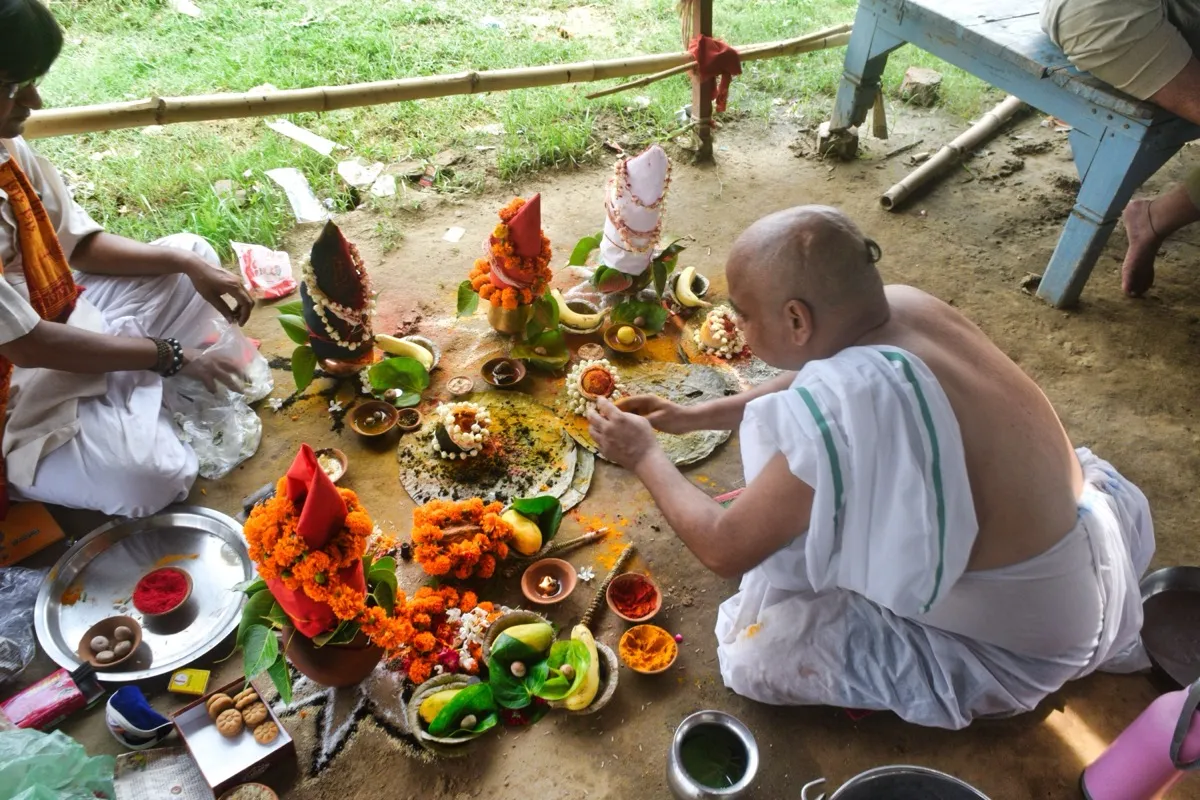
Sapindikarana — sapindi shradh — is the rite that moves the departed out of the transitional preta state and into the company of the ancestors. In English it is best rendered as the rite of joining: the deceased’s pinda is physically merged with the pindas of the father, grandfather and great-grandfather, and from that moment the family addresses them as an ancestor rather than alone. Most families perform it on the twelfth day after the death.
What the rite actually does
The word is literal. Sapinda means sharing a pinda, and sapindikarana is the making of that sharing. Four pindas are established — one for the deceased, three for the generations above — and the first is merged into the other three.
Before it, the departed is addressed as preta: a word that means simply the departed one but which the texts use for a soul without a settled place, and every offering through the first days is directed to them individually, by name. After it, they are pitri — an ancestor with a defined position in the line, included in the collective offerings made to all three generations together.
When it is performed
The scriptures allow real latitude: after three fortnights, around forty-five days; at six months; or at the completion of one year. In practice almost every family we work with performs it on the twelfth day, immediately after the ten days of daily pindas and the eleventh-day ekadashah.
Where the twelfth day is missed — a family abroad, news arriving late, circumstances unclear — it is performed later without losing anything. Some communities keep it at the first anniversary by custom rather than by accident, and that is a settled practice, not a delay.
The fiftieth shraddha
Sapindikarana does not stand alone. The texts describe a sequence of forty-nine shraddhas preceding it — the ten daily pindas of the dashagatra, then the Malin Shodashi, the Madhyam Shodashi and the Uttam Shodashi, sixteen each. Sapindikarana is the fiftieth and last.
That is why the tradition treats skipping it as it does. The forty-nine are preparatory: the subtle body is built, the taint of death is removed, the soul is made ready. Without the fiftieth, the preparation has no conclusion — a bridge built to within a metre of the far bank. The texts say the pretatva, the ghost-state, is not ended, and that the soul does not reach the ancestors.
We state that as the texts state it, and not as a threat. A family that has not performed sapindikarana has not harmed anyone and is not being punished; they have usually just never been told it was a separate thing from the thirteenth-day gathering. It can be performed at any distance from the death, including years later, and that is the practical answer rather than the ominous one.
The ceremony, step by step
- Preparation and sankalpa. The karta bathes, wears undyed cloth and wears the janeyu in apasavya, over the right shoulder. The sankalpa names the deceased, the gotra, the relationship and the purpose, and declares that the rite being performed is sapindikarana specifically.
- The four pindas are established. One for the departed, and three for the father, grandfather and great-grandfather of the line. They are set on kusha grass, tips to the south.
- Arghya samyojan. Before the pindas themselves, the water offerings are merged — the vessel of the deceased poured into the three ancestral vessels. The merging of the water precedes the merging of the pinda and prefigures it.
- The pinda merger. The core of the rite. The deceased’s pinda is divided and joined to the three, with the mantra of joining recited. This is the moment the status changes; everything before it is preparation and everything after is completion.
- Completion and brahmin bhoj. Tarpan, then the feeding of brahmins with dakshina. From here the departed is included in the parvana shradh with the others.
The underlying offering is the ordinary one — the pind daan vidhi applies, with the merger added. What marks sapindikarana out is the four pindas and the joining, not a different procedure.
Who performs it
Ordinarily the karta who made the daily offerings through the dashagatra continues, which is usually the eldest son. After him: a younger son, a grandson, a nephew. A daughter may perform sapindikarana — the scriptures permit it and we have guided many daughters through it. Where no family member can, a qualified pandit performs it in the family’s name and gotra, which is provided for rather than improvised. The full order is in who can perform pind daan.
The karta does not have to be at the tirtha. For families abroad the sankalpa details are taken in advance and the ceremony is performed with a live video link — NRI puja services covers the arrangement.
Where, and what it costs
| Where | Cost | What varies within the range |
|---|---|---|
| Prayagraj, Triveni Sangam | ₹5,100–11,000 | The number of brahmins fed, and whether pind daan and tarpan are performed on the same visit |
| Varanasi | ₹5,100–10,999 | As above. Families often combine it with asthi visarjan on the Ganga here |
| Gaya | ₹10,999–14,500 | Higher because the Gaya rite covers the 48 sites and is rarely done on its own |
| Haridwar | ₹7,100–11,000 | At Har Ki Pauri. The usual choice from Delhi |
Every figure covers samagri, dakshina and the written record, and the online ceremony costs the same as being there. Nothing is added on the day.
🙏 Sapindi Shradh at the Triveni Sangam
- The four pindas, the arghya merger and the full joining rite
- We check first whether yours was already done on the twelfth day
- Samagri, dakshina and the written record included — nothing added on the day
- Live video link for families who cannot travel, at the same price
Where sapindikarana was never performed and years have passed, the rite is still available and is usually arranged alongside pind daan at a tirtha. Where the annual rites have also lapsed for three years or more, a pandit may recommend looking at the wider picture first. Its place in the whole sequence is in the guide to Hindu death rituals.
Book Your Sacred Ritual
Authentic ceremonies performed by Veda-trained pandits at sacred sites across India.



