
Stepwise Guide to do Asthi Visarjan in Varanasi
Samagri, the boat and the tarpan are included, and we reply on WhatsApp the same day.

Asthi Visarjan in Varanasi is the immersion of a family member’s ashes in the Ganga, usually at Manikarnika or Harishchandra ghat, performed with a pandit who speaks the sankalp in your gotra. It takes two to three hours and costs from ₹5,355 including the boat and samagri. Everything we arrange is on our Asthi Visarjan in Varanasi page.
How the rite is performed, step by step
- Arrival and sankalp. The pandit meets you at the ghat with your booking reference. The sankalp names the departed, your gotra and your relationship.
- Snan. The person performing the rite bathes, or sprinkles Ganga water, before handling the kalash.
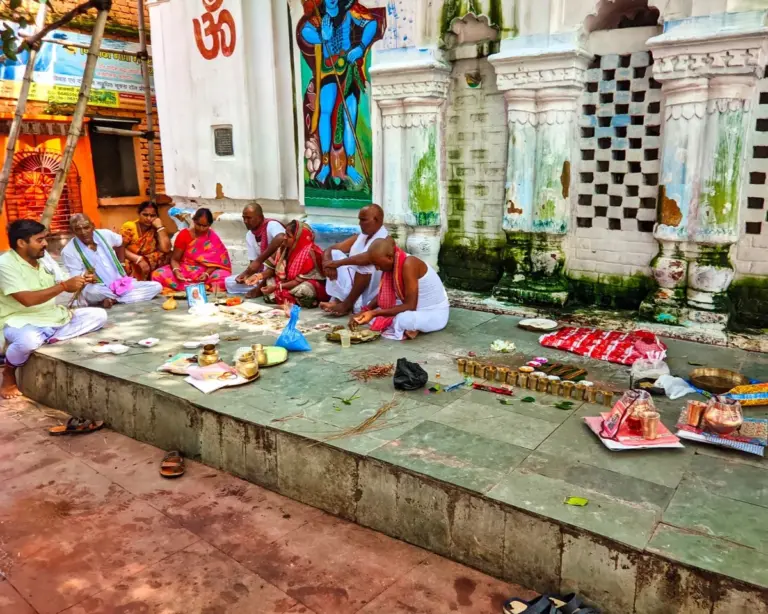
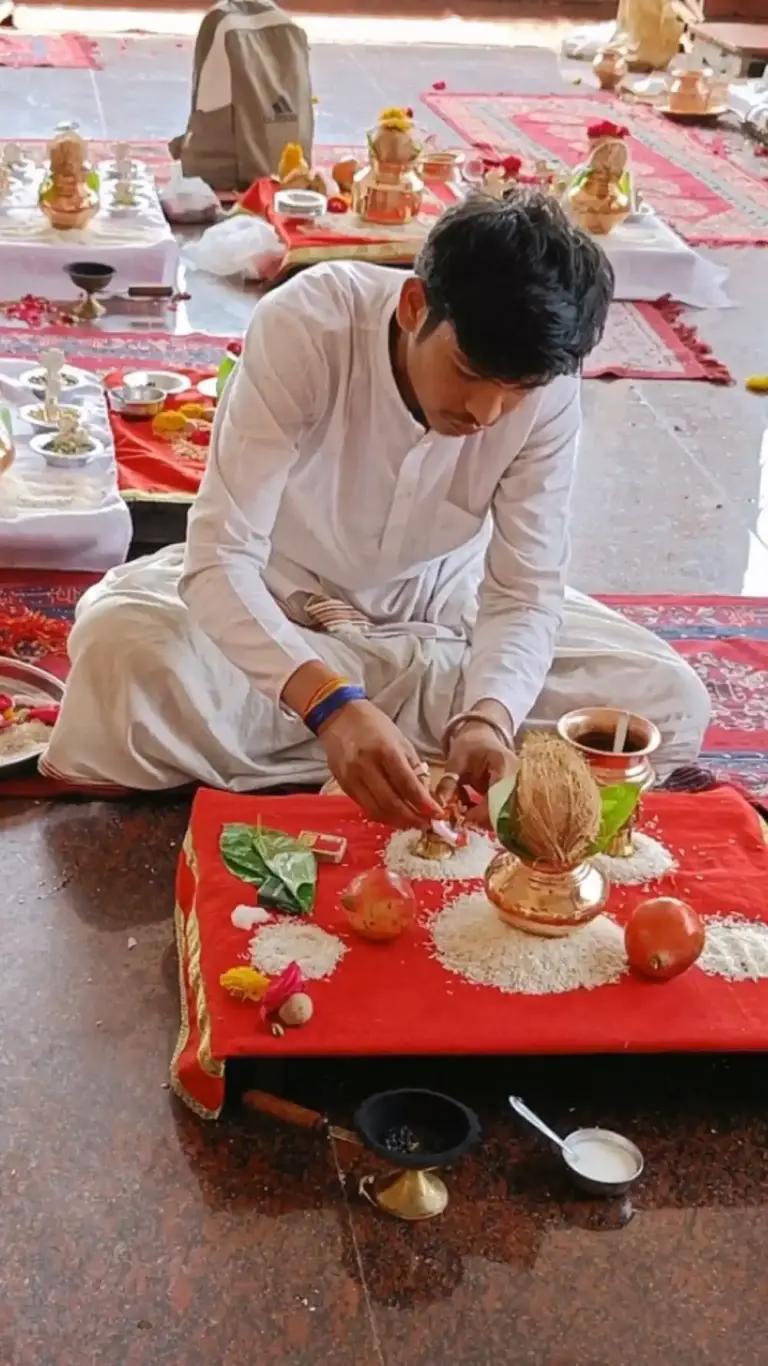
- Puja at the ghat. Offerings of water, sesame, barley, flowers and a lamp, with the mantras for the departed.
- The boat. You are rowed to midstream, where the current is strongest. The immersion is not done from the steps.
- Visarjan. The ashes are released into the river, with the kalash broken or released after.
- Tarpan. Water offerings made by the family, facing the correct direction, for the departed and the lineage.
- Close. The pandit completes the rite and the family takes prasad. Many then go on to Pind Daan.
What to bring
- The asthi kalash. Carry it in hand luggage if flying; do not check it in.
- The death certificate, or a copy. Airlines and some authorities ask.
- The gotra, and the departed’s name as the family uses it.
- A white dhoti or simple cotton for whoever performs the rite.
- Nothing else. Samagri, the boat and the pandit are in the package.
Carrying ashes to Varanasi
Domestic airlines in India permit asthi in the cabin, and most ask for the death certificate and the crematorium receipt. Carry the urn sealed and declare it at security rather than being asked. Families flying in from abroad should check with the airline before travelling, because requirements differ by carrier and country, and some ask for the embalming or cremation certificate as well.
Which ghat
Immersion is performed at the cremation ghats, and the choice is largely practical. The Ganga turns north at Varanasi, which is the reason the city holds the standing it does for final rites.
- Manikarnika. The principal cremation ghat and the one most families use. Busy, and continuously so. Its mythology is in our Manikarnika guide.
- Harishchandra. The older of the two cremation ghats, smaller and quieter. Families who want fewer people around often prefer it. See our Harishchandra guide.
- Dashashwamedh and Assi. Used for tarpan and the associated rites rather than the immersion itself.
When to perform it
Tradition places Asthi Visarjan within the first ten to thirteen days after death, but it is performed long afterwards without difficulty, and families often carry ashes for months before they can travel. There is no point at which it becomes too late.
Mornings are preferred and most rites are done between sunrise and midday. Pitru Paksha, Amavasya and the anniversary tithi are all common choices. Our note on ritual timings and muhurat in Varanasi goes into the auspicious windows.
What it costs
| Package | Price | What it covers |
|---|---|---|
| Asthi Visarjan in Varanasi | ₹5,355 | Pandit, samagri, boat, the immersion and tarpan |
| Asthi Visarjan with tarpanam | ₹7,100 | The above with the extended tarpan sequence |
| Performed on your behalf | ₹7,100 | You do not travel; video and photographs sent after |
| Two days, one night | ₹12,500 | Stay, transfers and the rite arranged together |
What sits outside the package is your travel, your room and anything you choose to give at the ghat. Priests stationed at the steps and those who ask for alms are customary rather than compulsory; ₹300 to ₹1,000 across a visit is usual.
If you cannot travel
Remote Asthi Visarjan is not a video of someone else’s ceremony. The family courier the ashes, or hand them to us on an earlier visit, and the pandit performs the rite in your gotra with a pratinidhi standing in for the family. You join by video or receive the recording and photographs afterwards.
Families spread across several countries use this most, because it removes the problem of everyone reaching Varanasi on the same day. Our guide to arranging Varanasi rites from abroad covers the logistics.
What families find hard, and what helps
- Arriving without a pandit arranged. The ghats are crowded and approached by people offering to help. Booking beforehand removes the moment they rely on.
- The crowds at Manikarnika. Cremation is continuous and the ghat is not a quiet place. Harishchandra is calmer if that matters to your family.
- Steps and mobility. The ghat steps are steep, worn and often wet. Tell us if someone elderly is performing the rite and we will arrange the approach and the boat accordingly.
- Being quoted a price on the day. A confirmed package in writing before you travel is the protection. Nothing should be added once the rite has begun.
- The grief itself. There is no correct way to hold yourself at the ghat. The pandit will carry the sequence; you do not need to have learned it.
Why Kashi
The Kashi Khand of the Skanda Purana treats Varanasi as the place where the cycle of rebirth can end, and the city’s association with final rites rests on that. The Ganga turns north here, flowing back towards its source, which the tradition reads as the river carrying the departed upstream rather than away. Shiva is held to be present in the city itself rather than visiting it.
That belief is why people come to Varanasi to die as well as to perform rites, and why hospices for the dying have operated here for generations. We cover that in our note on the Varanasi death hostel.
After the immersion
Asthi Visarjan completes one part of the rites. Many families go on to Pind Daan, at Varanasi or at Gaya, and to the annual shradh afterwards. These are separate observances and the one does not stand in for the other.
Families combining the two often perform the immersion at Varanasi and Pind Daan at Prayagraj or Gaya on the same journey. Tell us at the enquiry stage so the dates and the pandits are arranged in the right order.
The river, and doing this responsibly
Ashes themselves are not what burdens the Ganga. What accumulates is everything immersed alongside them: plastic bags, synthetic cloth, foil, and the volume of flowers. The Namami Gange programme has been working on the river for years, and families performing the rite can make a difference at the margin without changing it at all.
- Use a clay or biodegradable urn rather than plastic or metal.
- Keep the offerings to what the rite calls for. More flowers is not more merit.
- Leave the polythene on the bank. Cloth and wrapping do not go in the river.
- Ask us for the biodegradable samagri option when you book; we use it by default where the family has no preference.
Some families choose to immerse a portion of the ashes and inter or scatter the rest elsewhere. That is accepted practice and the rite is complete either way.
Arranging the rite
Send us the departed’s name, your gotra and the date you can travel, and we will confirm the pandit, the ghat and the total in writing before anything is paid. Packages are on our Asthi Visarjan in Varanasi page.
Keep reading
Questions families ask
Manikarnika Ghat and Harishchandra Ghat are the two most famous ghats in Varanasi (Kashi) for Asthi Visarjan. Manikarnika is considered the supreme cremation ghat mentioned in the Skanda Purana and the Kashi Khanda, where Lord Shiva himself is believed to whisper the Taraka mantra into the ear of the deceased — granting instant moksha. Harishchandra Ghat is associated with the legendary King Harishchandra who upheld dharma at this very site. After cremation at either ghat, Asthi Visarjan is performed in the Ganga adjacent to the respective ghat. Dashashwamedh Ghat and Assi Ghat are also accepted sites for families who arrive after cremation done elsewhere and wish to immerse the asthi in Kashi.
All three sites — Varanasi (Kashi), Prayagraj (Triveni Sangam), and Haridwar (Har Ki Pauri) — are supreme tirthas for Asthi Visarjan, each with distinct scriptural emphasis. Varanasi is uniquely associated with moksha because of Shiva's Taraka mantra belief, and the city is called Mahashmashan (the great cremation ground) in scripture. Prayagraj offers the confluence of three sacred rivers (Ganga, Yamuna, Saraswati) and is especially auspicious during Kumbh and Pitrupaksha. Haridwar's Har Ki Pauri is the first entry of Ganga into the plains and is most associated with the famous Brahma Kund. The "best" choice depends on your family tradition — our pandits can guide you based on your gotra and ancestral preferences.
The cost of asthi visarjan in Varanasi can vary widely based on several factors, including the services chosen, the pandit's fees, and any additional rituals performed alongside the visarjan. Basic packages might start from around Rs. 3,100 and can go up to Rs. 7,100 or more for comprehensive services that include puja ceremonies, boat services, and offerings. It's advisable to discuss the details and costs with service providers or pandits beforehand to understand what is included in the package. Prayag Pandits offer a complete package which covers everything and is available at nominal price. Click here to check it.
Yes. If cremation took place in your home city, the ashes can be collected in a clean urn and brought to Varanasi for immersion in the Ganga at Manikarnika, Harishchandra, or another accepted ghat. Per the Garuda Purana, if the urn is kept pure during transport (hung on a tree, not placed on the ground, protected from impurities), the immersion at Kashi carries the full spiritual merit. Our pandits assist families arriving by train or flight with: ghat selection, boat arrangements, the complete Asthi Visarjan vidhi, and the Sanskrit mantras "Namo Astu Dharmaya" (at entry) and "Sa me Prito Bhavatu" (during immersion). The ceremony typically takes 2-3 hours and can be scheduled on the same day as arrival.
Yes. Vedic scriptures permit daughters, daughters-in-law, wives, and other female relatives to perform Asthi Visarjan when a son is unavailable or when the daughter chooses to honour her parents herself. We regularly guide daughters through the complete Asthi Visarjan ceremony at Manikarnika and Harishchandra Ghats in Varanasi. The ritual's spiritual efficacy is identical regardless of the performer's gender, provided the correct gotra, sankalpa, and mantras are invoked. Pandits at Kashi are experienced with families where daughters perform the rites, and there is no stigma or restriction at the major ghats.
While not mandatory, combining Pind Daan with Asthi Visarjan is strongly recommended by scriptures for complete ancestral liberation. Asthi Visarjan releases the physical remains into the sacred Ganga, while Pind Daan provides spiritual sustenance (in the form of rice balls or pindas) to the departed soul's onward journey. In Varanasi, combined ceremonies typically include Asthi Visarjan at Manikarnika and Pind Daan at Pishach Mochan Kund — where souls trapped in Pishacha Yoni are believed to be liberated. Our combined Kashi Asthi Visarjan + Pind Daan package covers both rituals with full scriptural authenticity. Many families also add Tarpan to complete the ancestral trilogy.
Two to three hours at the ghat, including the boat. Allow half a day with travel within the city.
Yes. Daughters perform the rite and our pandits conduct it without qualification. Tell us the relationship so the sankalp is set correctly.
No. Families perform it years afterwards, and the rite is unchanged. The tithi matters more than the elapsed time.
It is released or broken into the river after the ashes, depending on your family’s tradition. Tell the pandit which your family observes.
Yes. Families frequently divide the ashes between sites. The rite at Varanasi is performed on what you bring.
Still have a question?
Ask our team on WhatsApp and we will help you plan the ceremony.
We reply on WhatsApp within 1–2 hours.
Ask a pandit (opens WhatsApp)Book Your Sacred Ritual
Authentic ceremonies performed by Veda-trained pandits at sacred sites across India.
- Clear package details before you book
- The ceremony in the language you choose
- 2,263+ families served
- Serving since 2019
- GST registered