
Key Takeaways
- Why dying at Kashi matters
- The practice, and the institution
- The fifteen-day rule
- What it is like inside
In This Article
In the lanes of the old city, a short walk from the Kashi Vishwanath temple, a whitewashed building takes a particular kind of guest: elderly, usually frail, with one or two relatives and very little luggage. Kashi Mukti Bhawan exists so that a devout Hindu who does not live in Varanasi can still die here. It is free, it is not a hospital, and the stay is limited to fifteen days.
Why dying at Kashi matters
Moksha is release from the cycle of death and rebirth — the state in which the individual soul is recognised as identical with Brahman and is no longer bound to further incarnation. It is the highest aim in the tradition.
The Kashi Khanda of the Skanda Purana, the principal text on Varanasi’s status, makes an unusual claim: that every being which dies within the city’s bounds — human, animal, insect — receives moksha, because Shiva himself speaks the Taraka Mantra into the ear of the departing soul. The mantra is given as Rama Nama, and it is held to dissolve karma and release attachment.
Which is the whole logic of the institution. If dying at Kashi carries that, then arranging to die at Kashi is not morbid. It is the most far-sighted thing a believer can do, and Mukti Bhawan simply provides the means for someone who lives elsewhere.
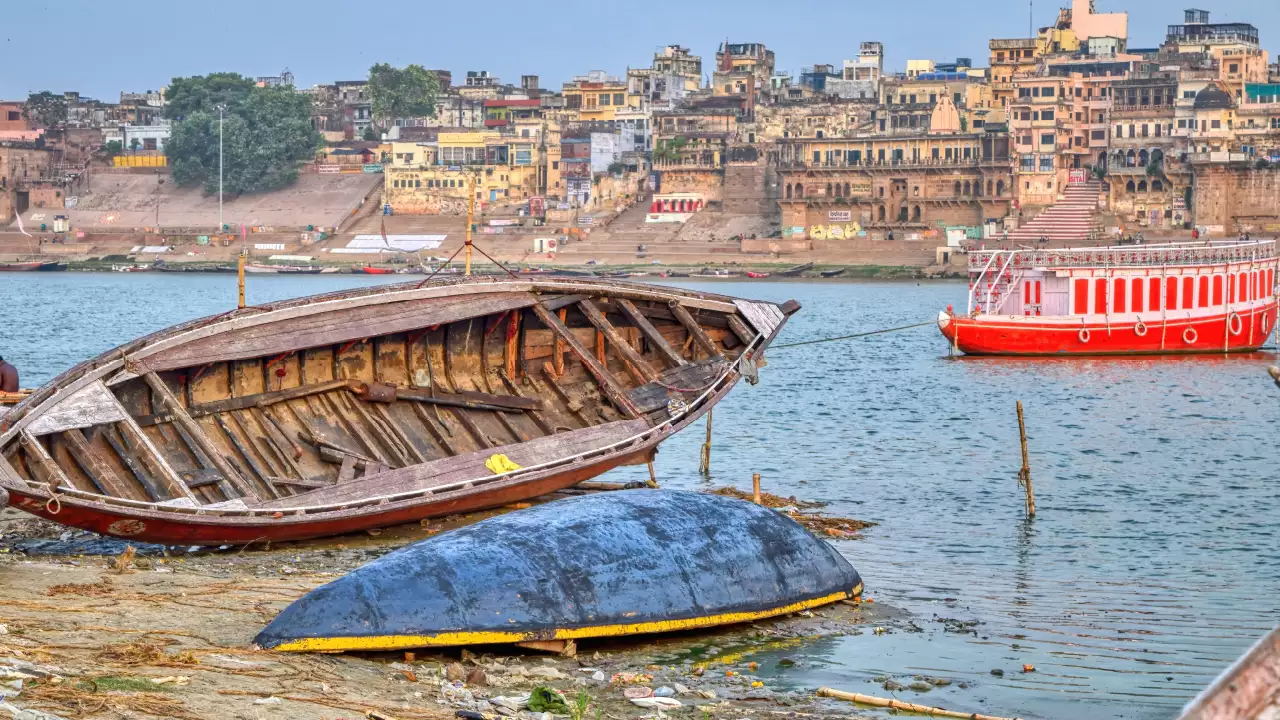
Kashi sits on the western bank of the Ganga and is known by three names: Kashi, the city of light; Varanasi, from the Varuna and the Asi; and Banaras. In the cosmology it rests on Shiva’s trident, above the material plane, in the earthly and divine realms at once. Our note on Kashi covers the city itself.
The practice, and the institution
Coming to Kashi to die is not a modern idea. The Kashi Khanda describes it directly: the one who, knowing death is near, makes his way to Kashi and dies there is liberated. Devout Hindus have made that journey as their last pilgrimage for a very long time.
What is modern is the institutional form. Kashi Mukti Bhawan was established in 1908 on its present site near the Vishwanath temple, substantially rebuilt and expanded in 1956 by the Dalmia family, and has run since as a free charitable institution. It is managed by a trust, staffed by a handful of sevara workers and a resident manager, and funded by donations. Rooms, basic meals, ritual assistance and cremation support are all provided without charge.
The fifteen-day rule
A guest is given a room for a maximum of fifteen days. If they have not died in that time they are asked to leave, because the room is needed for the next person waiting to die at Kashi.
It sounds harsh stated plainly, and there are three reasons for it.
- Capacity. There are only a few rooms, and the demand from across India is far larger than the space.
- What the institution is for. It is not a hospice managing chronic illness over months. It is for people at the threshold.
- What the scripture says. The Kashi Khanda does not hold that years of living at Kashi improve the outcome. The liberation is attached to the moment of death there. Someone who survives the fifteen days is encouraged to go home and return when death is closer.
In practice the manager reports that most guests die within a few days of arriving, and many within hours. The people who come are generally in the last stages of terminal illness or extreme old age, and have assessed their own position accurately before making the journey.
What it is like inside
Simple rooms around a central courtyard. Each takes a guest and usually one or two family members. A bed, a lamp, a small table. No machines, no drips, no monitors — that is the point of it rather than an omission.
Through the building there is continuous chanting of the names of Rama and Vishnu — Ram Nam Satya Hai, the name of Rama is the truth — sung softly by the staff and by the families of other guests. The understanding is not that this is pleasant background. The constant presence of the names is held to prepare the atmosphere of the building to receive the departing soul.
Guests are helped with their prayers where they are able. Families are encouraged to read aloud, perform the daily puja, and keep that atmosphere around their relative. When death approaches a pandit is called, and the Antyeshti begins before the moment of death, with specific mantras recited in the dying person’s ear.
Cremation at Manikarnika
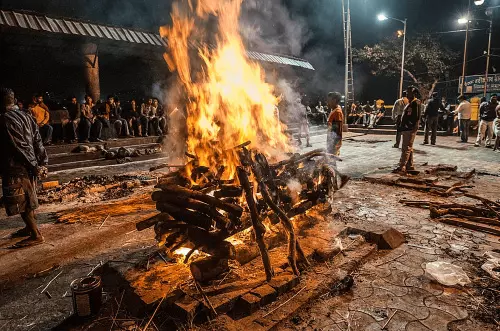
When a guest dies, the staff help the family take the body to the cremation ground. Manikarnika — the Mahashmashan — is the principal cremation site, and the fire there is said to have burned without interruption for centuries.
The ghat takes its name from an earring. One account has Shiva carrying Sati’s body in grief, with parts falling across the subcontinent to become the Shakti Peethas, and her earring — manikarna — falling here. Another has Vishnu’s Sudarshana Chakra dividing the body, with the earring landing at this spot and the ghat designated a Shakti Peetha. The accounts differ; the name is the same.
The cremation is conducted by the Dom community, hereditary custodians of the sacred fire, and each pyre is lit from that same flame.
Afterwards comes Asthi Visarjan — the immersion of the ashes and bone fragments in the Ganga, which the tradition treats as completing the release: the last physical tie dissolved into the river.
Practical information
| Detail | What applies |
|---|---|
| Where | Near the Kashi Vishwanath temple, in the Godowlia area. The exact address comes from the institution’s management |
| Who is accepted | Hindu pilgrims who are terminally ill and genuinely in the final stages. Medical evidence of terminal illness is normally required |
| Cost | Nothing. Rooms, basic meals, ritual assistance and cremation support are all free, funded by donations |
| Length of stay | Up to 15 days. Extensions are at the management’s discretion in exceptional cases |
| Family | One or two relatives are accommodated with the guest, and their prayers and puja are treated as part of how the place works |
| Pandit | The institution can arrange pandits for the Antyeshti and the rites afterwards. You may bring your own |
Other institutions
Mukti Bhawan is the best known but not the only one.
- Mumukshu Bhawan, also at Varanasi — larger, run by a different trust, on essentially the same principles.
- Gaya, principally a site for Pind Daan, also receives pilgrims who wish to die near the Vishnupad temple and the Phalgu.
- Vrindavan, for devout Vaishnavas who want their last days near Krishna’s own country.
- Puri, for those who want to die near Jagannath’s dham.
Why Varanasi, for the rites afterwards
Beyond this institution, Varanasi is central to the ancestral rites generally. Families come not only to die but to perform shradh, tarpan and Pind Daan for ancestors already gone, and the Kashi Khanda has a great deal to say about ashes immersed in the Ganga here.
| Rite | Price | What it covers |
|---|---|---|
| Asthi Visarjan in Varanasi | ₹5,355 | Immersion at the ghat with sankalpa and tarpan. A second tier at ₹13,125 |
| Asthi Visarjan at Varanasi | ₹7,100 | The fuller arrangement |
| Pind Daan in Varanasi | ₹7,100 | Pinda offered in your gotra at the ghat |
| Shradh at Varanasi (Kashi) | ₹10,999 | The shradh ceremony at the ghats |
🙏 Asthi Visarjan or Pind Daan at Varanasi
- Performed at the Ganga ghats with a pandit
- Sankalp in your family gotra
- All samagri arranged at the ghat
- Live video option for families who cannot travel
Common questions
Does Mukti Bhawan charge anything?
No. Rooms, basic meals, ritual assistance and cremation support are free. It runs on donations.
What happens if the person does not die in fifteen days?
They are asked to leave so the room can take the next guest, and encouraged to return when death is closer. Extensions are possible at the management’s discretion but are not the norm.
Is it a hospice?
No. There is no medical treatment or pain management. It is a place to die with the rites being performed, not a place to be cared for.
Can family stay with the guest?
Yes, usually one or two relatives, and their presence and prayers are considered part of how the institution works rather than a concession.
If you need the rites arranged
Whether you are travelling with a dying relative or performing Asthi Visarjan, Pind Daan or shradh for someone already gone, tell us the gotra and the circumstances and we will confirm the pandit, the ghat and the total before anything is paid. Our guide to Hindu death rituals sets out the full sequence from the moment of death onwards.
Book Your Sacred Ritual
Authentic ceremonies performed by Veda-trained pandits at sacred sites across India.



