
Key Takeaways
- What the ghat is
- Sati's earring
- Vishnu's kund
- The pyres
In This Article
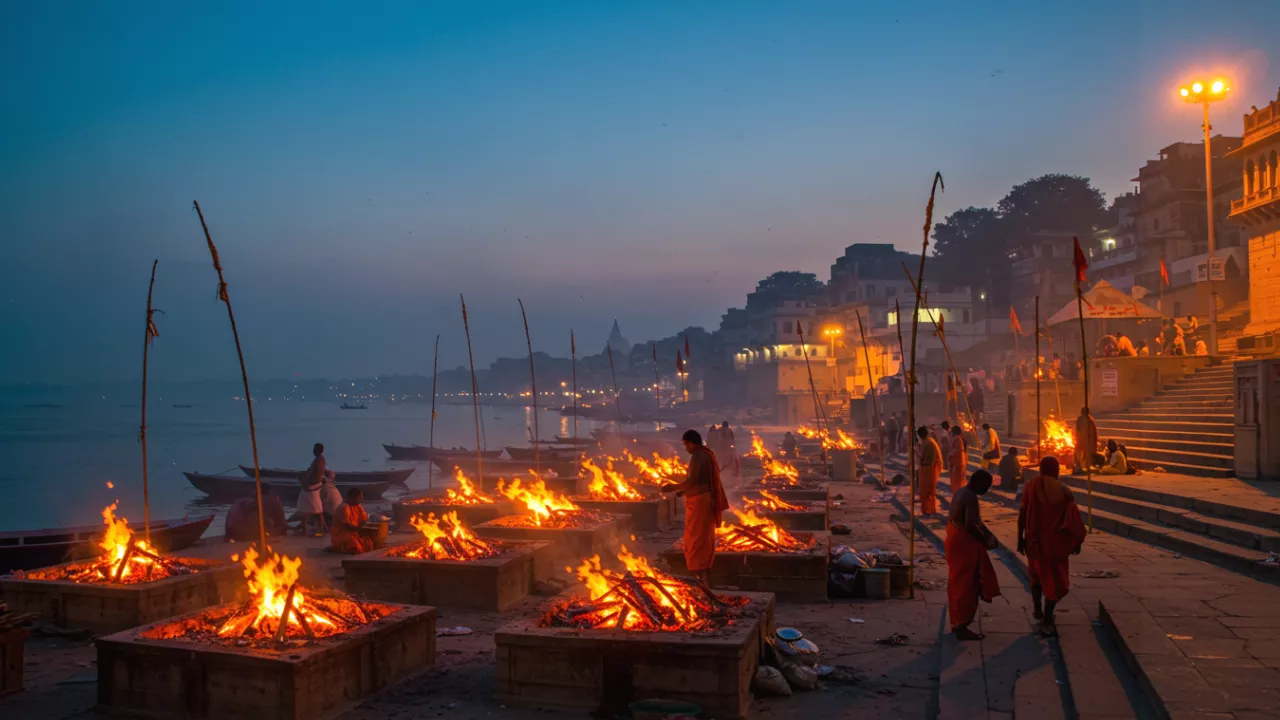
Manikarnika is the Mahashmashan, the great cremation ground, on the western bank of the Ganga at Varanasi. Its name means the jewelled earring, and two Puranic accounts explain it — one through Sati’s earring falling here as Shiva carried her body, the other through Shiva’s own earring dropping into the kund Vishnu dug. What draws families is the promise attached to it: that Shiva speaks the Taraka Mantra to those who die here.
What the ghat is
One of the oldest and most sacred of the Varanasi ghats, and the primary cremation site. Its standing is not only functional: being cremated here is understood not as an ending but as passage to moksha, release from samsara.
It is a working place, continuously. Steps descend into the river, priests conduct rites, families mourn, boatmen work the water, and pyres burn. It presents death without any softening, and the quality most visitors remark on afterwards is not horror but a kind of matter-of-factness.
Sati’s earring
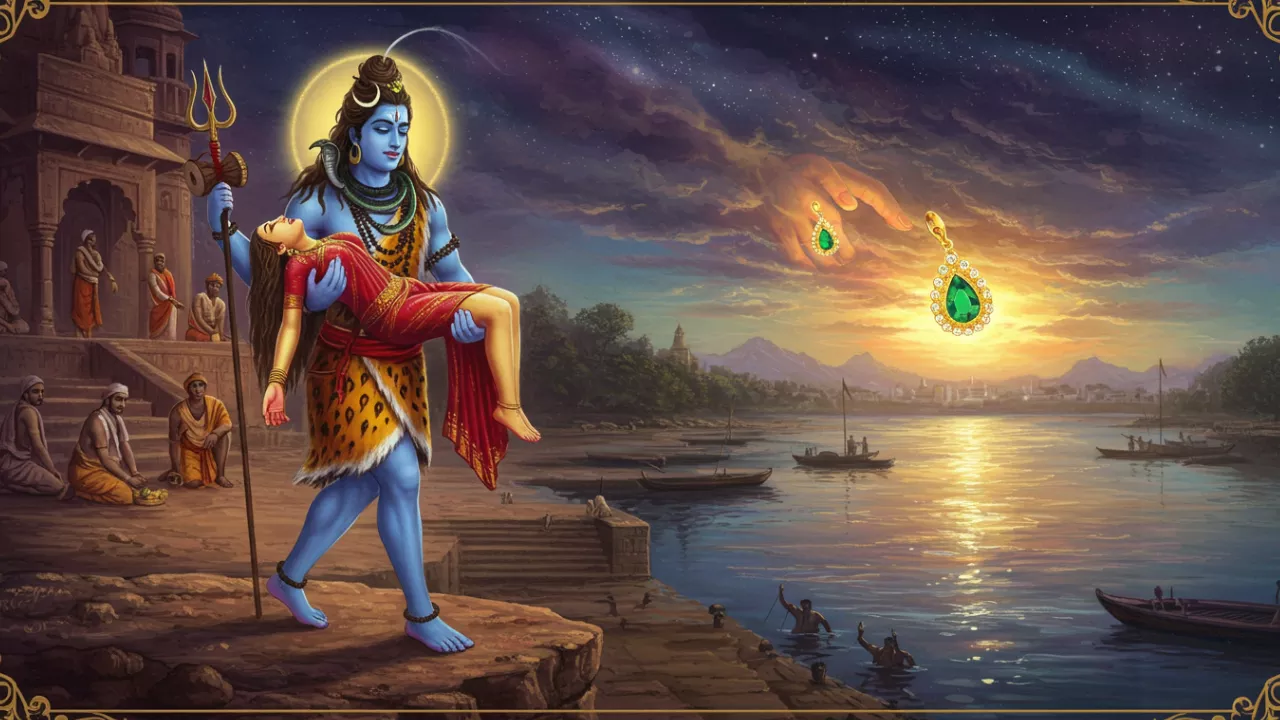
Daksha, Sati’s father, held a great yajna and invited every god and celestial being except Shiva, whose asceticism he disdained. Sati went uninvited, hoping to reason with him; Daksha ignored her and insulted Shiva again before the assembly. Unable to bear it, she invoked her yogic power and gave up her body in the sacrificial fire.
Shiva destroyed the yajna and beheaded Daksha, who was later revived with a goat’s head. Then, carrying Sati’s body, he wandered the universe in a grief that threatened creation itself. Parts of her body fell at places across the subcontinent, and each became a Shakti Peetha.
At Kashi, the tradition holds, what fell was her earring — the mani, the jewel, in her karna, her ear. Manikarnika takes its name from it. Our note on Kankhal at Haridwar covers the other end of the same story, the site of Daksha’s yajna itself.
Vishnu’s kund
The other account has Vishnu performing austerities at this spot for thousands of years, before the Ganga came down to earth, seeking a boon from Shiva. When Shiva appeared, Vishnu dug a pool with the Sudarshana Chakra and filled it with his own perspiration as an offering. Shiva was so moved that he trembled, and an earring fell from his ear into it.
That pool is the Manikarnika Kund, also called Chakrapushkarini Tirtha — a small stepped tank beside the ghat, still a focus of rites. Shiva’s promise attached to it is that whoever bathes there with real devotion is released from the cycle of birth and death, and that Kashi would be Avimukta Kshetra, a place he would never leave.
A third version simply combines the two: that Sati’s earring fell into the pit Vishnu had dug. The accounts differ in the detail and agree on the substance.
The pyres
The fire here is understood as Shiva’s own, and Agni as the messenger carrying the soul onward. The flame at Manikarnika is said to have burned continuously for centuries.
Families who want to understand what the days in Varanasi before a death involve will find our note on the Mukti Bhawan more use than anything written about the ghat itself.
The Doms
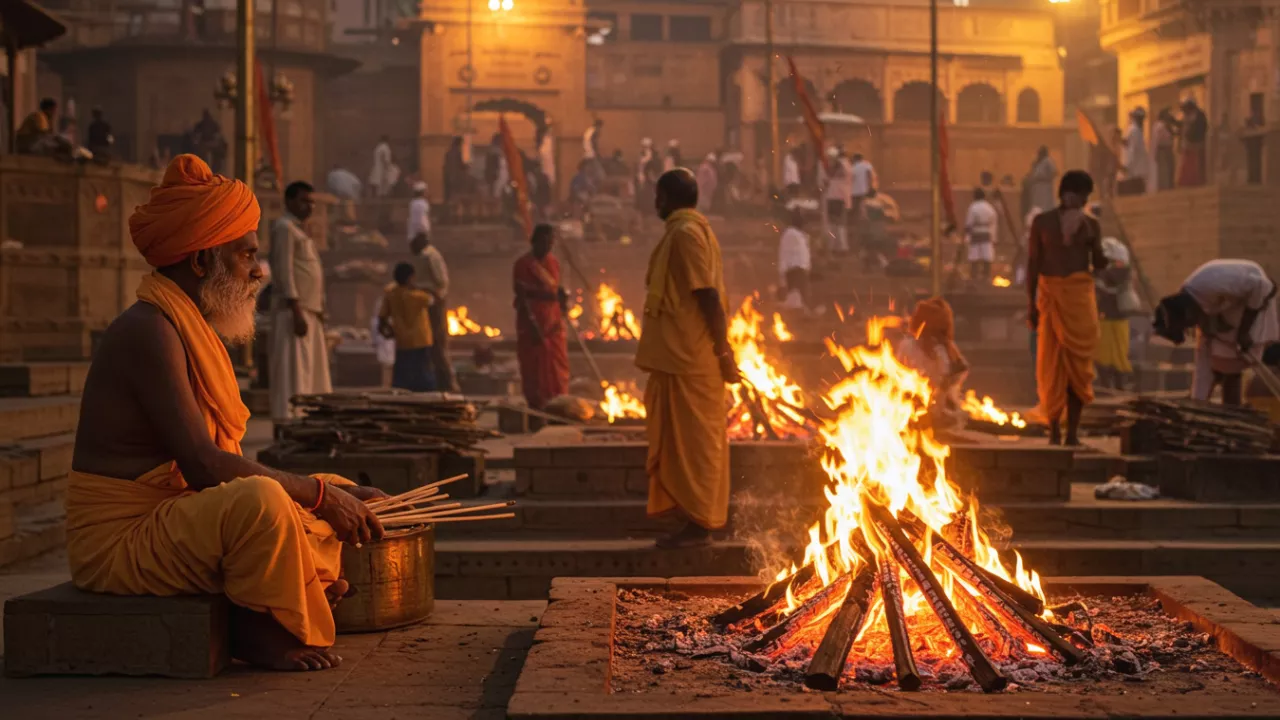
No account of Manikarnika is complete without them. The Doms are a Dalit community who have held, for generations, the exclusive right to conduct the cremations at Manikarnika and at Harishchandra Ghat. It is the Dom Raja, the head of the community, who provides the sacred fire that lights each pyre.
The tradition gives two origin stories. One is Raja Harishchandra’s, tested by Shiva and made to work as a cremator, who held so strictly to his duty that he would not cremate his own son without the fee. The other is Kallu Dom’s: Shiva, in disguise, sought to be cremated and found no fire pure enough until he came to Kallu, who held the eternal fire Shiva had given his ancestors — and who asked the disguised Shiva for the fee like anyone else. Shiva granted him and his descendants sole authority over the cremations at Kashi.
The point worth noticing is the inversion. A community marginalised everywhere else in the social order holds the position of ritual necessity here, and nobody is cremated at Kashi without them.
The cremation rites
- Arrival. The body, bathed and wrapped in a new shroud — white for men and widowed women, red or yellow for married women — is carried on a bamboo stretcher by male relatives, with “Ram Naam Satya Hai” chanted on the way.
- Immersion. The body is briefly immersed in the Ganga.
- The fire. The chief mourner, usually the eldest son, obtains the sacred fire from the Dom Raja or his representatives.
- Sankalpa. A priest takes the family through the formal vow for the departed.
- Circumambulation. The body is taken round the pyre five times, for the five elements the body is made of.
- Mukhagni. The chief mourner lights the pyre at the mouth.
- Kapala Kriya. Towards the end, as the skull is about to break, the chief mourner taps it with a bamboo stick — the release of the soul from the body.
- Collection. Once the pyre has cooled, which takes hours, the ashes and bone fragments are collected for immersion.
Asthi Visarjan and Pind Daan here
Beyond the cremations, Manikarnika is one of the principal sites for Asthi Visarjan — the immersion of collected ashes — and for Pind Daan. The traditional verse holds that those whose bones, hair, nails and flesh fall at Kashi reside in heaven however great their wrongs.
The sequence is the sankalpa, a purifying bath in the Ganga, the immersion of the ashes with the mantras, and the closing tarpan, with a pandit through each stage. One and a half to three hours depending on what is included. Our step-by-step guide to Asthi Visarjan at Varanasi has the full procedure.
Should the Pind Daan be combined with it? It is not required, but the tradition recommends it: the Asthi Visarjan releases the physical remains, and the Pind Daan provides what the soul is held to need for the onward journey. Families performing both do them in the same visit.
| Rite | Price | What it covers |
|---|---|---|
| Asthi Visarjan in Varanasi | ₹5,355 | Ghat-side immersion with sankalpa and tarpan. A second tier at ₹13,125 |
| Asthi Visarjan at Varanasi | ₹7,100 | The fuller arrangement, was ₹13,000 |
| Pind Daan in Varanasi | ₹7,100 | Pinda offered in your gotra at the ghat |
| Asthi Visarjan, 2 days 1 night | ₹12,500 | With Pind Daan and Kashi Vishwanath darshan |
| Online Asthi Visarjan | ₹7,100 | Performed on your behalf with a live video link |
🙏 Book Asthi Visarjan at Varanasi
- Immersion at the Ganga with sankalpa and tarpan
- Pandit through each stage of the rite
- Pind Daan on the same visit if you want it
- Live video option for families who cannot travel
Other shrines at the ghat
Manikarnika is a living ghat as well as a cremation ground. Priests offer daily prayers, pilgrims take the dip, and small shrines are set along it — the Charana Paduka, a marble slab bearing Vishnu’s footprints, stands near the kund and is where most devotees stop.
Visiting
If you are there for rites rather than to look, the arrangement is made in advance and the pandit meets you. If you are there as a pilgrim, come reflectively and observe rather than treating it as a stop on an itinerary — the atmosphere is what you came for, and it does not need documenting.
Our notes on Kashi and on the Ganga aarti at Dashashwamedh cover the wider city and the one ghat spectacle that is meant to be watched.
Common questions
Why is it called Manikarnika?
The jewelled earring. Either Sati’s, fallen here as Shiva carried her body, or Shiva’s own, fallen into the kund Vishnu dug — the accounts differ.
Can anyone be cremated at Manikarnika?
The tradition holds that distinctions of caste and standing do not apply at the pyre here. The cremation itself is conducted by the Dom community, who hold that right exclusively.
Can Asthi Visarjan be performed at Manikarnika?
Yes, and it is one of the principal sites for it. The immersion is in the Ganga at the ghat, with sankalpa and tarpan, and takes one and a half to three hours.
Is photography allowed?
No. It is prohibited and treated as a serious disrespect. Do not photograph the pyres or the families.
Arranging the rites
Tell us the rite, your family’s gotra and when you can travel — or that you would rather it were performed on your behalf — and we will confirm the pandit, the ghat and the total before anything is paid. Our FAQ covers what Asthi Visarjan is, where in Varanasi the shradh rites are performed, and whether people of other faiths may perform or witness them.
Book Your Sacred Ritual
Authentic ceremonies performed by Veda-trained pandits at sacred sites across India.



