
Key Takeaways
- Why this linga is different
- What a jyotirlinga is
- The temple's five levels
- History of the temple
In This Article
Mahakaleshwar is the jyotirlinga at Ujjain, on the Shipra in Madhya Pradesh, and the reason most pilgrims come to the city. Two things set it apart from the other eleven: the linga faces south, which no other jyotirlinga does, and it is worshipped as self-manifest. The pre-dawn Bhasma Aarti performed here with sacred ash exists at no other Shiva shrine.
Why this linga is different
Mahakaleshwar is the only Dakshinamukhi jyotirlinga, meaning the linga faces south. Every other one of the twelve faces east. In Hindu cosmology the south is the direction of Yama, so a south-facing Shiva is understood to be turned towards death itself — which is the sense in which he is Mahakal, the lord of time. Devotees come here specifically with prayers for long life and for release from untimely death.
It is also Swayambhu, self-manifest. Most sacred images are brought to life through consecration and mantra shakti; the Mahakaleshwar linga is held to draw its power from within itself. In Shaiva practice that distinction matters, and it is the reason darshan here is counted so highly.
What a jyotirlinga is
Jyotirlinga means pillar of radiant light — jyoti, light, and linga, form. The Shiva Purana tells of Brahma and Vishnu disputing which of them was supreme, and of Shiva appearing between them as an infinite column of light, challenging each to find its top or its bottom. Neither could. The twelve places where that column is said to have touched the earth became the jyotirlingas, and they are understood as sites where Shiva’s presence is direct and continuous rather than installed.
The twelve are Somnath and Nageshwar in Gujarat, Mallikarjuna in Andhra Pradesh, Mahakaleshwar and Omkareshwar in Madhya Pradesh, Kedarnath in Uttarakhand, Bhimashankar, Trimbakeshwar and Grishneshwar in Maharashtra, Vishwanath at Varanasi, Vaidyanath in Jharkhand, and Rameshwaram in Tamil Nadu. Our guide to all twelve jyotirlingas covers the full circuit.
The temple’s five levels
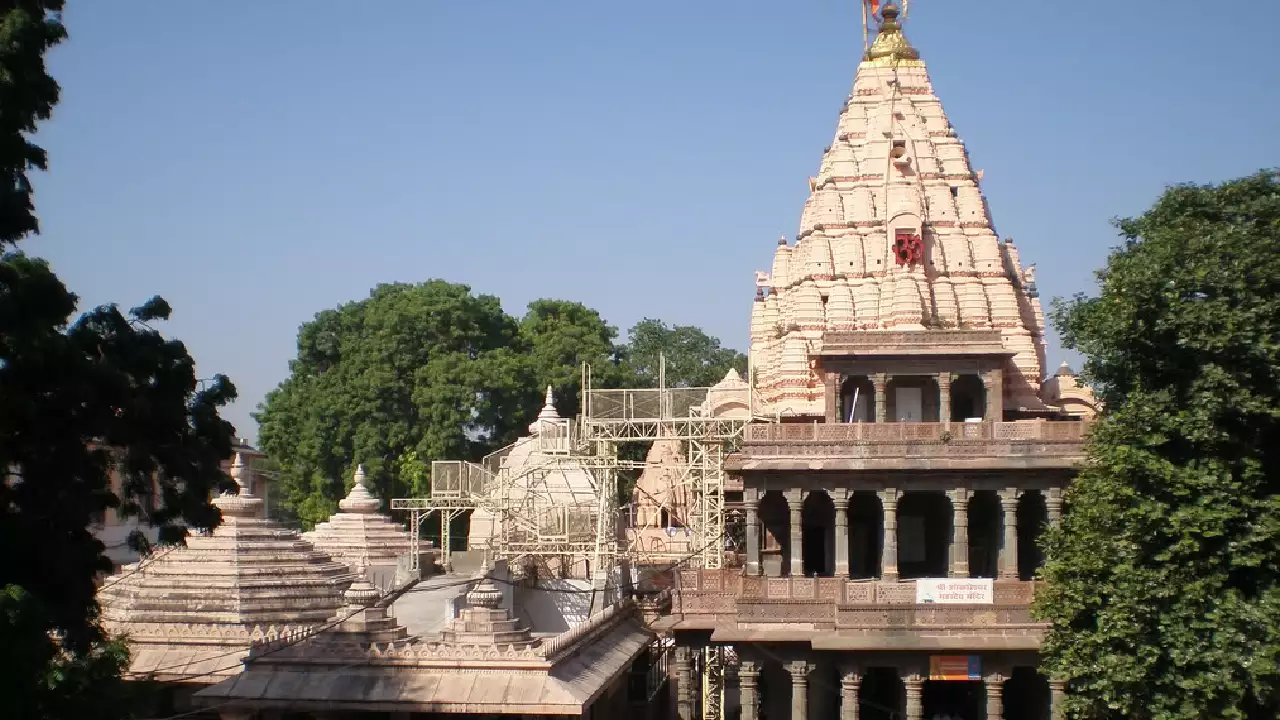
The complex rises in five levels, each holding a different shrine, in a mixture of Maratha, Bhumija and Chalukya styles — the Maratha work dating from the eighteenth-century rebuilding.
- Below ground. The Mahakaleshwar linga itself, in the primary sanctum, partly subterranean as the tradition for south-facing deities has it
- Ground level. Parvati to the north, Ganesha to the west, Kartikeya to the east, and Nandi facing south towards the linga
- Second floor. The Omkareshwara linga, a shrine in its own right
- Third floor. Nagchandreshwar — Shiva and Parvati on a ten-hooded serpent. Open to the public one day a year only
- Above. Further shrine rooms and the shikhara, visible across Ujjain
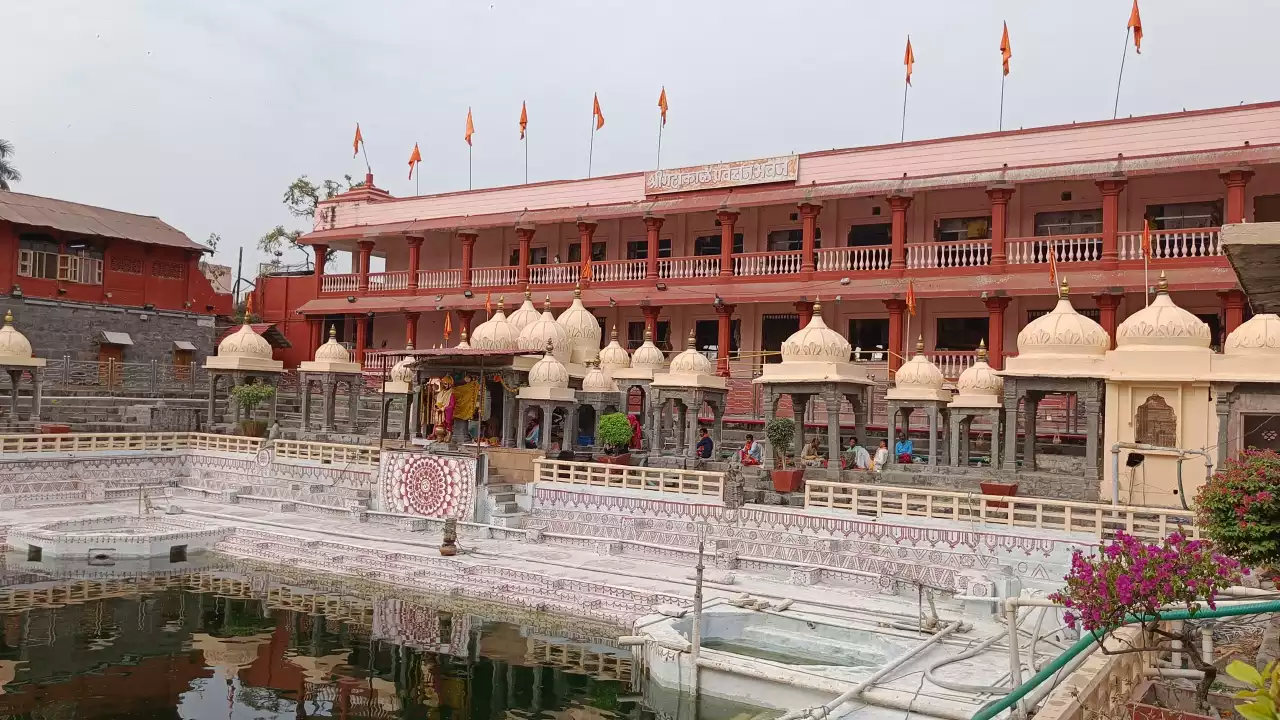
The courtyard around the temple carries carved pillars and stone reliefs, and a large kund sits within the complex where devotees bathe before entering the sanctum.
History of the temple
Ujjain appears in the Puranas as Avantika, and the Skanda Purana and Shiva Purana both name it among Shiva’s most favoured places, so the site is very old. The earliest construction on record is attributed to Kumarasena, son of King Chandpradyot, in about the sixth century CE, though a shrine here is thought to predate that by a long way.
Udayaditya and Naravarman, ruling in the twelfth century, rebuilt and enriched it during the Paramara period in Malwa. After later neglect and damage, the temple as it stands today is largely the work of the Maratha general Ranoji Shinde, acting under Peshwa Bajirao I in the eighteenth century — the five-level structure, the marble interiors, and the unbroken daily worship all date from that restoration.
The legend of Mahakal
The founding story is told in the Avantikhand of the Skanda Purana. In Avantika lived a brahmin, Vedapriya, whose son Priyamedha was devoted to Shiva. The demon king Dushana, serving the asura lords Ripudamana and Singhaditya, had forbidden Shiva worship across the region. A boy named Shrikhar, turned away from the shrine, kept up his prayers on the city’s outskirts, and a priest named Vridhi, hearing him, prayed alongside.
As Dushana’s armies breached the gates and the city seemed lost, the ground split and Shiva rose from it as Mahakal, in his most terrible form, and the demons were destroyed. His devotees asked him to stay, and he agreed, remaining as a jyotirlinga at the spot where he had appeared. The point the story makes is not only that Mahakal ends death, but that he protects those who turn to him entirely.
Bhasma Aarti
No part of Mahakaleshwar is more sought after. Performed before dawn, usually beginning between four and five in the morning, the linga is bathed, adorned, and then anointed with sacred ash — bhasma — while the Vedic recitation fills the sanctum. It is performed at no other jyotirlinga.
The meaning is in the ash. Shiva is described in the scriptures as smearing himself with the ash of the cremation ground, which is the image of his standing outside birth and death altogether. Ash is what material existence comes to in the end; offering it to the linga is an acknowledgement that everything returns to him.
- Advance booking is required, through the temple’s own registration
- Dress is traditional and enforced — dhoti-kurta for men, saree or salwar-kameez for women
- Photography inside the sanctum during the aarti is not permitted
- The aarti finishes around six, after which ordinary darshan begins
- Arrive well before the start; the numbers admitted are controlled
Darshan timings
| Ritual or darshan | Approximate time |
|---|---|
| Bhasma Aarti (Mangala Aarti) | 4:00 am to 6:00 am |
| Naivedya Bhog | 7:00 am to 7:30 am |
| Regular darshan opens | 8:00 am |
| Mahabhog | 12:00 pm to 12:30 pm |
| Sandhya Aarti | 6:00 pm to 6:30 pm |
| Shayan Aarti | 10:30 pm to 11:00 pm |
| Temple closes | 11:00 pm |
The schedule follows the Pancha Kala system of Agamic worship. Beyond it, the temple trust arranges Rudrabhishek, Laghu Rudra, Maha Rudra and Atirudra, as well as Rudraksha and panchamrit abhishek. Confirm the day’s timings with the trust before travelling, as they shift on festival days.
Ancestral rites at Ujjain
Ujjain is a tirtha as well as a temple city, and ancestral rites are performed at the Shipra ghats with a pandit who speaks the sankalp in your gotra. Families from Madhya Pradesh and the states around it often choose Ujjain rather than travelling to Gaya or Varanasi, and the rite is complete as performed here. Mangalnath, two kilometres away, is where the mangal dosh rites are done.
| Rite | Price | Where |
|---|---|---|
| Pind Daan in Ujjain | ₹7,100 | Shipra ghats, with tarpan |
| Asthi Visarjan in Ujjain | ₹7,100 | Shipra ghats, pandit and samagri included |
| Mangal Dosh Puja | ₹10,999 | Mangalnath Temple, usually on a Tuesday |
🕉️ Book Pind Daan in Ujjain
- Performed at the Shipra ghats
- Pandit assigned before you travel
- Sankalp in your family gotra
- All puja samagri included
When to come
The temple is open all year, but the experience is not the same in every season.
- October to February. Cool and comfortable, and the easiest time for both darshan and the city
- Sawan, July to August. The holiest month for Shiva. The Mahakal procession moves through the city on the Mondays and the crowds are very large
- Mahashivratri. The biggest night of the year here, and the city stays up for it. Not a time for a quiet ceremony
- Nag Panchami. The one day the Nagchandreshwar shrine opens
Every twelfth year, when Jupiter enters Leo, Ujjain hosts the Simhastha Kumbh and the bathing at Ram Ghat draws pilgrims in their millions. Mahakaleshwar is at the centre of it, and darshan queues run for hours.
Indore, about 55 kilometres away, has the nearest airport, and Ujjain Junction has direct trains from Delhi, Mumbai and Bhopal. For the rest of the city — Kaal Bhairav, Harsiddhi, Chintaman Ganesh, Sandipani Ashram and the ghats — see our guide to Ujjain’s temples and sacred sites.
Common questions
Which direction does the Mahakal linga face?
South. It is the only one of the twelve jyotirlingas that does, which is what Dakshinamukhi means, and the south is held to be the direction of Yama.
Is Ujjain a jyotirlinga?
Ujjain is the city; Mahakaleshwar, within it, is the jyotirlinga — the third of the twelve in the traditional order.
Is the Mahakaleshwar linga swayambhu?
Yes, it is worshipped as self-manifest rather than installed and consecrated, and that is held to be the source of its particular standing.
Can ancestral rites be performed at Ujjain instead of Gaya?
Yes. Ujjain is a recognised tirtha and the rite is complete as performed at the Shipra. Families who want the Gaya rite specifically still travel there.
Arranging a visit
Tell us the dates you can travel and whether your family needs rites performed as well as darshan, and we will confirm the pandit, the ghat and the total before anything is paid. Packages are on our Pind Daan in Ujjain page, and the mangal dosh puja at Mangalnath is arranged separately.
Book Your Sacred Ritual
Authentic ceremonies performed by Veda-trained pandits at sacred sites across India.



