Key Takeaways
- Key facts
- Why Trimbakeshwar
- The three-faced linga
- Kushavarta Kund
In This Article
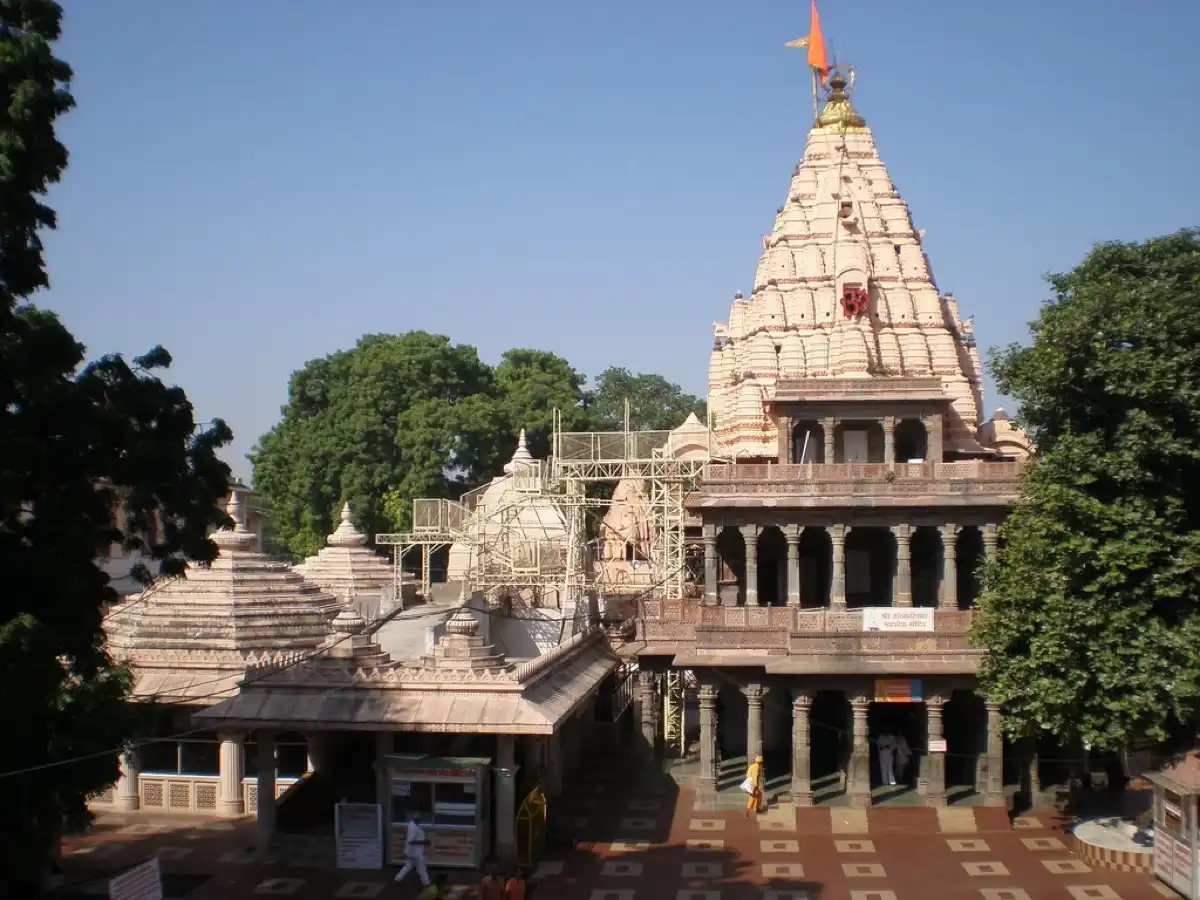
Kaal Sarp Dosh Puja at Trimbakeshwar runs four to six hours: a bath at Kushavarta Kund before sunrise, then a six-stage vidhi through Navgraha puja, Nag Devata worship, a Rahu-Ketu havan, Pind Daan and a closing Rudrabhishek, with the serpent idols immersed back in the kund at the end. It is arranged with the temple’s own pandits, not with us.
Key facts
| Detail | What to know |
|---|---|
| Temple | Trimbakeshwar jyotirlinga, Nashik district, Maharashtra, 28 km from Nashik |
| Among the twelve | Ninth, and the only three-faced linga — Brahma, Vishnu and Shiva together |
| Duration | Four to six hours for the full vidhi with havan and Rudrabhishek |
| Sacred water | Kushavarta Kund, the source of the Godavari |
| Strongest date | Nag Panchami, in the monsoon month of Shravan |
| Who performs it | Trimbakeshwar’s own pandits. Not us — see the banner above |
If all seven planets in a chart sit between Rahu and Ketu, the reading is Kaal Sarp Dosh. Our complete Kaal Sarp Dosh guide covers the twelve configurations and how the reading is made; this page is about how the rite is performed at Trimbakeshwar specifically.
Why Trimbakeshwar
Three reasons are given, and they are worth separating from what temple pandits say in their own interest.
The deity. Kaal Sarp Dosh is a Rahu–Ketu reading, and Shiva is propitiated at Trimbakeshwar as Nagabharana, the one who wears the serpent as an ornament — which the tradition takes to mean authority over serpentine afflictions rather than fear of them. The Skanda Purana’s Brahma Khanda names Trimbakeshwar among the foremost kshetras for removing serpent curses and Rahu-Ketu imbalance, and the Padma Purana’s Uttara Khanda names it as a site where Sarpa Dosha Nivarana carries full scriptural validity.
The river source. Trimbakeshwar is where the Godavari rises — the Dakshin Ganga, the Ganga of the south — and Kushavarta Kund is held to be the actual origin point. The texts assign particular weight to rites performed where sacred water comes out of the earth.
The three-faced linga. Brahma, Vishnu and Shiva present in one form, which the tradition treats as a complete rather than partial resolution of planetary karma.
The three-faced linga
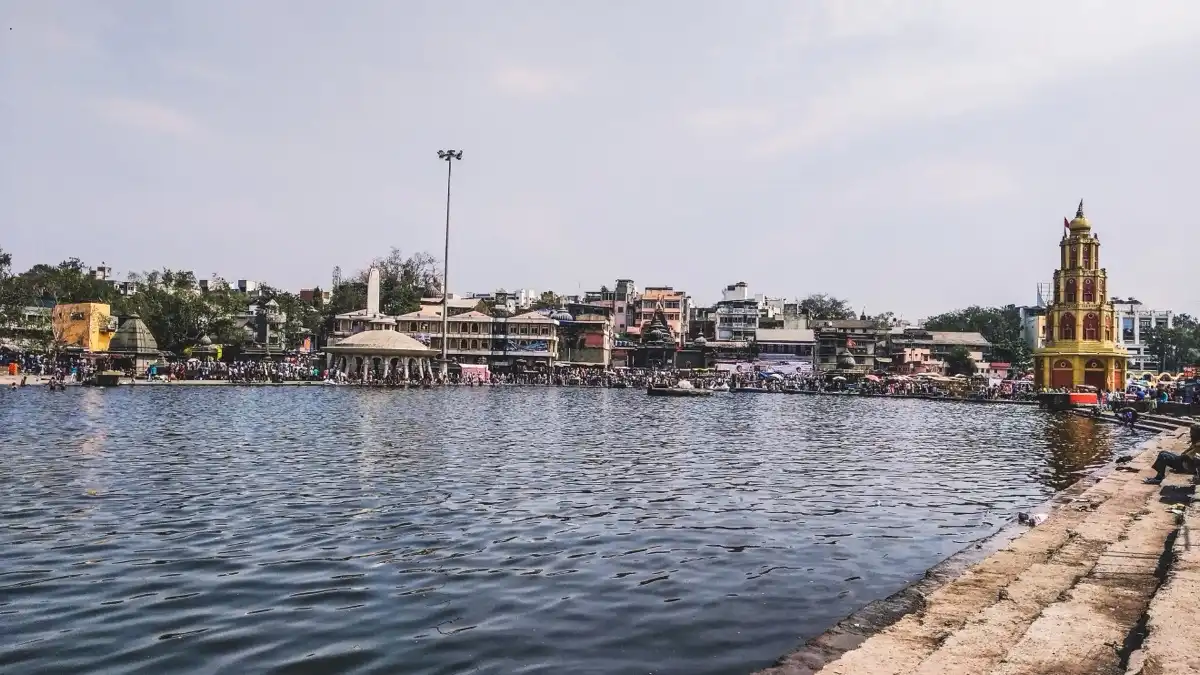
Of the twelve jyotirlingas, Trimbakeshwar’s is the only one that is not a single undivided column. The name says it: tri, three, and ambak, eyed or faced. What is in the sanctum is three interlocked thumb-shaped protrusions — angushtha-akar — rather than a pillar.
The Shiva Purana’s Kotirudra Samhita accounts for the form: Brahma, Vishnu and Shiva manifested here at once, each claiming primacy, and merged into a single column of light that kept the impression of all three. The faces are read as Brahma to the east, Vishnu to the west and Rudra to the south. The Brahma Kamala, the jewelled crown set over them, is uncovered only on particular occasions.
Kushavarta Kund
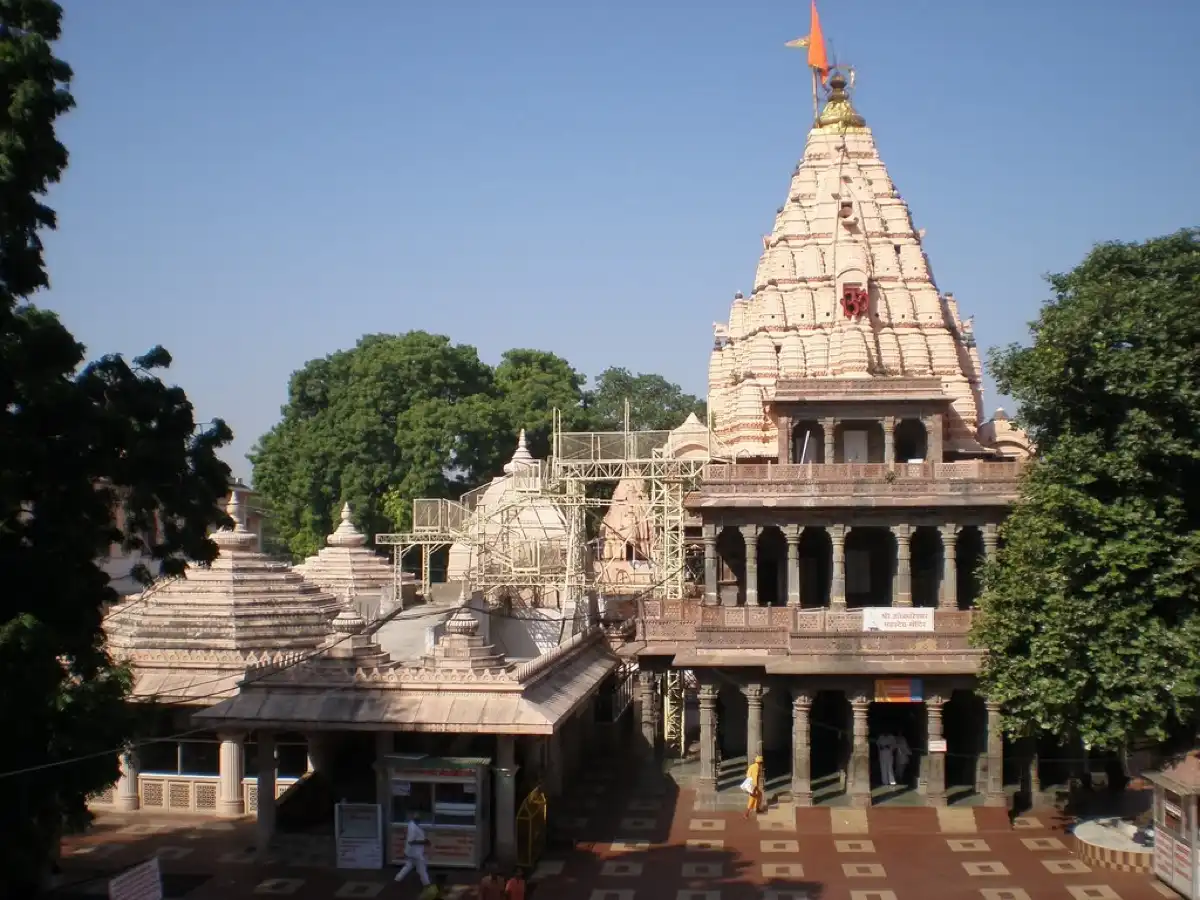
Not simply a bathing tank. It is the source of the Godavari, roughly twenty metres by fifteen, and the Padma Purana holds its water to carry the combined merit of the Ganga, Yamuna, Saraswati, Narmada, Sindhu, Kaveri and the Godavari herself.
The name comes from kusha grass, the same grass used as a priest’s seat and as a filter for water offerings. The Skanda Purana has Sage Gautama planting kusha here to catch and hold the waters of the Ganga he had brought to the place, making a vartani, a receptacle. The tank that formed became Kushavarta.
For this rite the kund does two jobs, which is a feature of the Trimbakeshwar version and not of the one at Ujjain. The bath here opens the ceremony and is not optional — it is the first step of the sankalp. And at the end, the silver or copper Nag idols worshipped during the ceremony are carried back and immersed in it. The kund is both the threshold and the seal.
The six-stage vidhi
Each stage builds on the one before. A pandit who shortens the sequence is performing an incomplete rite, so ask which stages are included when you confirm.
1. Snan at Kushavarta Kund, and the sankalp
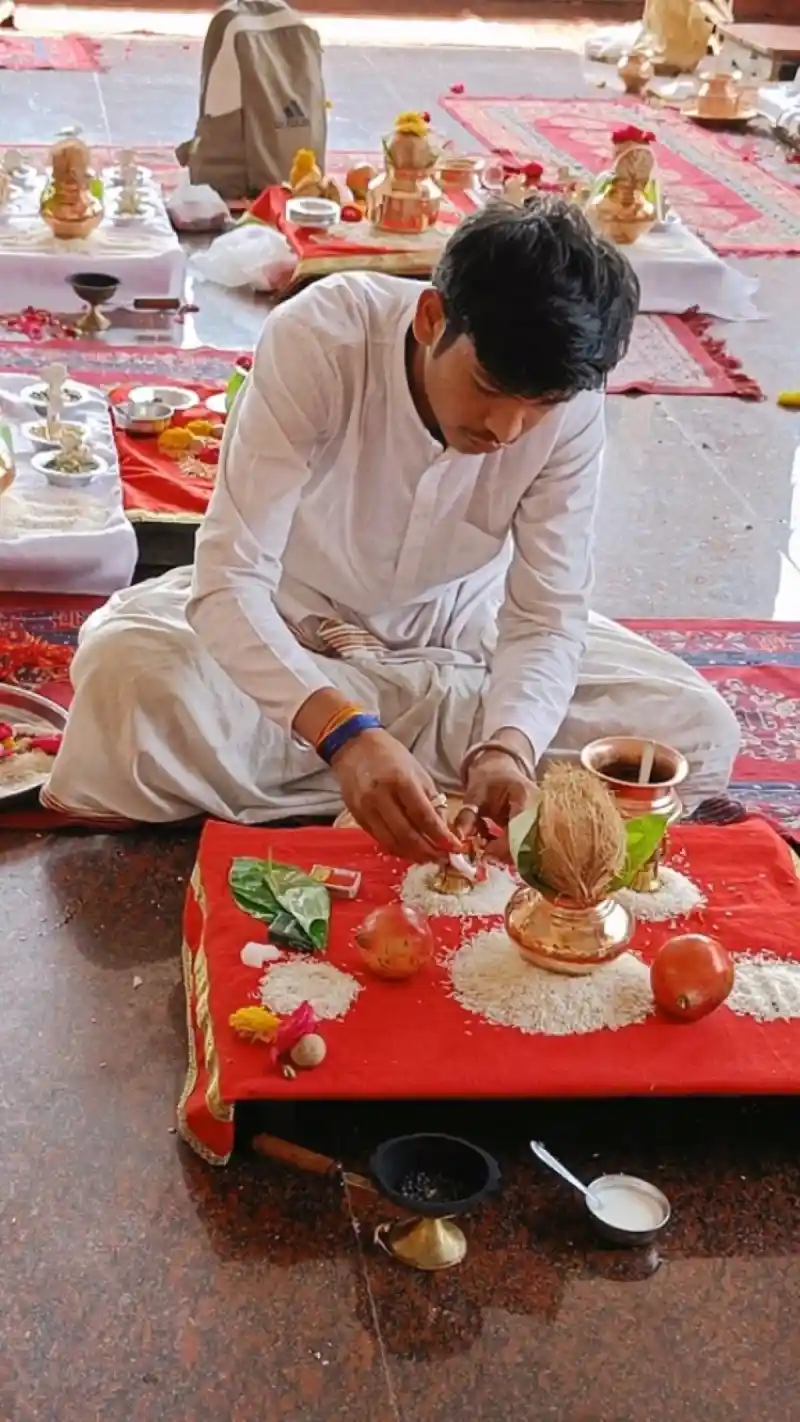
The bath before sunrise, then fresh clothes — white or yellow by preference — and the sankalp, spoken by the pandit with your full name, your father’s name, your gotra, the place and time, and the purpose: Kaal Sarpa Dosha Nivarana artham. The sankalp is what ties the ceremony to you; it is not a preliminary.
2. Ganesh puja, Kalash Sthapana and Navgraha puja
Ganesha first, with the sixteen-step worship, then the installation of the kalash as the witness and container of the rite. The Navgraha puja that follows addresses all nine planets, not only Rahu and Ketu — because the reading is that every planet caught on the axis is weakened, so the balance has to be restored across the whole system. Each graha gets its own mantras and offerings.
3. Nag Devata worship
The heart of it. Silver serpent idols — copper or clay in a smaller package — are placed and worshipped with milk, black sesame for Ketu, red flowers for Rahu, and sandal paste. The Nag Devata is invoked here not merely as a serpent deity but as Shesha, also called Ananta, on whom Vishnu rests: infinite time itself.
4. Havan with the Rahu and Ketu mantras
The fire is kindled with palash wood and samidha, and each oblation carries its mantra along with sesame, til-mixed ghee and the prescribed herbs. The minimum for a proper Rahu-Ketu Shanti havan is 108 oblations for each planet, so 216 in all; an extended rite goes to 1,008 each. Fewer than 108 per planet is not the full rite.
5. Pind Daan
This surprises families who associate Pind Daan only with Gaya or Prayagraj. It is included here because many Kaal Sarp readings are treated as having an ancestral dimension — an ancestor harmed by a serpent, or one whose death rites were never completed. The pindas offered address that side of it. Our notes on Pitra Dosh and shradh set out the connection.
6. Rudrabhishek, and the immersion
The linga is bathed with panchamrit — milk, honey, ghee, sugar and curd — then with Gangajal, with the Sri Rudram recited, by one priest or by a group. Then the Nag idols from stage three are carried to Kushavarta Kund and immersed, which closes the circuit.

The mantras used
Following the mantra phonetically while holding the intention of the sankalp is understood to be a real part of taking the rite, so they are worth having in front of you.
Ganesha, at the opening
ॐ गं गणपतये नमः — Om Gan Ganapataye Namah
वक्रतुण्ड महाकाय सूर्यकोटि समप्रभ। निर्विघ्नं कुरु मे देव सर्वकार्येषु सर्वदा॥ — Vakratunda Mahakaya Surya Koti Samaprabha, Nirvighnam Kuru Me Deva Sarva Karyeshu Sarvada. “Large-bodied one, radiant as ten million suns, keep my undertakings free of obstacles, always.”
Nag Devata
ॐ नाग देवताय नमः — Om Nag Devataya Namah. A direct salutation to the Nag deity, recited through the serpent worship.
Rahu and Ketu beej mantras
ॐ भ्रां भ्रीं भ्रौं सः राहवे नमः — Om Bhram Bhreem Bhroum Sah Rahave Namah, 108 times per havan cycle.
ॐ श्रां श्रीं श्रौं सः केतवे नमः — Om Shram Shreem Shroum Sah Ketave Namah. Rahu and Ketu sit directly opposite one another in a chart, so the two are always chanted together; one is not addressed without the other.
Shiva, for the Rudrabhishek
ॐ नमः शिवाय — Om Namah Shivaya, the five-syllable Panchakshara.
ॐ त्र्यम्बकं यजामहे सुगन्धिं पुष्टिवर्धनम्। उर्वारुकमिव बन्धनान् मृत्योर्मुक्षीय माऽमृतात्॥ — the Mahamrityunjaya mantra, Rigveda 7.59.12. “We worship the three-eyed one, fragrant and nourishing. As the cucumber is loosened from its stem, may he free us from death, not from immortality.” Our note on the Mahamrityunjaya jaap covers it on its own.
Choosing a pandit at Trimbakeshwar
The area around the temple has a known problem with touts — people who approach pilgrims at the bus stand, in guesthouses or at the kund with a “special” package at an inflated price, or at the other end with a suspiciously cheap rate for what turns out to be a few minutes of ceremony.
- A hereditary pandit registered with the Trimbakeshwar Devasthan Trust, who can give you their registration number if you ask
- Written confirmation of which stages are included and the mantra count
- Someone who does not approach you at the bus stand, and does not insist on cash only
- Willing to perform the full four to six hours rather than a condensed version
- Takes your full gotra and family details before starting, because the sankalp needs them
What it costs, and where we perform it
Trimbakeshwar’s pandits set their own rates and you should ask them directly. We have no part in that arrangement, so any figure from us would be guesswork.
| Location | Price | What it covers |
|---|---|---|
| Prayagraj, Triveni Sangam | ₹11,000 | Full vidhi with Navgraha Shanti, live video, prasad couriered. Was ₹15,000 |
| Haridwar, Har Ki Pauri | ₹7,100 | Full vidhi on the Ganga ghat, live video, prasad couriered. Was ₹9,100 |
| Trimbakeshwar | not offered | Arranged with the Devasthan Trust or a registered pandit there |
🕉️ Book Kaal Sarp Dosh Puja at Haridwar
- Full vidhi with Navgraha Shanti and havan
- Nag Devata worship and Rudrabhishek
- Live video link on WhatsApp or Zoom
- Prasad couriered in India and abroad
How to arrange it at Trimbakeshwar
- Through the Devasthan Trust. The temple’s own office assigns an officiating pandit for a standard fee. Basic but genuine.
- In advance, through a registered pandit. Ask for the Trust registration number and written confirmation of the stages.
- On arrival. Possible, but it means taking whoever is free on the day, and it is how most families end up with a shortened rite.
Choosing a date
Nag Panchami, in Shravan, is the strongest day of the year for any serpent-related rite, and families travel for it. Amavasya dates and the Pradosh tithis are the other days usually asked for. Festival dates move year to year, so confirm against a panchang with the pandit before booking travel rather than working from a published list. Avoid any period when the family is under sutak from a recent birth or death.
Trimbakeshwar or Ujjain
Neither is simply better. Trimbakeshwar works through the three-faced linga and Kushavarta Kund, and is the established centre for the serpent and ancestral remedies — it is also the only place Nagbali can be performed. Ujjain works through Mangalnath, which tradition names as the birthplace of Mars, and suits a chart where Kaal Sarp sits alongside a Mars affliction. Our Ujjain guide sets that out.
What the rite is understood to address
The Brihat Parashara Hora Shastra describes Kaal Sarp Dosh as producing four kinds of difficulty — avarodhana, obstruction; bhaya, fear; vyadhi, disease; and virodhana, opposition from people and circumstances. The rite is directed at those four through the Rahu-Ketu Shanti, the propitiation of Nag Devata, and Shiva’s grace.
What the tradition does not do is promise a result. The position is that the rite creates the conditions and the person’s own karma and choices do the rest. Anyone who offers you a schedule of outcomes — a timeline for a career to recover, or an illness to resolve — is going beyond what the texts say and beyond what anyone can know.
Can it be performed remotely?
Ours can. You give your name, gotra and birth details; the pandit performs the full vidhi at Prayagraj or Haridwar on the agreed day; and it is streamed to you so you can follow it and chant along. A written account follows, with prasad couriered to your address in India or abroad. Our puja services for families abroad explain the arrangement, and the booking page has the dates.
For Trimbakeshwar specifically, ask the pandit there whether they offer it. We cannot arrange it on their behalf.
Common questions
How long does the puja take?
Four to six hours for the full six stages, plus the bath at Kushavarta Kund before sunrise. Budget the whole morning.
Do you perform it at Trimbakeshwar?
No. Our Kaal Sarp packages are at Prayagraj and Haridwar. This guide exists because families ask how the Trimbakeshwar rite works before deciding where to go.
Why is Trimbakeshwar’s linga three-faced?
The Shiva Purana’s account is that Brahma, Vishnu and Shiva manifested here together and merged into one column of light that kept the impression of all three faces. It is the only one of the twelve like it.
Is this the same as Nagbali?
No. Kaal Sarp puja addresses the planetary reading in a living person’s chart. Nagbali performs a funeral for a serpent killed in the family’s past. Different rites, and one does not substitute for the other.
Arranging it
Tell us the birth details and what the reading showed and we will confirm the pandit, the location and the total before anything is paid — at Prayagraj or Haridwar. Message us on WhatsApp. If Trimbakeshwar is where you want it performed, go to the Devasthan Trust.
Book Your Sacred Ritual
Authentic ceremonies performed by Veda-trained pandits at sacred sites across India.



