Key Takeaways
- What the puja costs
- Why Ujjain for this puja
- Where in Ujjain it is performed
- The vidhi, step by step
In This Article
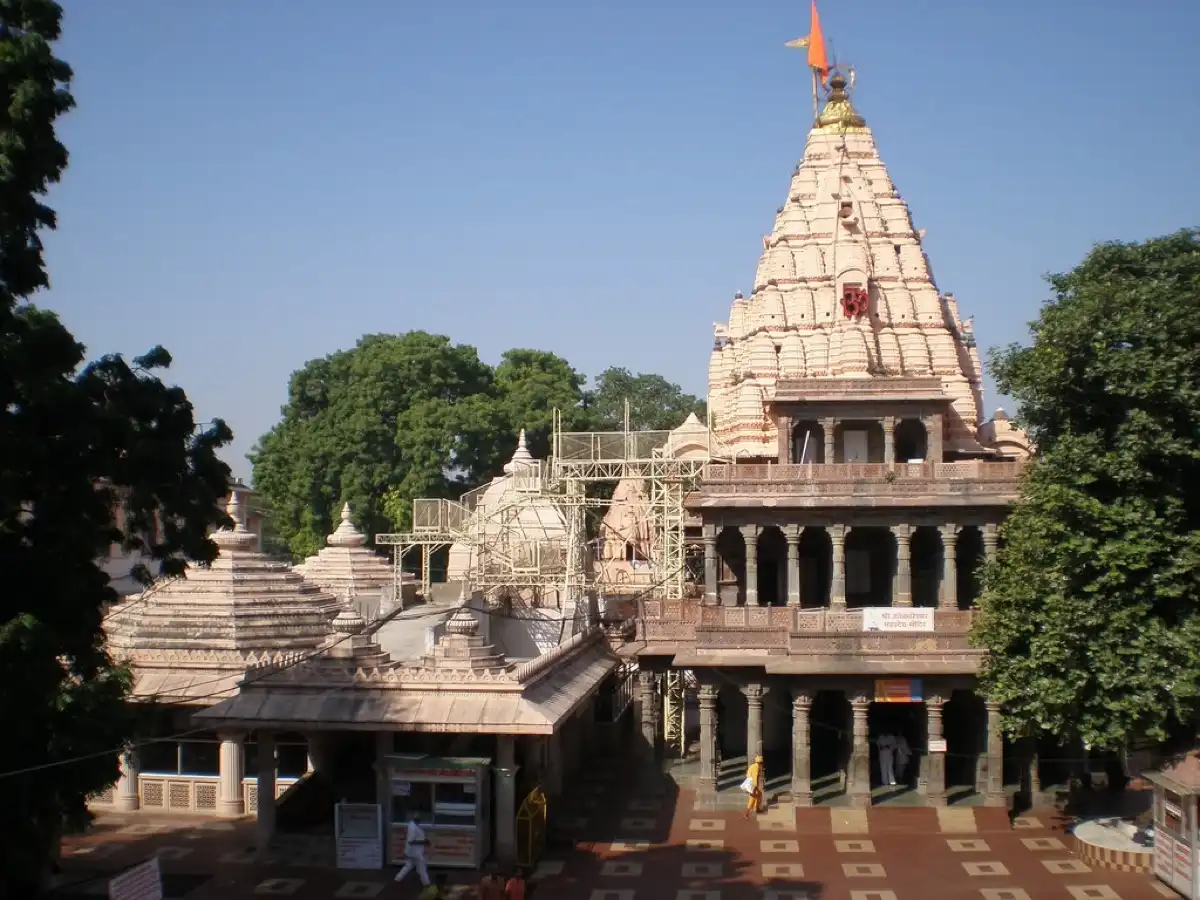
Kaal Sarp Dosh Puja at Ujjain is performed at Mangalnath Temple, on a hillock above the Shipra, with the bathing ritual at Ram Ghat and the main rites taking three to five hours. Arranged through the temple trust it is a modest walk-in ceremony; our own Kaal Sarp packages run at Prayagraj and Haridwar rather than at Ujjain.
What the puja costs
Two honest answers, because they are different questions. If you want us to perform it, the price is fixed and published. If you want it done at Mangalnath itself, you are arranging it locally and we cannot quote you a price for someone else’s work.
| Location | Price | What it covers |
|---|---|---|
| Prayagraj, Triveni Sangam | ₹11,000 | Full vidhi with Navgraha Shanti, live video, prasad couriered. Was ₹15,000 |
| Haridwar, on the Ganga | ₹7,100 | Full vidhi, live video, prasad couriered in India and abroad. Was ₹9,100 |
| Ujjain, Mangalnath | No package | Arrange through the temple trust office, or a local pandit you have checked |
At Mangalnath the trust office at the temple entrance registers devotees for a puja slot and assigns an officiating priest for a standard fee. That arrangement is genuine but basic: the ceremony may be abbreviated and ritual materials are usually bought separately at the temple shops, so budget for those on top.
Why Ujjain for this puja
Kaal Sarp Dosh is read as a condition of time and fate, the chart’s planets held between Rahu and Ketu. Ujjain’s association with Shiva as Mahakal, the lord of time, is why the city is named for this remedy at all. It is one of the seven Sapta Puri cities, alongside Ayodhya, Mathura, Haridwar, Kashi, Kanchi and Dwarka.
The more specific reason is Mangalnath. Tradition holds the temple to be the janm sthan of Mangal, the planet Mars, and the remedy at Ujjain is built around a Mars invocation alongside the Rahu–Ketu rites. That combination is what distinguishes Ujjain’s version of the puja from the one performed at Trimbakeshwar or Prayagraj.
The city also carries a long astronomical association. For centuries Hindu astronomers treated the meridian through Ujjain as their reference for calculating time, which is why it is sometimes called the Greenwich of India, and the Tropic of Cancer runs through the city. Our note on the Mahakaleshwar jyotirlinga covers the wider sacred geography, and the complete Kaal Sarp Dosh guide explains the twelve configurations and how the dosha is identified.
Where in Ujjain it is performed
Mangalnath Temple, the main venue
Mangalnath Road, near the Shipra, Ujjain 456006, about four kilometres from Ujjain Junction and roughly two from Mahakaleshwar. The puja is performed in the open courtyard or the havan kund area beside the temple, not inside the garbhagriha, which stays reserved for the resident priests. The sanctum holds a black stone Shiva linga with Mangal Deva beside it in his red form, seated on a ram.
Mahakaleshwar complex, used occasionally
Jaisinghpura, Ujjain 456006, about two kilometres from the station. The Kaal Bhairav shrine within the complex and the adjacent Shipra ghats are sometimes used, but the sanctum is very crowded and arrangements there are less settled than at Mangalnath.
Ram Ghat for the bath
About a kilometre from Mahakaleshwar, and the ghat used for the snan that opens the ceremony. It is the main bathing ghat on the Shipra and the site of the royal baths during Simhastha years.
The vidhi, step by step
Done properly the ceremony runs three to five hours. The sequence below is the one followed at Ujjain.
Before the day
Rise before sunrise, bathe, and wear clean cotton in saffron, yellow or white, with no leather. Avoid non-vegetarian food from the previous evening. If you are performing the rite on behalf of a relative who cannot attend, bring their photograph, full name and birth details.
Snan at the Shipra
The ceremony opens at the ghat. The pandit speaks the river invocation and the devotee takes three dips. This is the entry into the ritual space rather than a formality, and it is not skipped.
Ganesh sthapana and Navgraha invocation
At the temple, Ganesha is installed first, as in any Vedic rite. The nine planets are then invoked with their own mantras and offerings — red flowers and red sandalwood for the sun, white flowers and raw milk for the moon, red lentils for Mars, and so on through all nine.
Nag Devta worship
This is the part that makes it a Kaal Sarp puja rather than a general Navgraha Shanti. Silver or copper Nag and Nagin images are installed on a plate dusted with turmeric, and the devotee offers milk, sandalwood, white flowers, akshata and silver while the pandit recites the Nag Stotra and the Rahu and Ketu beej mantras, each a hundred and eight times.
Mahamrityunjaya havan
The fire ritual, with the Mahamrityunjaya mantra as the principal offering and between a hundred and eight and a thousand and eight ahutis depending on what has been agreed. Sesame, ghee, samidha wood and the prescribed herbs go into the fire.
Rudrabhishek at the Mangalnath linga
The linga is bathed with panchamrit — milk, honey, sugar, ghee and curd — then with Ganga water, with the Sri Rudram recited. Shiva wears serpents rather than fearing them, and this abhishek closes the circuit from the Nag Devta rites back to him.
Immersion
The Nag and Nagin images, the havan ash and the remaining materials are immersed in the Shipra at the designated ghat, which closes the ceremony.
Temple timings and choosing a day
| Session | Timing | Notes |
|---|---|---|
| Morning darshan | 5:00 am to 12:00 pm | The session the puja is normally performed in |
| Afternoon break | 12:00 pm to 4:00 pm | Sanctum closed |
| Evening darshan | 4:00 pm to 9:00 pm | Evening aarti around 7:30 pm |
| Mangal Bhaat Puja | 5:30 am to 7:30 am | Tuesdays draw the largest numbers |
Confirm the day with the pandit who will perform the rite, against a panchang, before you book travel. Tuesdays at Mars’s own site, Nag Panchami, amavasya and the Pradosh tithis are the days families usually ask for. Festival dates move year to year, so we do not list them here.
Choosing a pandit
This matters more than the choice of city. A careful ceremony at Prayagraj is worth more than a hurried one at Mangalnath.
What to check
- Jyotisha training, not only ritual practice. The vidhi is adjusted for the specific configuration — Anant, Kulik, Vasuki and the rest — and that needs someone who can read the chart.
- Experience with this dosha in particular. Ask how the rite differs between two named configurations. Someone who performs it regularly will answer at once.
- Familiarity with Mangalnath. The Nag and Nagin installation sequence and the Mangal Bhaat Puja are specific to this temple.
- A full quote in advance, materials and temple fees included, with nothing added once the ceremony is under way.
Reasons to walk away
- Being approached near the temple gates with an unusually low rate
- Being told your dosha is very severe by someone who has not seen your chart
- Any inability to describe the sequence when you ask for it
- No verifiable track record, and no one who will vouch for them
Ujjain or Trimbakeshwar
Both are named for this remedy and neither is simply better. They differ in emphasis.
Ujjain works through Mangalnath and Mahakaleshwar, with the Shipra as its river, and builds a Mars invocation into the rite. It suits a chart where Kaal Sarp sits alongside a Mars affliction — a manglik reading, a debilitated Mars — because the Mangal Dosha remedy can be performed at the same temple on the same trip. The tradition here is less codified than at Trimbakeshwar, so approaches vary more between pandits.
Trimbakeshwar performs the rite inside the jyotirlinga temple, with the Godavari as its river, and is the established centre for the ancestral remedies — Narayan Nagbali and Pitru Dosh — as well as Kaal Sarp. It suits a chart where Kaal Sarp is the primary reading without Mars complications, or where ancestral obligations are also outstanding. Our Trimbakeshwar guide covers it in detail.
Prayagraj is the option to consider if you want the Kaal Sarp rites and Pind Daan or tarpan in one visit, since the Triveni Sangam carries the full range of remedial rites.
Can it be performed remotely?
Yes, and for families abroad it is the usual arrangement. You give your name, gotra and birth details; the pandit performs the full vidhi on the agreed day at the sacred site; and the ceremony is streamed to you over WhatsApp or Zoom so you can follow it and chant along. A written account of what was performed follows, with prasad couriered to your address in India or overseas.
Shastrically, the rite draws its standing from the mantra, the vidhi, the place and the sankalp rather than from the devotee’s physical presence. Our puja services for families abroad set out how the arrangement works.
🕉️ Book Kaal Sarp Dosh Puja at Haridwar
- Full vidhi with Navgraha Shanti and havan
- Nag Devta worship and Rudrabhishek
- Live video link on WhatsApp or Zoom
- Prasad couriered in India and abroad
What to expect afterwards
The honest answer is that no one can tell you. Kaal Sarp Dosh is read as a pattern rather than a single event, and the puja is not described in the tradition as deleting it from a chart. Anyone who offers you a timetable for results, or tells you a health problem will resolve, is telling you what you want to hear.
What the tradition does hold is that the rite is the intervention and the devotee’s own practice is the continuation: the Rahu and Ketu beej mantras chanted daily, fasting on the appropriate lunar days, and attention to the matters the reading pointed at. Where Pitra Dosh has also been read alongside Kaal Sarp, the pandits we work with usually perform the Kaal Sarp rites first and the ancestral rites in a later month, because the two are not interchangeable.
Common questions
How long does it take?
Three to five hours for the full vidhi, with the bath at the ghat before it. Plan a whole morning, and a second day in Ujjain if you also want Mahakaleshwar darshan or the Bhasma Aarti.
Do I have to be present?
No. The rite can be performed on your behalf with a live video link, and that is how most families abroad arrange it.
Do you perform it at Mangalnath?
No. Our Kaal Sarp packages are at Prayagraj and Haridwar. At Ujjain we perform Pind Daan and Asthi Visarjan at ₹7,100, and the mangal dosh puja at Mangalnath from ₹10,999.
Is Ujjain better than Trimbakeshwar for this?
Not inherently. Ujjain suits a chart with Mars complications alongside the Kaal Sarp reading; Trimbakeshwar suits one where ancestral obligations are also outstanding.
Arranging it
Tell us the birth details and what the reading showed, and we will confirm the pandit, the location and the total before anything is paid. Packages are on the Kaal Sarp Dosh Puja page, or message us on WhatsApp.
Book Your Sacred Ritual
Authentic ceremonies performed by Veda-trained pandits at sacred sites across India.



